|
SCIENCE HANDBOOK |
||||||||||||||||||||||||||||||||||||||||||||||||||||||||||||||||||||||||||||||||||||||||||||||||||||||||||||||||||||||||||||||||||||||||||||||||||||||||||||||||||||||||||
|
Table of Contents
2) SCIENCE AND REMOTE SENSING SYSTEMS 2.1
Sensor Systems 3) Probes 4) Tricorder 4.1
Main Features Science Officer 1) Definition/Duties: ================== Aboard Federation starships/starbases, the crew members responsible for scientific research and investigations and for providing the ship's/base's commanding officer with scientific information needed for command decisions. The Chief Science Officer (CSO) is responsible for overseeing the different science labs/teams under their control and reporting to the commanding officer on a regular basis. The Assistant Chief Science Officer (ACSO) is responsible for aiding the Chief Science Officer in the execution of his/her duties. The Assistant Chief Science Officer is required to assume the role of Chief Science Officer if and when the need arises or if the Chief Science Officer is unable to perform his/her duty adequately.
1.1 Science Stations ================ Science stations on the command decks of Federation starships/starbases are used by science personnel to provide real-time scientific data to command personnel. These stations are not assigned full-time technicians, but are available for use as needed. In some cases the science stations are used by personnel attached to secondary missions including researchers, mission specialists and others who need to coordinate operations with the bridge/ops. An example of which would be the control of an automated probe , gathering samples from a hazardous area, later requiring specific ship manoeuvres in order to successfully recover the probe and its samples. Individual Science stations are generally configured for independent operation, but can be linked together when two researchers wish to work cooperatively. The primary science stations on the command deck have priority links to Conn, Ops and Tactical. During Alert status, science stations can have priority access to sensor arrays, if necessary overriding ongoing science department observations and other secondary missions upon approval by the Operations Manager (OPS). The Science I station incorporates an isolinear chip matrix panel that permits specialized mission profile programs to be loaded as needed, and also permits investigators to accumulate data for later study.
========================= Primary functions of Science stations include: - The ability to provide access to sensors and interpretive software for primary mission and command intelligence requirements and to supplement Ops in providing real-time scientific data for command decision making support. - The ability to act as a command post for coordination of activities of various science laboratories and other departments, as well as for monitoring of secondary mission status. - The ability to reconfigure and recalibrate sensor systems at a moment's notice for specific command intelligence requirements.
2) SCIENCE AND REMOTE SENSING SYSTEMS ===================================== 2.1 Sensor Systems ================== There are three primary sensor systems aboard Federation starships/starbases. The first is the long-range sensor array. This package of high-power devices is designed to sweep far ahead of the ship's flight path, or the starbase's orbit, to gather navigational and scientific information. The second major sensor group is the lateral arrays. These include the forward, port and starboard arrays on the primary hull as well as the port, starboard and aft arrays on the Secondary hull. Additionally, there are smaller upper and lower sensor arrays located around the ship/base to provide coverage in the lateral arrays' blind spots. The final major group is the navigational sensors. These dedicated sensors are tied directly into the ship's/base's Flight Control systems and are used to determine the ship's location and velocity. On the starbase they are used to control flight operations in much the same way as 20th century air traffic control systems controlled the movement of aircraft. In addition, there are several packages of special-purpose and engineering sensors such as the subspace flow sensors located at various points on the ship's/base's skin.
======================== The most powerful scientific instruments aboard Federation vessels are probably those located in the long-range sensor array. This cluster of high-power active and passive subspace frequency sensors is located in the Engineering Hull directly behind the main deflector dish. The majority of instruments in the long-range array are active scan subspace devices, which permit information gathering at speeds greatly exceeding that of light. Maximum effective range of this array is approximately five light years in high-resolution mode. Operation in medium-to-low resolution mode yields a usable range of approximately 17 light years (depending on instrument type). At this range, a sensor scan pulse transmitted at Warp 9.9997 would take approximately forty-five minutes to reach its destination and another forty-five minutes for the signal to return. Standard scan protocols permit comprehensive study of approximately one adjacent sector per day at this rate. Within the confines of a solar system, the long-range sensor array is capable or providing nearly instantaneous information. Primary instruments in the long-range array include: - Wide-angle active EM scanner - Narrow-angle active EM scanner - 2 meter diameter gamma ray telescope - Variable frequency EM flux sensor - Lifeform analysis instrument cluster - Parametric subspace field stress sensor - Gravimetric distortion scanner - Passive neutrino imaging scanner - Thermal imaging array These devices are located in a series of eight instrument bays directly behind the main deflector. Direct power taps from primary electro plasma system (EPS) conduits are available for high-power instruments such as the passive neutrino imaging scanner. The main deflector emitter screen includes perforated zones designed to be transparent for sensor use, although the subspace field stress and gravimetric distortion sensors cannot yield usable data when the deflector is operating at more than 55% of maximum rated power. Within these instrument bays, fifteen mount points are nominally unassigned and are available for mission-specific investigations or future upgrades. All instrument bays share the use of the navigational deflector's three subspace field generators providing the subspace flux potential allowing transmission of sensor impulses at warp speeds. The long-range sensor array is designed to scan in the direction of flight, and it is routinely used to search for possible flight hazards such as micrometeoroids or other debris. This operation is managed by the Flight Control Officer under automated control. When small particulates or other minor hazards are detected, the main deflector is automatically instructed to sweep the objects from the vessel's flight path. The scan range and degree of deflection vary with the ship's velocity. In the event that larger objects are detected, automatic minor changes in flight path can avoid potentially dangerous collisions. In such cases, the computer will notify the Flight Control Officer of the situation and offer the opportunity for manual intervention if possible.
========================== Federation starship systems constantly process incoming sensor data and routinely perform billions of calculations each second to solve the problem of interstellar navigation. Sensors provide the input; the navigational processors within the main computers reduce the incessant stream of impulses into useable position and velocity data. The specific navigational sensors being polled at any instant will depend on the current flight situation. If the starship is in orbit about a known celestial object, such as a planet in a charted star system, many long-range sensors will be inhibited, and short-range devices will be favoured. If the ship is cruising in interstellar space, the long-range sensors are selected and a majority of the short-range sensors are powered down. As with an organic system, the computers are not overwhelmed by a barrage of sensory information. The 350 navigational sensor assemblies are, by design, isolated from extraneous cross-links with other general sensor arrays. This isolation provides more direct impulse pathways to the computers for rapid processing, especially at high warp velocities, where minute directional errors, in hundredths of an arc-second per light year, could result in impact with a star, planet or asteroid. In certain situations. selected cross-links may be created in order to filter out system discrepancies flagged by the main computer. Each standard suite of navigational sensors includes: - Quasar Telescope - Wide-angle IR Source Tracker - Narrow-angle IR-UV-Gamma Ray Imager - Passive Subspace Multibeacon Receiver - Stellar Graviton Detectors - High-Energy Charged Particle Detectors - Galactic Plasma Wave Cartographic Processor - Federation Timebase Beacon Receiver - Stellar Pair Coordinate Imager The navigational system within the main computers accepts sensor input at adaptive data rates, mainly tied to the ship's true velocity within the galaxy. The subspace fields within the computers, which maintain faster-than-light (FTL) processing, attempt to provide at least 30% higher proportional energies than those required to drive the spacecraft, in order to maintain a safe collision-avoidance margin. If the FTL processing power drops below 20% over propulsion, general mission rules dictate a commensurate drop in warp motive power to bring the safety level back up. Specific situations and resulting courses of action within the computer will determine the actual procedures, and special navigation operating rules are followed during emergency and combat conditions. Sensor pallets dedicated to navigation, as with certain tactical and propulsion systems, undergo preventative maintenance and swapout on a more frequent schedule than other science-related equipment, owing to the critical nature of their operation. Healthy components are normally removed after 65-70% of their established lifetimes. This allows additional time for component refurbishment, and a larger performance margin if swapout is delayed by mission conditions or periodic spares unavailability. Rare detector materials, or those hardware components requiring long manufacturing lead times, are found in the quasar telescope (shifted frequency aperture window and beam combiner focus array), wide angle IR source tracker (cryogenic thin-film fluid recirculator), and galactic plasma wave cartographic processor (fast Fourier transform subnet). A 6% spares supply exists for these devices, deemed acceptable for the foreseeable future, compared to a 15% spares supply for other sensors.
=========================== Federation starships/starbases are equipped wit the most extensive array of sensor equipment available. The spacecraft/base exterior incorporates a number of large sensor arrays providing ample instrument positions and optimal three-axis coverage. Each sensor array is composed of a continuous rack in which are mounted a series of individual sensor instrument pallets. These sensor pallets are modules designed for easy replacement and updating on instrumentation. Approximately two-thirds of all pallet positions are occupied by standard Starfleet science sensor packages, but the remaining positions are available for mission-specific instrumentation. Sensor array pallets provide microwave power feed, optical data net links, cryogenic coolant feeds, and mechanical mounting points. Also provided are four sets of instrumentation steering servo clusters and two data subprocessor computers. The standard Starfleet science sensor complement consists of a series of six pallets, which include the following devices: Pallet #1 Wide-angle EM radiation imaging scanner Quark population analysis counter Z-range particulate spectrometry sensor Pallet #2 High-energy proton spectrometry cluster Gravimetric distortion mapping scanner Pallet #3 Steerable lifeform analysis instrument cluster Pallet #4 Active magnetic interferometry scanner Low-frequency EM flux sensor Localized subspace field stress sensor Parametric subspace field stress sensor Hydrogen-filter subspace flux scanner Linear calibration subspace flux sensor Pallet #5 Variable band optical imaging cluster Virtual aperture graviton flux spectrometer High-resolution graviton flux spectrometer Very low energy graviton spin polarimeter Pallet #6 Passive imaging gamma interferometry sensor Low-level thermal imaging sensor Fixed angle gamma frequency counter Virtual particle mapping camera
The standard Starfleet sensor complement comprises twenty-four semi-redundant suites of these six standard sensor pallets. These 144 pallets are distributed on the Primary Hull and Secondary Hull lateral arrays. The instrumentation is located to maximize redundant coverage. A total of 284 pallet positions are available on both hulls. The upper and lower sensor platforms provide coverage in very high and very low vertical elevation zones. These arrays employ a more limited subset of the standard Starfleet instrument package. In addition to standard Starfleet instruments, mission-specific investigations frequently require nonstandard instruments that can be installed into one or more of the 140 nondedicated sensor pallets. When such devices are relatively small, such installation can be accomplished from service access ports inside the spacecraft. Installation of larger devices must be accomplished by extravehicular activity. A number of personnel airlocks are located in the sensor strip bays for this purpose. If a device is sufficiently large, or if installation entails replacement of one or more entire sensor pallets, a shuttlepod can be used for extravehicular equipment handling.
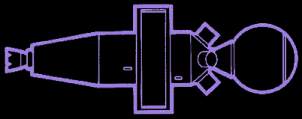
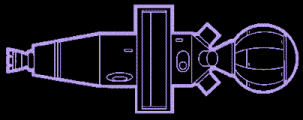
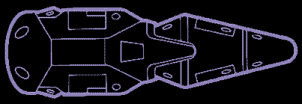
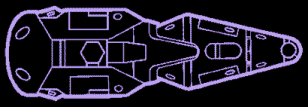
3) Probes =========================== =========================== The detailed examination of many objects and phenomena in the galaxy can be handled routinely by the ship�s/station�s onboard sensor arrays, up to the resolution limits of the individual instruments and to the limits of available data extraction algorithms used in extrapolating values from combinations on instrument readings. Greater proportions of high-resolution data of selected sites can be gathered using close approaches by instrumented probe spacecraft. These probes are generally sized to fit the fore and aft torpedo launchers, providing rapid times-to-target. Three larger classes of autonomous probes are based upon existing shuttlecraft spaceframes that have been stripped of all personnel support systems and then densely packed with sensor and telemetry hardware.
=========================== The small probes are divided into nine classes, arranged according to sensor types, power, and performance ratings. The features common to all nine are spacecraft frames of gamma moulded duranium-tritanium and pressure-bonded lufium boronate, with certain sensor windows or triple layered transparent aluminium. Sensors not utilising the windows are affixed through various methods, from surface blending with the hull to imbedding the active deflectors within the hull itself. All nine classes are equipped with a standard suite of instruments to detect and analyse all normal EM and subspace bands, organic and inorganic chemical compounds, atmospheric constituents, and mechanical force properties. While all are capable of at least surviving a powered atmospheric entry, three are designed to function for extended periods of aerial manoeuvring and soft landing. Many probes include varying degrees of telerobotic operation capabilities to permit realtime control and piloting of the probe. This permits an investigator to remain aboard the ship/station while exploring what might otherwise be a dangerously hostile or otherwise inaccessible environment. The following section lists the specifications of each class. The higher class numbers are not intended to imply greater capabilities, but rather different options available to the command crew when ordering a probe launch. All probes are accessible to Engineering crews for periodic status checks and modifications for unique applications.
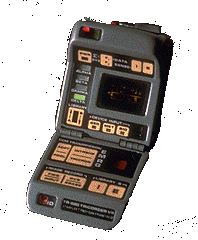
4) Tricorder =========================== The standard tricorder is a portable sensing, computing, and data communications device developed by Starfleet R&D and issued to starship/starbase crew members. It incorporates miniaturised versions of those scientific instruments found to be most useful for both shipboard and away missions, and its capabilities may be augmented with mission-specific peripherals. Its many functions may be accessed by touch-sensitive controls or, if necessary, voice command.
4.1 Main Features =========================== The standard tricorder measures 8.5 x 12 x 3 cm and masses 353 grams. The case is constructed of micromilled duranium foam, and is divided into two hinged sections for compact storage. The control surfaces consist of ruggedized positive-feedback buttons and a 2.4 x 3.6 cm display screen. While a full personal access display device-type multilayer control screen would have afforded the user with a wider range of preferences in organising commands and visual information, the simplified button arrangement was chosen for greater ease of use in the field. The internal electronics, on the other hand, were designed to provide the greatest number of possible options in managing sensor data, visual images, and multichannel communications, in all incoming, outgoing, or recorded modes. The major electronic components include the primary power loop, sensor assemblies, parallel processing block, control and display interface, subspace communication unit, and multiple memory storage units. Power is provided to the total system through a rechargeable sarium crystal rated for eighteen hours of full instrument activity. True power usage rate and maximum useful time is, of course, dependent on which subsystems are active, and is continuously computed for call-up on the display. Typical power usage is 15.48 watts. The sensor assemblies incorporate a total of 235 mechanical, electromagnetic, and subspace devices mounted about the internal frame as well as imbedded in the casing material as conformal instruments. One hundred and fifteen of these are clustered in the forward end for directional readings, with a field-of-view (FOV) lower limit of � degree. The other 120 are omnidirectional devices, taking measurements of the surrounding space. The deployable hand sensor incorporates 17 high-resolution devices for detailed readings down to an FOV of one minute of arc. Within these FOV limits, both active and passive scans can provide readings approaching the theoretical limits of the EM radiation of physical process under study. By combining readings from different sensors, the tricorder computer processors can synthesise images and numerical readouts to be acted upon by the crew member. The computer capabilities of the standard tricorder are distributed throughout the device as preprocessors attached to the various sensors and twenty-seven polled main computing segments (PMCS). Each PMCS contains subsections dedicated to rapid management of the sensor assemblies, prioritising of processing tasks, routing of processed data, and management of control and power systems. The PMCS chips supplied with the TR-580 and TR-595H(P) standard tricorders are rated at 150 GFP calculations per second. The control and display interface (CDI) routes commands from both the panel buttons and display screen to the PMCS for execution of tricorder functions. Multiple functions can be run simultaneously, limited only by PMCS speed. In practice, crew members usually carry out no more than six separate scanning tasks. Communications functions are carried out by tricorder through the subspace transceiver assembly (STA). Voice and data are uplink/downlinked along standard communicator frequencies. Transmission data rates are variable, with a maximum speed in Emergency Dump Mode of 825 TFP. Communication range is limited to 40,000 km intership, similar to the standard communicator badge. The data storage sections of the standard tricorder include fourteen wafers of nickel carbonitrium crystal for 0.73 kiloquads of interim processor data storage, and three built-in isolinear optical chips, each with a capacity of 2.06 kiloquads, for a total of 6.91 kiloquads. The swappable library crystal chips are each formatted to hold 4.5 kiloquads. In Emergency Dump Mode, all memory devices are read in sequence and transmitted, including any library chips in place. In practice, the total time to dump a standard tricorder�s memory to a starship/starbase can be as long as 0.875 seconds.
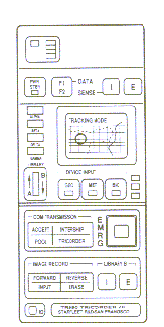
4.2 General Description of Controls and Indicators ======================================= When stowed, the only visible control is the power switch. It shows a red power-on light and a green power level indicator. When deployed, all of the available controls are visible.
PWR STBY � Power standby light. If the tricorder is not used for more than ten minutes, this indicator will illuminate, and the tricorder goes into low-power mode. Any new touch of any control will bring the device back up to full power. When the tricorder is stowed but performing ongoing tasks, low-power mode does not occur. F1/F2 � Control function select switch. Most buttons on the tricorder have more than one function. This is a convenient toggle for often-repeated function changes and may be programmed by the individual crew member. The F1/F2 switch is active during data operations only. I and E � These two controls manage the source of sensory information, either the tricorder itself (Internal) or remote device (External), or both sources simultaneously. The remote device can be any sensor platform that uses the same data collection machine language. The term "platform" denotes a vehicle operating on or above another planetary body, including a spacecraft. Display Screen � This screen is capable of showing any realtime, stored, or computed image. The display area is similar in construction and function to Starfleet control panels and display screens, although the layering technique is simplified and the default image size is naturally smaller. Selected areas of an image may be enlarged by touch; many other screen functions may be customised using the standard tricorder�s stored setup programs. Library A/B � The standard tricorder contains a read/write drive to record information onto small crystal memory chips for later retrieval, or to load previously recorded information into the tricorder�s main memory. Each chip has a maximum capacity of 4.5 kiloquads. Alpha Beta Delta Gamma � These indicators denote which data recording or retrieval activity is taking place in the tricorder library section. A more detailed readout of data operations can be called up on the display screen. Device Input � Each of these three keys can be assigned to manage up to nine remote devices, for a total of twenty-seven different information sources. For a routine away mission, the default settings on power-up are GEO, MET and BIO, covering geological, meteorological, and biological functions. Comm Transmission � This section controls the transmission of data and images to and from the tricorder through the STA. ACCEPT toggles the tricorder to accept one-way transmissions from a designated remote source. POOL allows for networking of the tricorder and one or more designated remote sources. INTERSHIP sets up a special tricorder-to-ship data link employing multiple high-capacity channels. TRICORDER sets up a similar high-capacity link, but to other tricorders. While all four modes can be active simultaneously, the system will slow down significantly. In practice, no more than two modes are usually necessary at one time. EMRG � This is the emergency "dump everything to the ship" button. It provides for non-error-checking burst mode data transmission in critical situations. In practice, this function can be used no more than two times before the standard tricorder�s primary power is exhausted. All sensing tasks are suspended and power is maximised to the STA. Image Record � This section manages single or sequential image files recorded by the standard tricorder. The control has four divisions: FORWARD, REVERSE, INPUT, and ERASE. When used in concert with other tricorder functions, relatively complete documentation of an away mission can be achieved. At standard imaging resolution, at a normal recording speed of 120 Area View Changes (AVC)/sec, the tricorder can store a total of 4.5 hours of sequential images. Higher speeds yield a proportionately lower total recording time. Library B � Library B is the primary storage area for sequential images, though the memory configuration may be changed to include other storage areas, depending on the application. I and E control the image source. ID � This touchpad may be used to personalise a tricorder for default power-up settings, or as a security device for single-crew member operation.
===================== Starships are equipped to support a number of research teams whose assignments are designed to take advantage of the fact that the ship is a mobile research platform whose assignments will take it through a very large volume of space. Such secondary research missions typically include stellar mapping and observation projects, planetary surveys, interstellar medium studies, cultural and lifeform studies. These secondary mission teams must necessarily focus their work on stars and planets near primary mission sites, but the broad operating range of starships makes these extraordinary opportunities to study a large number of celestial objects. As with other investigative teams, secondary research projects are generally developed by Starfleet researchers or affiliated university and industrial scientists, and assigned to starships for either short-term or ongoing investigations. Starships in extended mission configurations include facilities to support approximately twenty specialised mission teams, depending on team sizes and types of investigations being conducted. These facilities include living accommodations for up to 225 people, as well as nonspecialised laboratory and work spaces that can be configured for specific investigator requirements. Additionally, some forty sensor pallet assignments on the lateral arrays are reserved for mission-specific instrumentation, which can be installed and modified as needed. Similarly, some fifteen instrument mounting positions within the long-range array cluster are available for mission-specific investigations. Each individual department or investigation team is responsible for the operation of its own observations and experiments. Because secondary mission investigations are by definition subordinate to primary mission requirements, these teams must remain flexible in their operations. Nonetheless, each department or team is responsible for providing a regular update of operational preferences to the Operations Manager (OPS) so that the daily mission profiles can be designed to satisfy as many departmental needs as possible.
|
||||||||||||||||||||||||||||||||||||||||||||||||||||||||||||||||||||||||||||||||||||||||||||||||||||||||||||||||||||||||||||||||||||||||||||||||||||||||||||||||||||||||||