A good rate of pay.
Good opportunities for promotion.
Good holidays.
Prestige.
The opportunity to work but also have a good family life.
Job security.
Friendship with work mates.
Opportunities to be creative/show initiative.
A degree of independence.
Responsibility.
A good rate of pay.
Good opportunities for promotion.
Good holidays.
Prestige.
The opportunity to work but also have a good family life.
Job security.
Friendship with work mates.
Opportunities to be creative/show initiative.
A degree of independence.
Responsibility.It is, however, difficult to find the 'commonly accepted' ingredients of a 'good' job - people differ in their needs and wants. Job satisfaction is dependent on many things, such as:
The individual employee and his or her attitudes.
The job.
The business.
The rewards.
The working environment.Wages & Salaries
Pay can be seen as a way of 'compensating' or 'rewarding' employees for work done. There are a number of differences between wages and salaries:
WAGES
1. Paid Weekly. .
2. Paid in Cash. .
3. Paid usually to part-time workers e.g. students on ‘holiday’ work.
SALARIES
1. Paid Monthly
2. Paid by Cheque
4. Paid directly into bank/building society account.
Many of these differences are disappearing as businesses increasingly, for economic and security reasons, pay employees wages/salaries directly into either bank or building society accounts.
Fees
These are an alternative to taking on a permanent employee and paying them a wage or salary. In the UK today they are becoming increasingly common as people are hired to carry out a contract. The fee is paid as a reward for work done but the person is not taken directly on to the firm's payroll. Fees will be paid either on the amount of time worked or on the quantity of output produced.
Calculating Pay
The amount paid for a normal working week is the basic wage or salary. Many employees receive other benefits in addition to this. There are various methods of paying a worker:
Flat rate - This is a set rate of weekly or monthly pay based on a set number of hours. It is easy to calculate but it gives no incentive to work harder.
Time rate - The worker receives a set rate per hour. Any hours worked above the set number of hours are paid at an overtime rate which is generally higher than the normal rate per hour e.g. time and a half or double time.
Piece rate -Payment is made for each item produced which meets a certain quality standard. This encourages hard work but is not suitable for jobs which require time and care. Also, in service occupations, output is often difficult to measure and therefore piece rates are not appropriate.
Bonus - This is paid as an additional incentive to employees. It can be paid out of additional profits earned by the employer as a result of the employee's effort and hard work. Bonuses may also be used at times when workers might be inclined to slacken effort e.g. summer holiday times.
Commission - This is a payment made as a percentage of the sales a salesperson has made.
Payment by Results
This term refers to any system if payment which is related it the amount a worker produces. Payment by results is widely used for industry. The simplest form is piece rate payments, as indicated above, with other types being commission, bonuses and any form of performance-related pay.
Payment by results is easiest to set up in a manufacturing situation where an actual product is being produced but it can also be used in a service situation. A time is usually set for the completion of a service and the worker receives extra payment if the service is completed in less than this set time. If workers complete products in teams then the payment by results is usually based on the team performance rather than on individual performance.
Profit-related Pay
This involves giving the workers a share of the profits of the organisation. It may be in the form of a bonus or may involve giving the worker shares in the organisation. If a worker receives shares, these usually do not carry the right to vote and they have to be held for a minimum of one year. The attraction to the worker is that he/she receives a dividend from the shares and also gains if they go up in value.
In 1987 the UK government introduced a scheme whereby they hoped to encourage employers to Stop granting pay increases to everyone, in the belief that wage rises can only be financed through increased productivity and profits. The scheme allows employees limited tax relief and part of their take home pay is linked to profits.
Fringe Benefits (Payment in Kind)
This means the worker being given some goods or a service, instead of money. It may be in the form of free or cheap goods, free travel, free or cheap meals, home telephone bills paid, company cars given, school fees paid or free day nurseries provided for an employee's children.
Flexitime
Employees have the opportunity to work a number of core hours per day. With certain hours at the beginning and end of each day being flexible. Workers can choose to work longer than normal on some days and accumulate hours owed to put towards time off during the normal working day.
Non-Monetary Techniques Of Motivation.
There are a number of ways of motivating workers, apart from pay. These usually involve an increase in one or all of the following:
The variety of work.
Responsibility.
Recognition.
Sense of working as a team.The Wage Packet
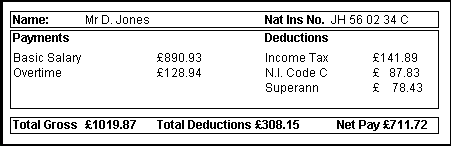
Every employee receiving a wage packet will be given information on how the total earned is made up and what deductions are being made. This is known as a pay advice slip.