There are basically two methods of calculating an employee's pay:
time based;
output based.
Each method has a number of different varieties.
Time rates are based on the number of units of time worked, eg hours, weeks. Hourly rates are most common, eg £5.00 per hour for 30 hours a week as a counter assistant. There is often a basic rate for each hour worked up to an agreed number of hours a week. If more hours are worked, then these are paid at a higher rate, as overtime.
The payment of a salary is also related to work over a period of time, though in this case it is a year. An annual salary is agreed which is then usually divided into twelve equal parts. Thus an employee is paid one twelfth of their annual salary for every month worked. The actual amount paid will usually start with a basic sum. People often then receive additional pay, eg for the number of years worked with the employer, for accepting specific extra responsibilities, for gaining additional qualifications.
A salary is a common method of payment in administrative or professional posts where it is difficult to work out the number of hours that will need to be worked or define the output.
The simplest output-based wage payment system is a piece rate in a manufacturing business. This is based on the number of times the employee completes a particular task. Piece rates are meant to encourage employees to work hard but may only be suitable if the output is repetitive and simple. The unit of output must be easy to measure without argument.
The payment of a commission is in a way a type of piece rate, except that the unit of output is not a product but a sale. The commission will often be a percentage of the value of the sale.
Salespersons can be partly paid in commission, so much for every sale. Payment by commission encourages sales and means that staff are paid out of the extra income they generate.
Another much more modern method of payment, which is also related to output, Is performance-related pay. The employee is given a target. The targets can be very simple, e.g. working a number of days without absence. However, managers can be given more complex targets. For example, a sales manager can be rewarded for increasing the number of active clients, or a headteacher for increasing the number of students on roll. For whatever reason it is given, a bonus will be awarded for reaching a numerical target.
Target setting is becoming an increasingly important part of calculating pay. However, it is important that targets are well thought out. If they are too low, they are likely to have little effect. Little extra effort will be needed to reach them. However, targets that are so high that they are unlikely to be met may also have little effect. Worse than this, employees may decide that any more than a minimum effort is pointless as they will not be rewarded.
In fact, many people's pay is made up of a basic pay which is time-related and then a bonus that is linked to output or sales, etc. This bonus is an incentive to reach a target. The basic pay could be based on the number of hours worked or an annual salary.
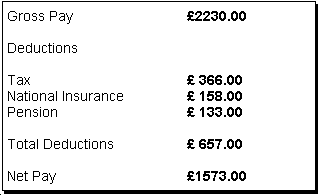
By the Employment Protection Consolidation Act 1978, an employee must receive an itemised pay slip. This will show gross pay (pay before any deductions), net pay (the amount actually "taken home") and any deductions. The two most important deductions will be income tax and national insurance contributions. Other possible deductions may be contributions to a pension fund or trade union. An example of this is shown below.