This is usually for one person and is a small to medium sized room with a door and windows (where the room contains an outside wall). It is called a' cellular' office because it is one of a number of 'cells' or units within the building.
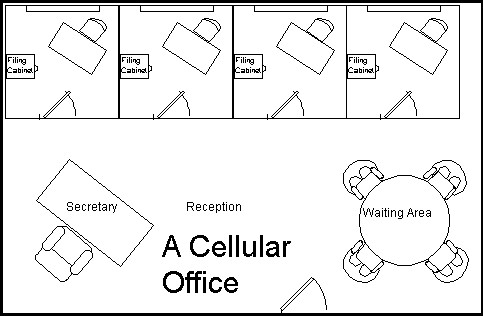
ADVANTAGES
- They provide privacy for the user who may need to discuss confidential issues with others.
- They can be locked, providing security for documents or money when the office is not staffed.
- They provide a quiet working environment where there are few distractions from other workers.
- They can confer status on the occupant as they are usually occupied by management.
DISADVANTAGES
- It is more difficult to supervise staff when they cannot easily be seen.
- They take up more space in a building as each unit has to be partitioned with doors and windows.
- Junior staff find it more difficult to approach senior staff who occupy cellular offices because the 'barriers' created by the partitioning.
- Separate offices require individual lighting and heating, which is more expensive to provide and operate than a larger open office environment.
- It is less easy to talk to colleagues when they in separate offices, which can slow down communication within an organisation.
OPEN PLAN OFFICES
Many organisations today make use of the open plan office layout where a large working area is broken down into smaller areas, through the use of shoulder height screens, which can accommodate small groups of workers. This type of office layout will normally accommodate several different grades of employee, and managers may work alongside secretarial support and administrative assistants.
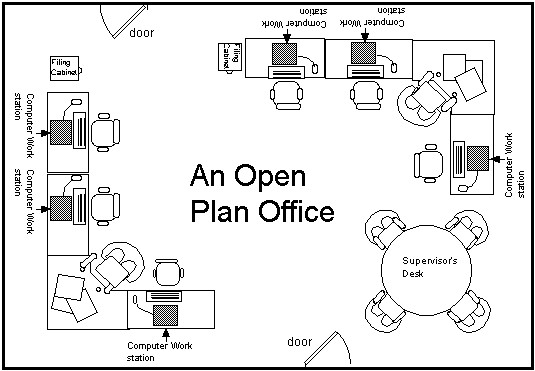
ADVANTAGES
- Staff supervision becomes easier and more subtle, as it is possible to see who is doing what in this open environment.
- Communication between different workers, different departments and manager and subordinate is made easier because there are less artificial barriers.
- The layout of the office can be altered with relative ease should it become necessary to increase or decrease the size of one or more working areas.
- Work flow between individuals and departments tends to be faster and more straightforward as workers can see and talk to each other with ease.
- In larger organisations, the open plan layout makes it easier to organise centralised services such as reprographics and wages departments.
DISADVANTAGES