From Crystal Lake to New York State:
Consuming the Tourist Spectacle in the Finger Lake region
Steve Conway, Chris Carter & David Crowther
The Production of Wine
In any consideration of viticulture it is general to focus upon production methods and to distinguish between the European concern with the craft of production, and the consequent individual variation of products between producers and seasons, and the New World concern with the science of production, and the resulting spatial and temporal homogeneity of the product. Thus, it becomes possible to consider the product in terms of the nature and scale of its production, with the implicit expectation that homogeneity implies mass production and therefore mass marketing and distribution, while craft production implies discernment in consumption and limited volumes. When considering the wine produced within the Finger Lakes region of New York State however this type of classification does not apply. In this geographical area there exist a number of small-scale producers, who nevertheless focus upon homogeneity and technology in their production methods without a focus upon large-scale production and the consequent development of appropriate channels of distribution. Thus, these wineries are essentially micro producers without the product differentiation that enables the products to acquire a distinctive place within what has become a global industry. The demand for, and access to, the products of the Finger Lakes region therefore remains restricted to inhabitants of, and visitors to, the region.
The viticulture of the region therefore is an interesting case for further study, both in terms of the nature of the product and its market and in terms of the specific economics of the Finger Lakes region. It is argued in this paper that it is the nature of the region, which determines both the nature of the product and the nature of its distribution. Furthermore, it is argued that this must be interpreted within the context of the semiotic analysis undertaken in this paper. This analysis shows that the viticulture of the region does not in fact comprise a part of the global wine industry, but rather remains local and an essential part of the economic regeneration of that region.
The Geo-economic Context of the Finger Lake Region: The Lung of New York
The agriculture lands of the Finger Lake region have long been in decline; this is evidenced by fading market towns and rural depopulation. This experience is of course not unusual, rural communities throughout the world have been ruptured by the forces of agri-scientific farming and increased urbanisation: the world of the agri-novels of Thomas Hardy is long gone. The circumstances that rural communities now find themselves, raises important questions about their actionable survival into the next century: are we observing the death of a region? Or are their possibilities for constructing a robust alternative means of economically sustaining a community? As with many communities facing similar problems the Finger Lakes region has turned to tourism, the world’s largest industry, in order to carve out an economic future. The creation of tourist space and the concomitant transformation of a region in decline is clearly the result of a number of distinct but interconnecting factors which, inter alia, include: one, the geographic position of the space, is there a proximity to a major source of tourists?; two, does the space contain features that can be constructed as tourist attractions?; three, is there the requisite social capital within a particular space to create the cluster (hotels, transport links, restaurants etc.) necessary to ensure actionable survival?
The Finger Lake region of New York is fortunate in many respects: it is a short flight from New York City, it is a half-day drive from significant urban centres of New England. Furthermore, it is close to the site of Cornell University, the large Ivy League school; it is also on the scenic route between New York, Niagara Falls and Canada. The Finger Lake region is therefore easily reachable, but why would anyone want to go there? In answering this question, there is the significant natural beauty, this is matched by an interesting settler history which includes nineteenth century radicalism and an Amish community which is still in existence. However, with any tourist space, there are issues of temporality that need to be addressed by a space: how long does it take to ‘do’ the Finger Lakes? Is there ‘enough’ for a weekend visit? How would that time be spent? This returns us back to the notion of the tourist cluster; it also takes us into the issue of the choreographing of a tourist experience. Some travel companies specialise in highly stylised packages which whisk tourists from attraction to attraction (‘It is Tuesday it must be the Empire State’); self directed visits are evidently more fluid, though there is still a need for choreographing, the difference being that it is implicit and open to customisation. This insight leads us back to the importance of the cluster; this is something that we will now consider in the context of the Finger Lake tourist space.
Aside from the physical beauty of the Finger Lake region, the gilded confines of Cornell University, there has been a proliferation of ‘attractions’ to fill the time of any visitor to the space. Within a short hire-car drive visitors can take in ‘real’ agricultural experiences, etc, etc. Visitors can also visit one of the many Finger Lake wineries, to taste ‘authentic’ wine. To the urban visitor to the tourist space there is a chance to experience the ‘other’, a life of simple pleasures and naturalness; this opportunity is offered by one of their many rural-rustic cultural intermediaries. The core of this issue is the notion of the authenticity of the experience of the real country existence as carefully choreographed into the tourist industry of the region.
The Tourist Spectacle in the Finger Lakes
The Finger Lakes are of glacial origin and run approximately from north to south in parallel with each other, with a road running alongside each lake. Along each of these roads the tourist spectacle can be seen to exist in a convenient series of spectacles designed to be consumed by the tourists traversing, without diversion because there is no spatial diversion, alongside each lake. These spectacular events are historic, traditional, scenic and consumerist; they variously embrace sites of historic battles and sites, visits to traditional farms, and enjoying such participatory events as haycart rides, scenic parks, craft parks and antique shops. However, the most significant of these, for the purpose of this paper, is the visiting of the local wineries. The tourist has the opportunity of participation through the consumption of the events of the tourist trail - for so it is signalled - and indeed the geography of the trail is such that this consumption has been conveniently organized into small chunks which are spread across the trail. Thus, the traversing of the tourist area of the Finger Lakes through the consumption of the tourist spectacle has been signaled in a manner which is unmistakable to all tourists and an essential part if the linear spectacle of the lakes is participation in the ‘wine experience of the Finger Lakes’.
For the tourist spectacle to be complete, there is a necessity for it to be more than consumable in situ; it must also be capable of being reproduced so that the consumption can be demonstrated to oneself, at a later date, and to others. This therefore is the purpose of souvenirs that become an integral part of the spectacle. Souvenirs comprise the various photographic trophies, which are acquired while traversing the landscape of the spectacle and the various icons acquired during this experience. Thus, it is possible to acquire antiques and artifacts from the various shops along the route as well as the trophies from the vistas to the wineries. One of the trophies from the wineries is of course the wine, but this wine is only one of the trophies that it is possible to acquire during the visit. Others include the ubiquitous T-shirts and baseball caps, together with a whole range of other goods, such as fruit preserves, cut glass artifacts and wine accessories, the exact nature of which varies from one winery to another.
The fact that the wine is regarded, both by the tourist consumers and by the producers themselves, can be evidenced from a consideration of the semiotic inherent in the ‘wine experience of the Finger Lakes’, and it is to this that we now turn. This experience can be considered from two aspects: the aesthetics of the winery layout and the tasting experience.
The aesthetics of the layout: the ‘zone of purchase’
As Botschen & Crowther (1999) have argued, the layout of the customer space in the winery creates an aesthetic which predisposes (or fails to create this predisposition) the customer to consume the goods on offer. Thus, within the wineries the wine is stored and displayed in bins that create a simulacrum of the authentic wine producers methods of storage. It is however a simulacrum because, unlike an original, these bins are not in appropriately environmentally controlled cellars but rather within the shop space itself and carefully designed, not for conservation of the product but rather for a display which will entice purchase of the product. More significantly the wine is set out within the shop in a carefully orchestrated juxtaposition with all the other goods in the shop such that the complete experience requires a study of the range of goods on offer in order to make an appropriate individual purchase decision. That purchase decision is not concerned with which wine to buy but rather with which trophies of the spectacle to obtain. Wine is just one of the possible trophies on offer to the tourist.
For a wine producer any shop attached to the vineyard acts as a tasting and promotion environment in the expectation that this tasting will lead to subsequent purchases of the product, in preference to the alternatives available from other producers. Thus the shop is not designed necessarily as a profit making enterprise, but rather as a promotional device. However, for the wineries of the Finger Lakes this is not the case as the wine produced is almost exclusively available only from the outlet at the winery itself. Although all the wineries have their individual websites which facilitate sales from elsewhere this happens on only a very small scale. Indeed, these websites are all linked to the tourist websites of the region, thereby providing further evidence of the nature of the products on offer. For wine producers channels of distribution are extremely important as this determines how much of their offerings they can see. For the Finger Lake wineries, however, distribution channels are extremely limited and restricted to outlets within the catchment area for tourism. Thus, the sales of the product arise almost entirely from the winery itself and from the tourists visiting and partaking of the spectacle. For a wine producer this would be extremely unusual but for an organization in the tourist trade this would be the norm as the souvenirs of the tourist spectacle only have meaning when acquired during the consumption of that spectacle.
A consideration of the economics of pricing therefore becomes important when contrasting the wine industry with the tourist industry. For the wine industry scale of production is important as is the time taken in the production process, which affects the capital involved in the process. Thus, broadly speaking, price can be expected to reflect the quality of the wine, but that price must be set also in relation to the alternative products available - in other words the alternative wines produced around the world in this global market. The tourist industry however, for an individual firm, is not global but rather extremely local and at the site of an individual winery there are no alternative producer’s wine available. Instead, the alternatives available are the other souvenirs. Thus, pricing can be set in relation to other souvenirs rather than relative to other wines, and there need be no relationship between price and capital investment, as a surrogate measure of quality. Additionally, the scale of purchase of tourist trophies, rather than wine, tends to be small scale and so customers can be expected to buy individual bottles rather than cases of wine. This leads to two conclusions: firstly, the small scale of purchases will require the profit margin per unit to be high; and secondly, the incentives for multiple purchases can be initiated at a low volume. Thus, the wineries will offer discounts for multiple purchases at a level as low as three bottles. Given that the purchase of souvenirs is small in number per customer then the incentive to increase the purchase quantity will be great for the producers as this is the principle method of selling their products; thus it can be observed that the price per unit is high, supporting the argument that this is a tourist industry rather than a wine industry.
The tasting experience and the ‘zone of tasting’
Key to the transformation of space from winery to tourist spectacle is the wine tasting experience; this shift is brought about by a combination of an explicit ‘zone of tasting’, provided by the counter on which the glasses are placed and filled, and the ‘process of tasting’. The zone of tasting provides the formal arena in which the ‘serious’ business of the wine tasting will occur; within the Glen Nora winery the sense of gravitas is reinforced through the delimiting of this space from the ‘zone of purchase’ by a glass wall. The counter is clear of the clutter that characterises the zone of purchase, and laid out with the spartan equipment of the tasting process: the wine biscuits, the glass pitcher for the undrunk sample, the list of wines, and the pencils for the scribbling of judicious comments. The removal of clutter within the zone of tasting is an important precursor to the wine tasting, since it will allow the tasters to focus on the evaluation task that lies ahead and underlines the importance of their gaze on the properties of the individual wines. The counter also separates the winery expert from the wine tasters; starkly distinguishing the transmitter of the local wine knowledge. The process of tasting is routinized and, as with the aesthetic of the zones of purchase and tasting, represents a simulacrum. The formal nature of the routine in which each wine is, in turn, described by the winery ‘expert’, a sample poured, tasted and evaluated, also provides a framework for the decoding of appropriate local practice in which the uninitiated can nevertheless collude with the ‘wine expert’ in a knowing dialogue.
Part of the semiotic is, of course, to present the image of a complete replication of the authentic tasting ceremony of one of the European countries with a history of wine production. To satisfy the needs of the tourist - the American tourist naturally, because in this region there is no other – however this tasting experience must be adapted into the simulacrum of the tourist tasting. Thus rather than considering the essential components of wine such as bouquet, the winery ‘expert’ focuses upon the things which constitute the shared knowledge of America, such as residual sugar content, carefully constructed into a scientific paradigm. This is mutually understood between the ‘expert’ and the consumer who interact in complicit understanding with shared communication in the same way as bees interact through their dance. The effect of this is that Europeans (such as the authors) act out a different dance based upon their European paradigm and might not be able to share in this discourse. Consequently, we were surprised to find that the wines which appealed to the American tourists were completely different to those appealing to our European palate (for exampl, the fruit wines seemed to appeal greatly to everyone present other than ourselves).
The discursive practice of tasting and purchase, as outlined above, amounts to a relational process between the vineyard and its visitors. The purchase of bottles of wine can be read in one of two ways: first, it is merely the opportunity to purchase a wine that the visitor enjoyed; second, it is the opportunity to obtain an artefact which can then be removed from the wine tasting space. It is our view, consistent with our notion of Finger Lake wines as primarily constituting a tourist spectacle, that the latter view is of greater importance. Thus the artefact acts as a trophy that confirms the authenticity of the tourist’s experience.
This insight combined with the pre-configured aesthetic form of the wine bottle as a carefully stylised genre (as distinct from beer bottles) leads us to the importance of the livery on the wine bottle as a means of communicating and concentrating a message from the vineyard (tourist facility) to the buyer (tourist visitor). In order to interpret or decode the message from the wine bottles produced by the various vineyards of the Finger Lake region, it is useful to engage in a semiotic deconstruction of the livery on the bottles. Firstly, we will give an overview of semiotics, this is to be followed by a deconstruction of a two contrasting wine bottles from the Finger Lake wine region.
The Semiotics of Authenticity and Spectacle
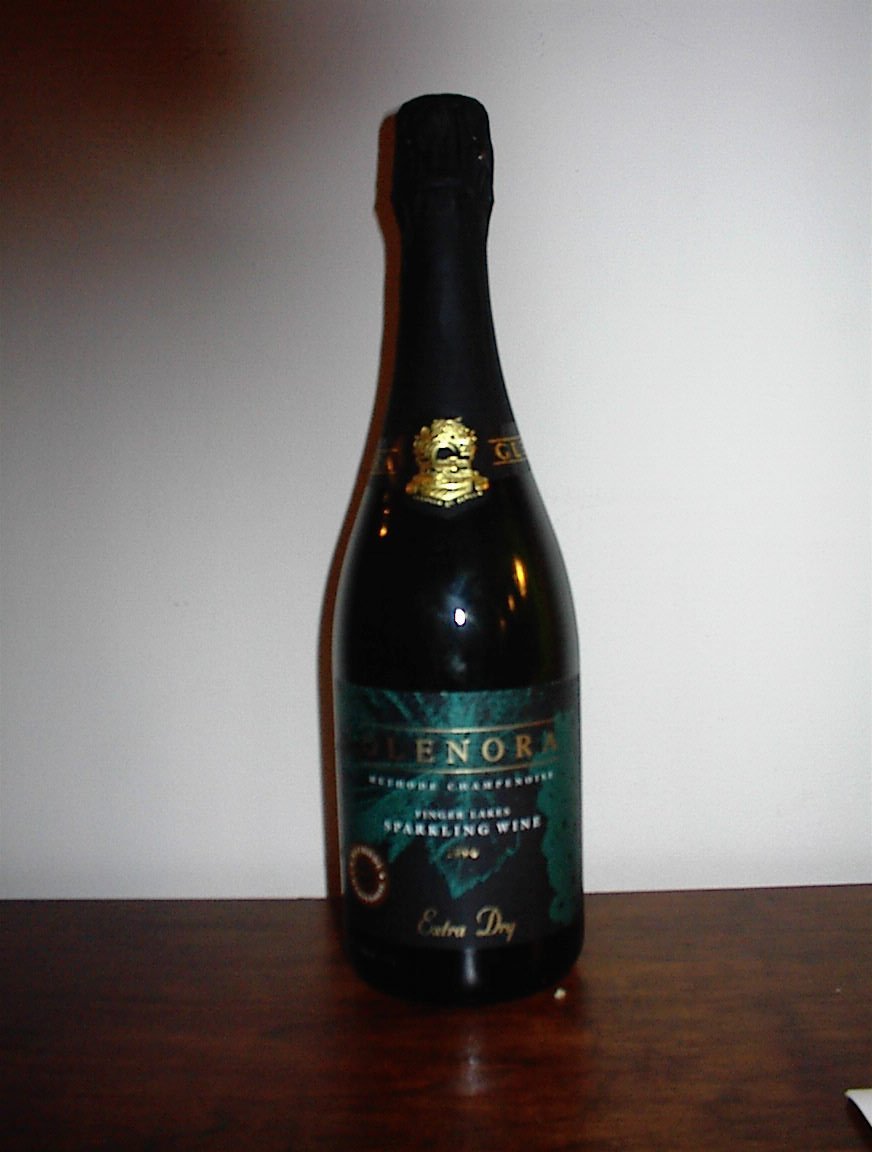
Bottle One: Glenora Methode Champenoise
Glenora is positioned at the upper end of the Finger Lake wine market in terms of reputation. This reputation is socially constructed and is spatially relative (prestige in one area does not necessarily transfer across contexts). Bourdieu demonstrates how prestige is an interconnection of economic, social and cultural capital, as such, these are the bases for competition between different vineyards. The bottle shape is standard, and from a distance Glenora would look very much like a French champagne bottle. This is achieved through the contrast between black, gold and dark green on the bottle. Such colours and their contrast are synonymous with quality and a superior product. The attempt to denote a quality image is also apparent by the use of the Glenora crest on the stem of the bottle takes a classical form.
A closer examination of the label reveals how it makes use of local imagery (the vista of the Seneca Lake) juxtaposed between the vineyard, a grape vine, an uppercase G and the symbolic power of two lions. This pastiche can be interpreted as attempting to make a semiotic connection between Glenora and the region with wine that is ‘robust’ and ‘powerful’. The insignia is accompanied by the phrase Glenora on Seneca which is an anglicization of the French referents between wine and river. In shifting our attention to the main label, the main legend ‘Glenora’ is underscored by the statement ‘Methode Champenoise’. This use of the French is used to establish a legitimacy that is achieved by linking Glenora sparkling wine with the venerable tradition of the French champagne industry. This is further emphasised by the use of the golden, circular stamp ‘Methode Champenoise’. Through the use of these signs there is a clear attempt to establish the credentials of Glenora as being a quality wine. It is interesting to note that the French champagne industry in the late ninety eighties was successful in obtaining an international law judgement which resulted in the geographical protection of the term champagne. This meant that ‘sparkling wine’ manufacturers were no longer able to describe and market their product as champagne unless they were actually situated within the Champagne region of France.
Bottle Two: Harbor Moon
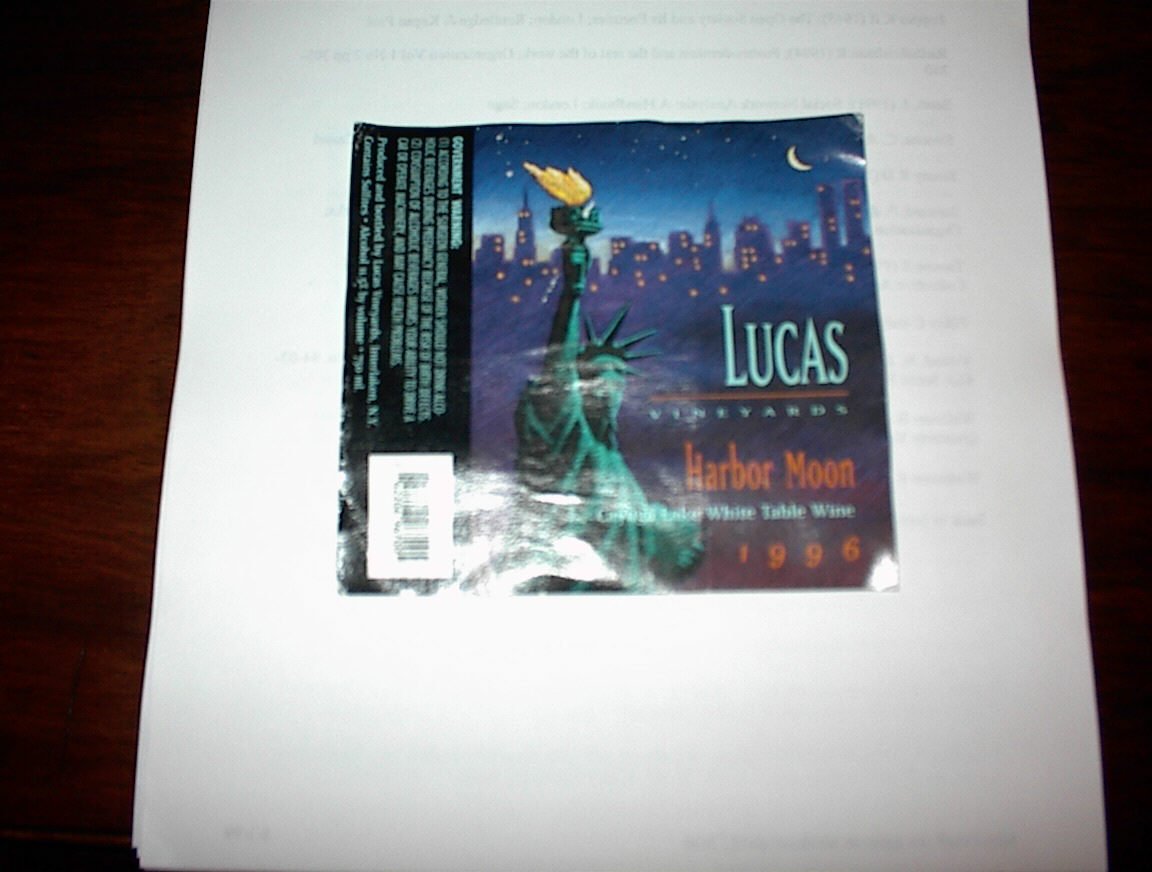
Harbor Moon is positioned towards the middle to lower end of the range of wines produced by Lucas, a competing winery on the Cayuga Lake. As a table wine, the bottle is standard, though the deep purple-green colouring of the glass is less typical. In contrast to Glenora, Lucas do not attempt to construct the semiotic of authenticity for Harbor Moon; there is no gold seal of approval, no prominent gold lettering, and no reference to the production method or grape. Furthermore, the label seems completely at odds with the nature and origin of the product, depicting the Statue of Liberty accompanied by a backdrop of the Manhattan skyline at night. Yet the spatial disjuncture between the imagery of the label and the location of the winery can be made sense of through the knowledge that most of the likely purchasers are domiciled near the eastern coastline. Thus, in terms of making sense of the semiotic of Harbor Moon it is clear that the consumption of the tourist artifact is linked to an affinity with the familiar rather than the ‘other’.
Discussion
The deconstruction of the two bottle labels above highlight two very different ways of communicating with consumers. An obvious conclusion would be to suggest that there was a binarism between the two products: Glenora being a serious wine, while Harbor Moon was purely for tourism. However, in our view such an analysis is suspect. It is our contention that both of the wines constitute tourist artefacts over and above any other function. As such they are carefully stylised reminders of the tourist spectacle undertaken by visitors to the area.
It is therefore apparent that any understanding of the wine industry must be undertaken not in terms of a part of the global wine industry, but rather in terms of the local tourist industry cluster. Thus, the wineries of the area are an essential and integral part of the regeneration of the region through its development as a region of tourism. As such it becomes impossible to view the wineries as an industry in isolation as separate and discrete from their environment, which is of course a local environment appealing to local tourists.