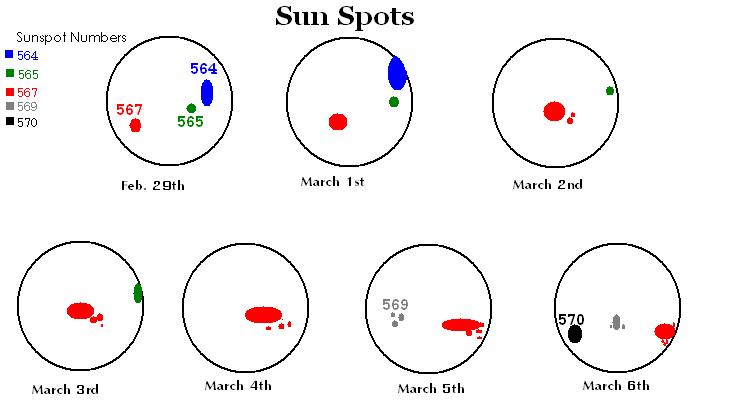
Procedure: The procedure on this lab was simple. Watch the sun spots for several consecutive days, and make observations. I got my information from the SOHO Homepage where they have a link to the current sunspots, and other very interesting pictures and data about the sun. I observed and made drawings from February 29th, to March 6th.
Results: The results of this lab showed me that the sunspots moved very quickly, and at the same time, some seemed to move very slowly. This led me to believe that there is differential rotation on the sun. The same differential rotation that is seen on the Jovial planets. Differential rotation is where the surface of the planet moves faster, and maybe even in a different direction, from location to location. I observed one sunspot (0567), seemingly move much slower then the surrounding spots. Sunspot 0567 seemed to move more toward the equator of the sun, which may account for the slowness, but I believe the liquid/gas surface of the sun would account for differential rotation. Below is the results that I saw on the SOHO website:
Conclusion: As a conclusion, I tried to estimate the rotational period of the sun, just based on my observations on SOHO. I used the spot which occurred through the entire week of viewing (0567). During the week, the sun spot moved about 40% across the viewable side of the Sun. At that rate I would guess that it would take 17 to 20 Earth days to make a full rotation. It was very interesting to see how new spots would seem to appear within a day, and how other spots would ‘break up’ into more spread out spots over the surface. After reading more about Sun Spots, I learned that there is differential rotation on the sun, but the equator moves faster then the poles, not slower. The sunspots are actually cooler gasses that show up against a much hotter, brighter surrounding area. At any one moment, there could be hundreds of sunspots, or none at all!
Grade:A
Please email '[email protected]' for any questions/comments! Thanks!