For My Grade Five Students
This page is also for your parents to read!!!
This page is for you lucky kids who have a great, solid background in English as a first language. Knowing English naturally is a gift!
There are many differences between learning a language as a first language and learning it as a second one.
First, you know a good basic vocabulary before you begin to learn ABC's.
Also, you have a "feel" for the patterns and rules of the language without having to learn every one.
Without even saying "I'm a monkey's uncle" you are W-A-Y ahead of the other kids in class. You can ace all the tests up to grade 7 or 8 without having to put in much effort.
However, if you just "hang in there" you are just waiting for your clasmates to catch up, but you are not staying ahead!
My first goal for you is to keep you ahead of your classmates, by expanding your use - speaking, reading, writing - of English in your Hebrew-speaking environment.
My second goal is to teach you some of the formal rules of grammar. If you learn them and get comfortable with them early on, by the time you get to the "tough stuff" that the other kids learn in grades 7 and up, you will find it all "a piece of cake."
Grammar
Grammar is simply a set of "rules" on how to use a language.
Basic English grammar involves knowing what a basic sentence is (a complete thought) and the words: nouns, verbs, adjectives, adverbs, prepositions, conjunctions, pronouns and articles therein.
Next comes knowing about constructing the different types of sentences: regular, negative ("no"), and interrogative (question) sentences.
After that, comes knowing the rules of correct punctuation: capitals and stops, commas, colons, hyphens...and more.
Finally, you can start getting into more complicated sentences and know about phrases and clauses - there are different types of each - the different tenses, and other more complicated stuff.
Here is my page of grammar topics with online quizzes for many of them. I will keep adding to it, so check back often.
Vocabulary
Vocabulary means knowing and BEING ABLE TO USE as many words in the language as possible.
Want to have a great vocabulary? Read, read, read! Find great books and read as much as you can. Read stuff on the internet. Read the back of cereal boxes (if they are in English!) Do as many word puzzles as you can. Crossword puzzles are great.
Learning "lists" of vocabulary is difficult, as if you don't use the words, you will soon forget them. Still, there are lots of things that I can point out to you.
Some examples:
- knowing about homophones and the like;
- knowing about other confusing words (lay/lie, affect/effect, principle/principal and zillions more!);
- knowing how to figure meaning from context;
- knowing how prefixes and suffixes alter word meaning; and more!
Spelling (and Reading)
To be able to enjoy reading, you have to be able to read QUICKLY.
You certainly know that reading in English is no easy thing. There are so many confusing letter combinations, giving us sounds that we never expect! Do you know that there are 26 letters, but 44 possible sounds?
Why are "ate" and "eight" pronounced the same? Go figure!
Even the simplest word has to be learned. Everyone KNOWS that that animal that goes miaow is spelled "cat." Right? But why not "kat?" You see, even such a simple word must be studied!
So, that means, you have to study words, and their SPELLING.
There are about 220 basic words that every kid should know to read and understant. They are called Dolche Words. Being able to read these words automatically makes reading much easier. (Also, check out the links on the left side-bar.)
After that, the world is the limit. Just go memorize the dictionary. (Ha ha -but that's a method, too.)
My Grade 5 students are being taught these words. Each list focuses on a different type of spelling convention.
You can also see all the lists together here.
Of course, the best way to learn ANYTHING is through FUN and GAMES, and I found a site with Games using the spelling lists! (Unfortunately, I can't find a "main page" with active links, so I will give you all the links here:)
| Lists 1-5. | Lists 6-10. | Lists 11-15. | Lists 16-20. | Lists 21-25. | Lists 26-30. |
You can also find some hints, links and games on the spelling page.
Reading (and Spelling)
The more you read...the more everything improves.
Don't have books? Go to a library!
My lucky students can have any book that they see here on the ReadingA-Z site. Just email me and I will send the file to you to print out.
Writing
Unless you are a "born" writer, one who has a talent and love for it (like a "born" artist), sitting down and doing "creative writing" can be a pain. I know, I used to be there.
I also learned that you can improve, and finally LOVE creative writing. I know, I'm there!
No matter what, there are certain things that ALL writing must have (intro, body, conclusion). Did I mention correct grammar and spelling, too?
The more you write, the better you get, just like any skill. SO KEEP WRITING!
Dictionaries and Other Tools
A skilled craftsman or artist knows that he needs good tools.
DO YOU HAVE A GOOD DICTIONARY?
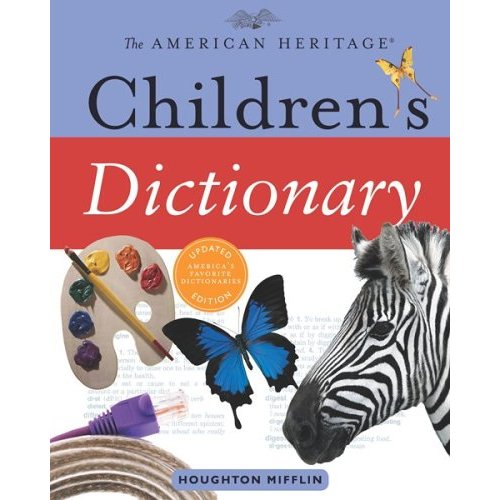 |
You MUST HAVE ONE AND USE it! (And not as a doorstop!) I recommend this beautiful, dictionary. But any one is OK, as long as you enjoy (!) using it. That means that it is age-appropriate, not too heavy to pull off the shelf, handy for use(not stored high up!), and at the right age level for you! |
Another useful tool is a "Thesaurus." This is a book that gives you synonyms of words so that your creative writing can be more interesting.
Of course, today, there is the internet to solve all our problems. www.dictionary.com and www.thesaurus.com are great sites too!