This city that in the last
century was the center of the German colonization of Llanquihue, today is characterized
being the departure point for the displacement to the places of greater tourist
attraction and to construct the nexus with the most austral regions of the country.
The colonization of the south of the country had to the Bernardo work to a great
extent And Phillipi, that dedicated to great part
the
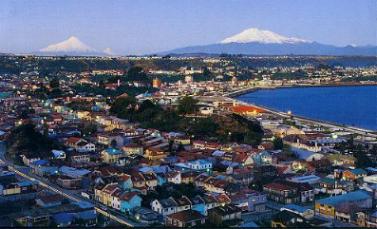
capital of the Region of the Lakes offers to the visitor all the attractiveness
of its marine life. Located in the North shore of the Sine of Reloncaví, to
1,016 kms. to the south of Santiago, hundreds of originating boats of the coast
sure6no give life to the sector. The Sine of Reloncaví can be appreciated in
all its splendor from the Costanera Avenue that borders the city in several
blocks.
The
House of Art Diego Rivera, located to a block of the Seat of Arms, serves as
seat for diverse artistic and cultural manifestations. The museum Juan Pablo
II, located in the Avenue Vestibules s/n, exhibits objects and documents on
the German colonization and the first inhabitants of the region.
To
2 kms. of the Seat of Arms the colorful Creek of Angelmó is located, the one
that must its name to Don Angel Montt (1857), benefactor of the natives, who
called " Angel Mó ". Is a port of boats, schooners and sailboats who daily cover
the routes towards the adjacent islands. Also it is port of ferrys that make
trips to the Island of Chiloé, more austral Chaitén and zones like Chacabuco,
Lagoon San Native Rafael and Puerto.
By
his colorful style it is constituted like the most representative place of Puerto
Montt, being immortalized by famous national and foreign painters. At the end
of the creek it is located the fresh market of fish and mariscos and a fair
of fruits and vegetables. It is the point where the islanders come to commercialize
their products. In Angelmó Creek the visitor can enjoy an ample supply of gastronomy
of the sea, which has turned to Puerto Montt into the capital of the marine
gastronomy of Chile.
From
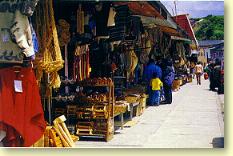
Angelmó Creek, in the direction of downtown, he is located the Artisan Fair,
place in which the tourist finds the most varied expressions of our crafts in
materials like wood of larch, leather, basketwork, and all weave class. As opposed
to Angelmó, the Tenglo island is separated of the continent by the channel of
the same name. It is arrived at her in boats that make the transfer from Angelmó.
Excellent Vista of Canal Tenglo is obtained from the coastal sector of Chinquihue,
to 15 kms. to the west of Puerto Montt.
In
front of the Seat of Arms in the sector this of the city, km 0 of the Austral
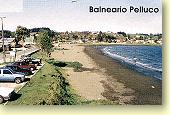
Longitudinal Way is located. Continuing by this distant coastal way to 4 kms.
it is acceded to the bath of Pelluco that characterizes by its gastronomical
establishments and beaches. Continuing by this way are places of singular beauty
and attractive bays, like Coihuín and Blue Piedra, to finally arrive at creek
the Sand.
To 51 km of Puerto Montt
the archipelago of Calbuco is located, programmed excursions allow to cross
channels and islands and to enjoy rustic and nautical activities. Calbuco,
island surrounded by beautiful rural landscapes and insulares, founded like
town and fort by Don Francisco Hernandez Ortíz on 1302. Navegue by its attractive
channels, matting and coves. To 75 km of Puerto Montt Maullín is located,
ample fluvial zone and marine on extensive white and fine sand beaches, it
counts on the escenciales services so that the tourist or traveller enjoys
during his permanence in this commune. Between its attractiveness we have:
Hill the Picuta, Stone of the Wolf, Puerto Godoy, Quillahua, Punta Pangal,
Carelmapu, Brave Sea, Amortajado and Quenuir.
of
its life to investigate, to plan and to coordinate the coming of immigrants
German to the zone. In 1845 the Law of Colonization for this territory was dictated
and in 1850 Perez named to Don Vicente Rosales like colonization agent while
Phillipi was in German contacting families .
From
its Seat of Arms, through the Costanera Avenue that constitutes the principle
of 225 route or Vicente Perez Rosales, the route begins that borders the Southeastern
shore of the Llanquihue lake. To 45 kms. of distance in villa of Cove, giving
origin to the way of circumvallation of Lago Llanquihue. To the northeast it
leads to Petrohué and Peulla, whereas towards the Southeastern it is acceded
to Ralún and Cochamó. The Petrohué river and its jumps, the proximity of Osorno
volcano and the Lake All the Saints conform a dream scene. Navigation by the
lake allows to arrive at Peulla and during the passage the Pointed volcano,
Hill Tronador and Isla Margarita are observed.
Port
Twigs is located in the western South shore of Lago Llanquihue and to 20 km.
of Puerto Montt, nailed in a natural frame formed by the lake, and volcanos
Osorno and Calbuco; it counts on attractive like the Phillipi Park, and the
fire way. It has an ample range of tourist services that allows the development
of the tourist activity. Frutillar, famous by its Musical Weeks, is located
in the sector this of Lago Llanquihue, counts on services of lodging and feeding.
Their colorful gardens grant a very special seal to him, emphasize the German
Colonial Museum, their architecture and gastronomy.
Fresia is located to 36 km to the west of longitudinal highway 5 the south,
by the route V-30; its main quality is eminently rural and is represented by
the sectors Llico low, Huempeleo and Tegualda - Burned House. Low Llico, to
50 km to the southwest of Fresia, has access terrestrial, by the channels V-310
and V-320 until port of Maichihue, and soon marine, via boat. This locality
presents/displays attractive for the practice of agroturismo like cavalcades,
strolls by the beach, excursions to the mountain range of the coast, and fishes.
Huempeleo, this colorful accessible locality by the routes V-46 (Fresia - Tegualda)
and V-912, offers the observation and photography of red deers in captivity
and flora and local fauna.