Foreword: This page serves as a tribute to a pioneer Singapore artist whom I respect. He may not be my favourite artist, yet I think he greatly deserves our respect for the contributions he has made to the arts and culture scene in Singapore.
---------------------------------------------------------------------
Model artist
Liu Kang was a Renaissance man who painted, wrote and enjoyed music. His death marks the end of the founding era of Singapore art, of which he was a pioneer and leading light.
Taken from: The Straits Times Interactive
By Ong Sor Fern
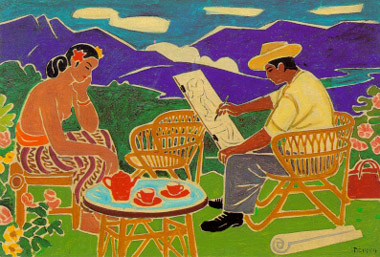
AN ARTIST who engaged deeply with his world and a man passionately interested in his milieu.
The 93-year-old died of natural causes at Mount Elizabeth Hospital at 2.59am on 31 May 2004.
His daughter Tow Sen, 55, was by his side, and wept quietly as she recounted: 'I talked to him. I told him several times 'I love you' and he nodded his head. I was so happy that he was hearing something nice before he passed away.'
Liu's death marks the end of an era for Singapore art.
Artist Ong Kim Seng, 58, said: 'I call him the last of the Mohicans because he's the last one of the Nanyang School.'
Along with Chen Wen Hsi (1908 - 1991), Cheong Soo Pieng (1917 - 1983), Chen Chong Swee (1910-1985) and Georgette Chen (1907 - 1993), Liu defined the so-called Nanyang School of art.
They were the pioneering batch of Singapore artists who sought to combine the influences of Western art with a South-east Asian sensibility.
Liu was a founding father of Singapore art in more ways than one. Surgeon-artist Earl Lu, 75, said: 'He was one of the great teachers. He trained a lot of artists.'
After World War II, Liu taught art at several schools, including Dunman Government Chinese Middle School, Chinese High School and Nanyang Girls' School.
He was also active in promoting the arts. He was a founder member of the Singapore Art Society in 1949 and served as its president from 1970 to 1980. He was also the president of the Association of Chinese Artists Of Singapore for 12 years.
He once said in an interview: 'The most precious times of my youth I had to teach, to live, and I did a lot of voluntary work for art.'
Born in 1911 to Hokkien peasants, he migrated to Johor when he was six years old. He grew up in Malaysia and studied in Shanghai. Singapore was a wartime refuge that became a permanent home.
While he was educated in China and influenced by the West, he was keenly aware of the multiracial and multicultural aspects of Singapore society.
Potter Iskandar Jalil, 64, a family friend who taught Liu's daughter Tow Sen pottery in the 1970s, said: 'Even though he was Chinese educated, he looked at me as one of the rising Malay artists. I appreciated that respect and recognition.'
Besides travelling extensively in South-east Asia, especially to his beloved Bali, Liu also visited India in 1971.
He told The Straits Times in 1981: 'India is the source for the cultural roots for much of South-east Asia. China is important to the artist for pictorial techniques and traditions, but the cultural values of South-east Asia are derived from India.'
While he was interested in the past, he kept a keen eye on new developments in Singapore's art scene too.
Ong remembered that Liu would often attend his discussion sessions about his Himalayan trips: 'He really supported the younger painters. Even though he had a knee injury and was in pain, he still came to my slide shows.'
He was also a familiar presence at exhibition openings and galleries, often accompanied by his retired teacher wife Chen Jen Ping, 91. The two would hold hands like the childhood sweethearts they were and whisper comments to each other.
Mr T. K. Sabapathy, 65, an art historian who is co-editing a new translation of Liu's critical writings, noted that dual roles as practitioner and commentator are not unusual in the artistic community.
'But his writing was sustained as intensely as his paintings,' he added. 'He had kept quite a close critical, watchful eye on art and artists in Singapore. He wrote reviews and general commentaries as well as developed a critical discourse on matters larger than art.'
Liu's interest in critical writing was encouraged in Paris and Shanghai by Fu Lei. The famous academic translated the first Chinese editions of French literature and was the father of renowned pianist Fou T'song.
Liu's son, Thai Ker, 66, chairman of the National Arts Council, said that he learnt about intellectual analysis from his father, who used to stand in front of his easel, lost in thought.
'He actually was very strong in his intellectual development about art,' he added. 'He wasn't just picking up his brush and painting, and not being able to explain why.'
As befitting someone who thought long and deeply about art, Liu had very firm opinions about art and art-making.
While everyone described him as mild-mannered and courteous to a fault, Dr Lu said laughingly: 'But he could be annoyed if you interfered with his desire to paint.'
He recalled a painting trip to India just five years ago. Engrossed in his painting, Liu had not heard the call to board the bus. Dr Lu chuckled at the memory: 'He either didn't hear it or didn't know, so the bus left. He was very angry.'
But the enduring memory is one of an even-tempered man.
Mr Sabapathy recalled: 'He always had that smile on his face, either a full smile or one that was about to emerge. He was very amiable.'
Mr Kwok Kian Chow, 48, director of the Singapore Art Museum who is helping to organise a commemoration service at Liu's home on Saturday, offered another insight into the romantic heart of the man.
'Liu Kang spoke excellent Fuzhou (Foochow, Northern Fujian) but he was Hokkien (Southern Fujian). I found out that this was the dialect of his sweetheart whom he wanted to impress.'
As someone who had lived through the upheaval of the Japanese Occupation, Liu possessed the hard-won content of a survivor.
An interviewer once marvelled at his calm smile when retelling a tale of losing 200 canvases in Muar during the war.
Material wealth evidently mattered little to him, as evinced in his generous donation last year to the Singapore Art Museum of his lifetime's collection of works. The collection, numbering over 1,000 pieces, was estimated to be worth about $18 million.
The teetotaller took his pleasures in the music of Beethoven and local food, professing a weakness for delicacies like kaya toast with kopi and soft-boiled eggs, kong bak pau (bun with fatty pork) from Beng Hiang Hokkien restaurant in Amoy Street, char kway teow and fizzy drinks.
As recently as last year, he kept up an active schedule of attending exhibitions and going out for meals because, as he told The Straits Times: 'I have to, because at my age, you don't know when you're going to go'.
He lived up to his philosophy as expounded in a 1982 documentary on his life: 'To be an artist of merit, you have to experience life in all its aspects, its highest and its lowest.
'I want to participate in all of life's aspects, whether they are deemed good or bad by society. I like to try everything at least once.'
The wake is at Liu Kang's home at 20 Jalan Sedap. A Commemoration By Singapore's Art World will be held there on Saturday at 10am before the funeral. It is organised by the Singapore Art Museum, Nanyang Academy of Fine Arts, Federation of Art Societies, and Singapore Arts Federation.
The cremation is at Mount Vernon Hall 2 on Saturday at 1.30pm.
--------------------------------------------------------------------
LIFE AND TIMES
Born in Fujian on April 1, 1911 of Hokkien peasant stock.
Migrated to Muar, Johor, where his father bought a rubber plantation, in 1916.
After secondary school, he enrolled in the Shanghai Academy of Fine Art in 1926. Met Chen Jen Ping, sister of his classmate Chen Ren Hao, in 1927. Went to Paris in 1929 to study art.
Returned to Shanghai in 1933 to teach at the Academy.
Married Chen in Shanghai in 1937. They left for a holiday in Malaya which became an extended stay when the Japanese bombed Shanghai. The couple have four sons - Liu Thai Ker, 66, Liu Hong, 64, Liu Liang, 62, Liu Kah Teck, 60 - and a daughter, Liu Tow Sen, 55.
Founder member of the Singapore Art Society in 1949.
In 1952, visited Bali with fellow artists Chen Wen Hsi, Cheong Soo Pieng and Chen Chong Swee. The following year, they collaborated on the landmark exhibition Four Artists To Bali.
Awarded the Public Service Star in 1970 and the Meritorious Service Medal in 1996.
In 2003, donated a lifetime's collection of works, estimated to be worth $18 million to the Singapore Art Museum.
--------------------------------------------------------------------
Liu Kang Biography Page: (http://www.knowledgenet.com.sg/singapore/SG/BI/BILIK001.asp?next=0)
Singapore Art Museum's Collection (Works by Liu Kang): (http://www.nhb.gov.sg/cgi-bin/sam/asearch.pl?a044)
--------------------------------------------------------------------