BACK TO HOME
Alright, so where are these dead zones?
There
are over 400 eutrophication-associated dead zones in the world. Here, youíll
find information about four of the most prominent.
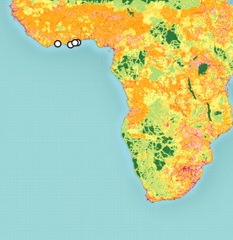
West Africa:
The
West African Dead Zone exists in the Gulf of Guinea. There are
actually four hypoxic systems, spanning from the Ivory Coast across Ghana and
Togo to Benin. In a study done on this upwelling region, findings reveal that
there has been a gradual but consistent reduction in the amount of zooplankton
in the waters. This is due to a gradual warming of upwelled surface waters.
This warming is believed to have caused a decrease in the prevalence of large
copepod Calanoides Carinatus, a
temperature sensitive species. This decrease has a negative effect on the
growth of zooplankton in the upwelling regions. This, in turn, can potentially
have a similarly negative effect on the population of fish in the region, and
by connection, the fisheries and local economies.
Global
warming is largely considered the cause of this phenomenon. [more on this in
the global warming section]
Oregon:
There
are several hypoxic systems off the west coast of the United States. One of
particular interest is the Oregon coastal dead zone. Unlike the West African
dead zone that was due largely to temperature change in upwelled waters, the
dead zone off the coast of Oregon is due to low oxygen content in the water. It
is, however, thought that global warming is the cause of this dead zone as
well. The process starts with the land heating up (due to global warming),
which results in stronger and more persistent winds. Because the winds are so
persistent, upwelling doesnít cease; it continues almost perpetually. This
produces a constant flow of nutrient rich water from below, which creates a
surplus of phytoplankton. Not able to be consumed, the extra phytoplankton dies
and decomposes on the seafloor, a process that consumes oxygen. The water is
then left with critically low oxygen levels – too low to sustain the life
it once could such as Dungeness crabs and fish.
This
process significantly impacts the economic conditions much of Oregon and
Washington, as the local economies are largely supported by fishing. [for more,
see corresponding economic impact page] This process worries scientists because
of its prevalence in dead zones all around the world.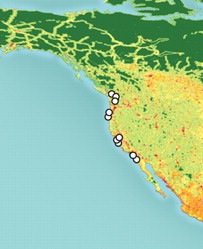
Black Sea:
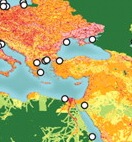
The Black Sea
dead zone is an example of a different kind of dead zone. In the 1980ís it was
the largest dead zone in the world, however it has existed as a hypoxic dead
zone for thousands of years due to naturally occurring conditions. Almost 90%
of the water in the Black Sea is completely devoid of oxygen and contains more
poisonous hydrogen sulfide than anywhere else on earth, however the surface of
the sea is rich in oxygen. This is due to the geography of the sea. Because the
sea is landlocked (except for a practically non-existent path of water out to
the Aegean sea), there is no circulation of water, or upwelling, to evenly
distribute the oxygen.
Although
the Black Sea is a natural dead zone, it was still affected by eutrophication
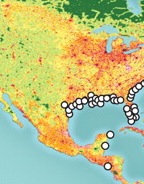
Gulf of Mexico:
The hypoxic
dead zone in the Gulf of Mexico provides another interesting and varied example.
If it werenít for the large amount of hurricane activity in the region, which
causes some degree of water circulation, this dead zone would be the biggest in
the world. It is primarily caused by eutrophication