BACK TO HOME
Technology
The technology used to study ocean dead zones has evolved over time to fit with the characteristics of the ocean to collect more effective data. All the technologies have the same basic goal: to collect data on the temperature and sediment samples throughout different depths of the ocean to gain knowledge about how the ìbiological pumpî works in the ocean. This refers to the movement of plant and animal debris through the oceanís euphotic and benthic zones. This can give scientists a better understanding of how sinking debris move through the ocean and thus how hypoxic zones form (Buesseler, Valdes, and Price 1997) (Buesseler 2001).
Examples of
different technologies:
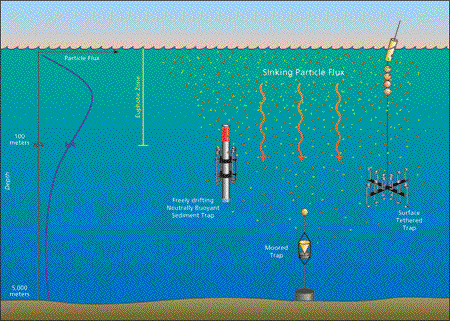
Image from (Buesseler, Valdes, and Price 1997)
Surface tethered trap and Moored trap
These two technologies are more conventional methods to measure the amount of particles that fall to the bottom of the ocean. The surface tethered trap is suspended on the oceanís surface by a buoy and it monitoring these particles that rain down through tubes attached to the buoy. A moored trap collects sediments in a similar manner but it is situated on the ocean floor.
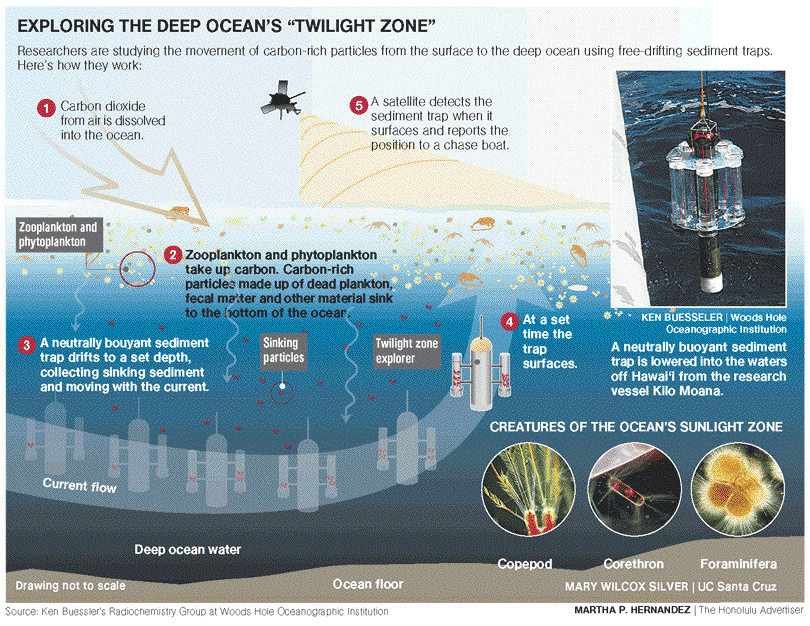
Twilight Zone Explorer- Freely drifting trap
The former two
methods are effective yet there is some amount of error because they collect
the sediment that falls vertically through the water rather than accounting for
the horizontal currents within the ocean. ìSediment falls through the water at
a rate of about 10 to 200 meters per day, while it is carried horizontally by
currents at a rate of from 5 to 50 kilometers per day.î Thus, scientists at the
Woods Hole Oceanographic Institute developed a technology that is free drifting
so it moves with the current, collecting more accurate data of the movement of
particles. (Buesseler, Valdes, and Price 1997)
Details of Twilight
Zone Explorer, Image from (Buesseler 2001)
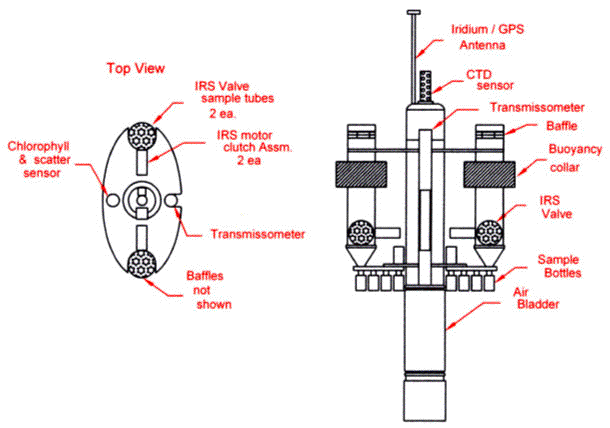
Image of Twilight
Zone Explorer from (Buesseler 2001)
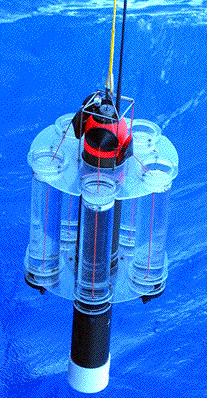
Image of Twilight
Zone Explorer from (Buesseler 2001)
Current Research
The current research
on ocean dead zones is extensive, covering three main topics: the effects of
hypoxia and eutrophication, studies of specific ocean dead zones, and studies
of specific marine life. Presently, the study of the effects of climate change
on ocean dead zones is in its beginning stages. There are still many
uncertainties regarding relationship between local effects on ocean dead zones
and marine ecology such as overfishing and pollution contrasted with the
effects of global climate change like changes in ocean chemistry. The ocean is
a slow moving entity making it difficult to know the specifics of long-term
effects of warming. Also with the vastness of the ocean and its life comes
complex and many unique ecosystem interactions that can be difficult to study.
However, regardless of the nature of the research, all data analysis shows
rapid growth in ecosystem degradation (Jackson et al. 2008).