BACK TO HOME
Upwelling,
Eutrophication, and Hypoxia
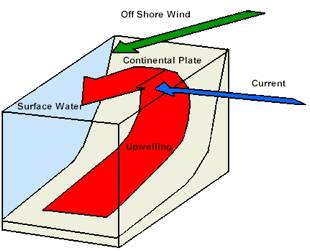
Upwelling is a natural oceanic occurrence in which wind stresses drive dense, cool and nutrient-rich water from the deep ocean towards the surface in order to replace the surface water, which is characteristically lighter, warmer and nutrient-deplete. Upwelling can be differentiated into five categories: coastal upwelling, large-scale wind driven upwelling in the ocean interior, upwelling associated with eddies, topographically-associated upwelling and broad diffusive upwelling, also in the ocean interior. Coastal upwelling, is not only the most well known type of upwelling, but is also the one most closely associated with present day development of coastal, oceanic dead zones. Coastal upwelling is most relevant to the human world because the coasts are the home to some of the most productive fisheries due to the cool upwelled water. The deep waters contain high concentrations of phosphates and nitrates from decomposed plankton. The decomposed, organic material rains towards the bottom. When there is an inundation of chemical nutrients at the depths of the ocean, a process called eutrophication occurs. Typically, the process of coastal upwelling brings the nutrients from bottom of the ocean to the surface, and therefore is the site for primary production. Phytoplankton with the addition of dissolved CO2 and sunlight combine to create organic compounds primarily through photosynthesis (Richards, 2008).
(http://www.galapagosonline.com/Galapagos_Natural_History/Oceanography/Upwelling.jpg)
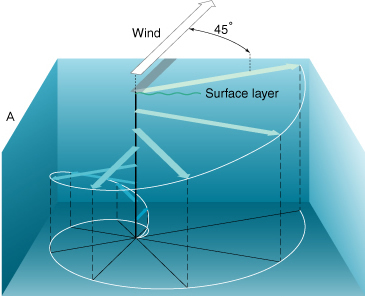
The key to coastal upwelling is the existence of Ekman Transport and the Coriolis effect. The coastal winds drive the surface waters offshore, which draws cold water from the deep ocean the surface to replace the surface waters. The wind driven currents are turned clockwise in the Northern Hemisphere and counterclockwise in the Southern Hemisphere because earth is a sphere and has a tiled rotational axis. As the diagram depicts, the surface waters of the ocean are deflected at a 45 degree angle. Although the lower layers are deflected at a greater angle, they loose energy. The total engery flow will be perpendicular to the wind direction. In terms of upwelling, the Ekman transport moves the fast, surface waters away from the coast, so the nutrient-rich deep water can be brought to the surface.
(http://oceanmotion.org/images/ocean-in-motion_clip_image001.jpg)
Although upwelling is a necessary oceanic phenomenon, when intensified it can lead to an alarming condition called hypoxia. In the past, intensification of ocean upwelling has been attributed to improper disposal of domestic and industrial waste, run-off from nitrogen-based fertilizers that have not been adequately absorbed by the crops, and groundwaters. In addition, rainwater is a major contributing factor because it has an incredibly high nitrogen content due to unclean use of fossil fuels, particularly from combustion engines and smokestacks (Hasler, 2008). Whatever we release into the atmosphere eventually is cycled into the ocean. Surprisingly, new dead zones are appearing, particularly on the Oregon Coast, without any excessive nutrient input from agriculture, which has led to recent speculation that global warming and its consequences, such as changes in ocean circulation, venilation efficeny, and the oceanís diminished ability to absorb oxygen due to a steady warming of its surface waters, may be directly related to the creation of new, coastal hypoxic areas (Juncosa, 2008). In addition to this phenomenon, global warming also seems to be responsible for the ìsuper-chargingî of coastal upwelling systems, leading to hypoxia. Other research has suggested that increased temperatures due to global warming enhance an oceanic organismís demand for oxygen. (Durate and Vaquer-Sunyer, 2008)). In addition, increased temperatures due to global warming enhance an oceanic organismís demand for oxygen. (Durate and Vaquer-Sunyer, 2008).
Hypoxia and Dead Zones:
Eutrophication is defined as a process caused by excess fertilization by chemical nutrients from a transfer between bodies of waters, for example rivers feeding into open coasts, or the movement between stratified oceanic layers (Hasler, 2008). In the case of marine dead zones, when an upwelling system is intensified either through excessive amounts of anthropogenically introduced chemical nutrients to the ocean or changes in the oceanís natural processes due to global warming, the cool, nutrient-rich waters that have been brought to the surface contain extremely high levels of phosphorus, nitrogen and other organic growth substances. The nitrogen-based fertilizer increases the present natural levels of nitrogen in the ocean, and conditions of intensified upwelling bring excessive amounts of nutrient-rich water to the surface. Regardless of the way in which the chemical nutrients are delivered to the surface, each stimulate large-scale growth of phytoplankton and algae in the surface waters. When there is an excessive amount of nutrients, the phytoplankton and the algae produced from the excess nutrients would not all be eaten by the surrounding marine animals that rely on phytoplankton and algae as a food source. The uneaten phytoplankton eventually die, and sink to the depths of the ocean where they decay with the help of other bacteria. The bacteria use oxygen to decompose the phytoplankton. When too much of the surrounding oxygen in the deep waters is used for this bacterial decomposition of the phytoplankton, the result is a condition known as hypoxia. These specific hypoxic areas are more commonly referred to as dead zones because the lack of oxygen, eventually the hypoxic areas become lifeless. The entire ocean is not hypoxic because of the ability for the oceanic layers to mix. The upper, more oxygen-rich layer will mix together with the lower, oxygen-deplete regions of the ocean in order to replenish the ocean depths. In the summer, seasonal dead zones most frequently occur during a stable temperature gradient that favors ocean stratification: a cool, deep ocean, and the warmer, surface waters. In the case of non-seasonal dead zones, vertical mixing between the upper and the lower layers of ocean does not occur potentially due to global warming, as it affects the stratification patterns and thus the efficiency of ocean ventilation. The depletion of oxygen in the deep ocean results in unsuitable habitats for marine life. If certain species that are mobile are forced to leave their normal habitats, hypoxia leads to a decline in biological diversity (Solow, 2004). It also contributes to disruption of migratory patterns and decreased ability to grow and reproduce (Durate and Vaquer-Sunyer, 2008).
Characteristics of Hypoxia:
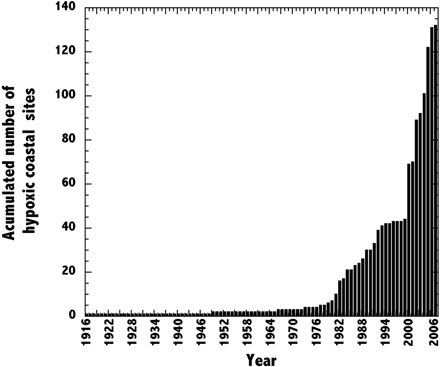
Conventionally, waters are thought to be hypoxic if they contain less than 2 mg O2/liter of water, but a recent study shows hypoxia thresholds for organisms that inhabit the deepest oceanic layer vary greatly. Therefore, the current and future projections for the number and size of oceanic dead zones have been underestimated based on an incorrect assumption for what constitutes the lethal O2 levels. This is evidenced by the fact that coastal hypoxic sites have exhibited an exponential growth rate of 5.54% year-1 over time as hypoxic conditions continue to worsen, most likely due to global warming stresses (Durate and Vaquer-Sunyer, 2008).
(http://www.pnas.org/content/105/40/15452.full)