BACK TO HOME
Environmental Consequences
The decrease of dissolved oxygen levels in coastal marine
ecosystems around the world is cited as one of the most severe changes in
ecological variables in the past decades. These hypoxic environments are increasing
due to continued eutrophication, which spurs large growths of primary producers
and in turn decimates dissolved oxygen levels as the organic matter decays, as
well as global temperature warming, which decreases oxygen solubility, and
affects ocean stratification. The conditions that these dead zones pose put
marine ecosystems at great environmental risks like loss of biodiversity,
massive death of aquatic life, and alterations of food webs. (Diaz et al. 2001) (Vaquer-Sunyer and Duarte et. al. 2008)
(Vaquer-Sunyer and Duarte et. al. 2008)
Hypoxic Ecosystems
In normal aquatic ecosystems, oxygen dissolves into the
water directly from the atmosphere or from the respiration of phytoplankton.
This dissolved oxygen supplies life to the animals on the surface waters as
well as bottom waters as the oxygen mixes downward. However, in an ocean dead
zone, this supply of dissolved oxygen to the bottom water (benthic zone) is
decreased or decimated as the decomposition takes up oxygen..
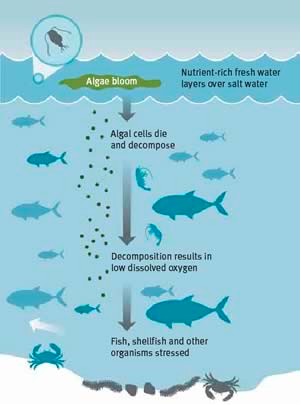
(Addison, 2004)
Oxygen levels in this environment reach critical levels,
which affect fish and bottom feeders like shrimp, crabs, and oysters.
Consequences
The algae blooms and the hypoxic environment have serious
consequences on the marine ecosystem, including death of marine life, harm to
reproduction and growth of marine life, forced changing of migration patterns,
and toxicity of water.
Hypoxia kills off significant amounts of animals,
specifically those that dwell on the benthic zone most affected by hypoxia,
such as: clams, oysters, shrimp, crabs and lobsters. This leads to a serious
loss of biodiversity in the marine ecosystem. However, it is difficult to tell
exactly what level of dissolved oxygen leads to death since each animal reacts
differently to the changing levels of dissolved oxygen. Extensive research has
been completed regarding the study of specific animals and the survival
threshold of each as well as the levels of dissolved oxygen that harms the
development of each animal (Vaquer-Sunyer and Duarte et. al. 2008). It is hard
to estimate an exact minimum amount of dissolved oxygen that leads to mass
extinction, but studies show that effects on marine life begin to occur as
oxygen levels go below 2 mg O2 per Liter (Diaz et al. 2001).
However, a recent study, Thresholds of hypoxia for marine biodiversity, addresses the variability of oxygen thresholds of
different marine animals.
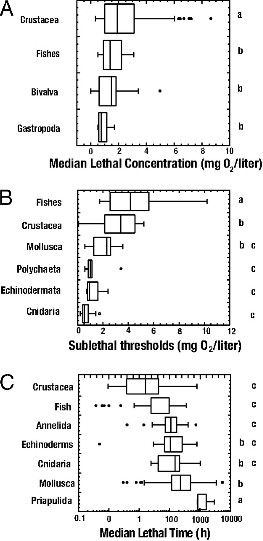
Figure: ìBox plot showing the distributions of oxygen thresholds
among taxa for median lethal concentration (A), median sublethal concentration
(B), and median lethal time (C)î (Vaquer-Sunyer and Duarte et. al. 2008)
This study illustrates that crustaceans are extremely
sensitive to the reduction of dissolved oxygen compared to other marine life.
They have the highest median lethal concentration and the shortest median
lethal time. Mollusks show the most resistance to hypoxic conditions since
their median lethal concentration is quite low. Another interesting observation
is that fish are the most susceptible to sublethal concentrations, meaning that
fish are significantly affected by ìreduced growth and reproduction.î The study
concludes that the dangers of hypoxia affect marine life differently due to the
disparities in adaptation and mobility as well as ìbehavioral and metabolic
changes.î (Vaquer-Sunyer and Duarte et. al. 2008)
Other than affecting reproduction and growth in marine life,
hypoxia causes many other stresses. In general, these areas are unsuitable habitats,
leading to forced migration away from dead zones. This can lead to great
strains on the animals that are not adapted to migrate long distances or are
forced to live in new environments closer to the surface of the ocean.
All of the mortality and the devastation of life of
crustaceans, fish, shrimp and crabs have larger environmental consequences
within the fish population and in turn the fishing industry. Ocean dead zones
in conjunction with habitat destruction and overfishing have lead to devastation
fish population.
Table: ìPercent decline (biomass, catch, percent cover) for
fauna and flora from various marine environmentsî (Jackson et al. 2008)
Taxon Starting
date Location
%
loss
Estuaries and coastal seas
Large whales Pristine
Global
85%
Small whales Pristine Global
59%
Pinnipeds and otters Pristine
Global
55%
Sirenia Pristine
Global
90%
Raptors Pristine
Global
79%
Seabirds Pristine Global
57%
Shorebirds Pristine
Global 61%
Waterfowl/waders Pristine
Global
58%
Sea turtles Pristine
Global
87%
Diadromous fish Pristine
Global 81%
Groundfish Pristine
Global
62%
Large pelagics Pristine
Global
74%
Small pelagics Pristine
Global
45%
Oysters Pristine
Global
91%
Mussels Pristine
Global
47%
Crustaceans Pristine
Global
39%
Other invertebrates Pristine
Global
49%
Seagrass Pristine
Global
65%
Wetlands Pristine
Global
67%
Large carnivores Pristine
Global
77%
Small carnivores Pristine
Global
60%
Large herbivores Pristine Global
63%
Small herbivores Pristine
Global
54%
Suspension feeders Pristine
Global
68%
Shelf and pelagic fisheries
Large predatory fishes 1900 N.
Atlantic 89%
Atlantic cod 1852 Scotian
shelf 96%
Fish 4–16 kg Pristine
North
Sea 97%
Fish 16–66 kg Pristine
North
Sea 99%
Large predatory fish 1950s
Global
90%
Large pelagic predators 1950s
Tropical
Pacific 90%
Fishery biomass 1959
Bohai
Sea 95%
Excess algae blooms lead not only to hypoxic environments
but also to toxic algae. Certain algae blooms release toxic compounds, such as
neurotoxins and hepatotoxins into the marine ecosystem. Often, these toxins
biomagnify, meaning that they increase in concentration, as they move along in
the food chain. This can threaten larger marine life such as fish and shellfish
as well as humans that consume these animals. (Water quality. updated 2008)
In conclusion, marine ecology is very delicate, and hypoxic dead zones ñ its algae blooms and dissolved oxygen content ñ are a threat to these fragile ecosystems as well as humans that rely on the coast for food and life.