
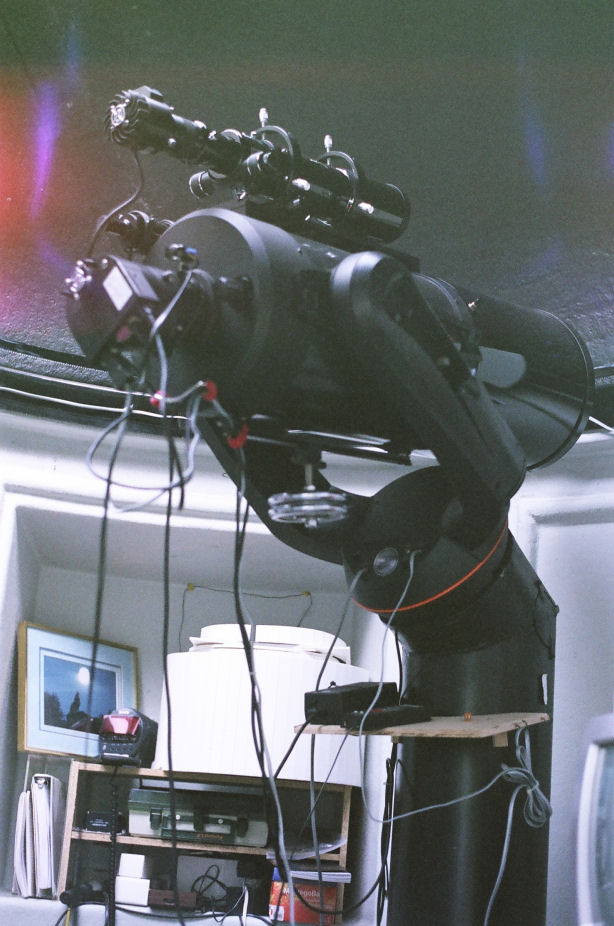
Everything works nicely, although I did have to add extra counterweight below the "scope" (note the silver bar-bell weights)
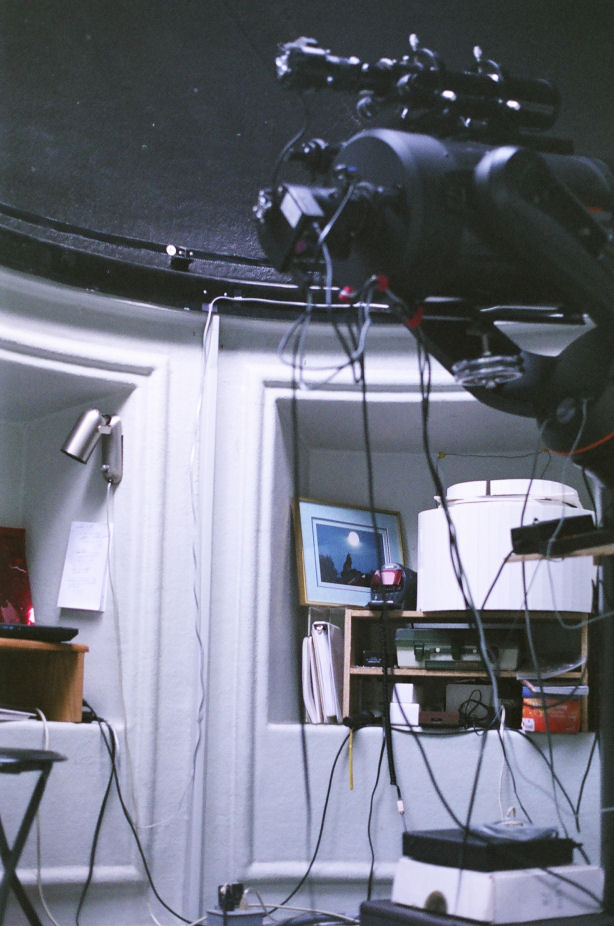
The big white "drum" is the lightbox that is used for flat-field calibration.
This set-up is "almost autonomous" because my little laptop has only a single serial port (connected to the dome controller), and a single USB port (connected to the CCD imager). That leaves no way of communicating with the telescope. Also, for reasons that are beyond my novice computer knowledge, VB scripts don't run on this computer (old IBM Thinkpad, Win 95).
So, I use TheSky's "telescope simulator" to fool TheSky, its Dome Controller module, and Automadome into thinking that there's a telescope involved. That enables Automadome to control the dome position. I manually position the 'scope on the object of interest, initiate guiding, and tell CCDSoft to run the imaging sequence. A short script in Orchestrate ("go to target, wait 5 minutes, loop continuously") keeps the dome following the target as the Earth rotates, and I snooze. Pretty neat! (and this way I can keep my day job).