The Fluid Nitrogen System
This variant of cooling is rarly used. Only extreme OCs are using that for their experiments.
Well, the price of such a system will be about 1200 DM or 10 000 ATS !!!
The Water Cooling System
Regarding to cars, also a computer is producing heat. This heat is comparable to a heat, that an engine in a cars produces. Long time ago cars were cooled only by air. But nowadays the cooling system is one with water.
That�s why some people came to the idea to try to build such a water cooling system for the PC.
This system provides the best possible cooling. Of course some danger is connected to that method. Imagine what will happen, if some fluid leaks.
The whole system could be destroyed.
We can devide......
open systems
and
closed systems
Open systems are, as the name says open. That means that there�s contact to the medium, there�s an open extension tank. No pressure is used at all. The extension tank has to be maintained. That means that you have to take care of it, you have to refill it, when some water is evaporated. This is a very important step, because, if the water level is to low, the pump can�t transport water in the system. That will cause the loss of cooling.
As a matter of fact, the CPU will get overheated and may get damaged.
An open system concludes:
An cooling element, an extension tank and a pump
Closed don�t have any extension tank. Here�s no direct contact to the cooling medium. The water is cooled by a so called Water cooler, as you know from an automobile. You can imagine that this cooler will be cooled by fans sitting on the cooling fins. Normally a higher pressure is used.
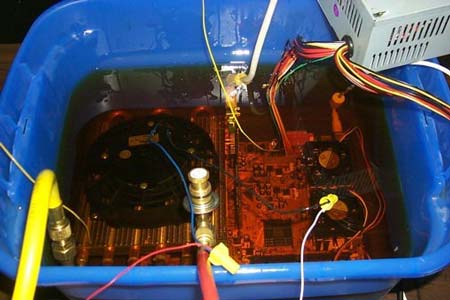
Oil Cooling:
I think that there�s nothing to say about *smile* take a look at the picture above......it says more than 1000 words......