| Front | ||
Offaly Anti-War Movement |
||
|
|
||
| Saddam Assassination Attempt - 8th April | ||
|
Saddam's fate unclear after strike
The fate of Iraqi President Saddam Hussein is uncertain after a US bomber destroyed a residential building where he and his sons may have been meeting. Monday's raid, in which at least nine civilians are believed to have died, was apparently launched after a tip-off from an intelligence source. Senior regime figures were understood to be meeting in a building in the Mansour district of Baghdad - a bunker behind or underneath the al-Saa restaurant, according to the Washington Times. US military chiefs seized the opportunity for another "time sensitive" strike at the head of the Iraqi regime. A US commander, Brigadier General Vince Brooks, said detailed forensic work may be needed to establish whether the Iraqi leader and his sons, Uday and Qusay, were among those killed.
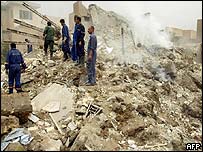
Two of the bombs were 2,000lb (900 kilogram) earth-penetrating "bunker-busters" and the other two were delayed-fuse bombs of the same size. There has been no confirmation that Saddam Hussein was injured, killed or indeed inside the building at the time. According to the crew, the controller who passed on the target details had told them "this is the big one". 'They went for broke' Eyewitnesses said two houses were flattened and nine Iraqis were killed. The bombing left an 18 metre-deep crater, broke windows and doors up to 300 metres away. Orange trees were ripped out by their roots and a heap of concrete, mangled iron rods and shredded furniture and clothes was visible at the scene, reports said. A Pentagon spokesman said it was "extraordinary" that the delay between receiving the intelligence and hitting the target was just 45 minutes. He described the raid as "very, very effective" - although the Pentagon was still tryingg to establish "what individual or individuals were on site". It is thought that for safety the Iraqi leader often hides out in residential areas. The last television pictures of Saddam Hussein in public - shown by Iraqi TV on Friday - were shot very near the spot that Monday's attack took place. Intelligence experts say the attack was clearly the result of a huge intelligence effort which could include:
The biggest breakthrough would be if senior people close to Saddam were now spying for the coalition, BBC correspondent James Westhead says. Colonel John Hughes-Wilson, a former British military intelligence officer, told the BBC: "I think they went for broke on this - this was a serious piece of intelligence planning. First strike Even if Saddam Hussein has lived on to fight another day, the Americans will be hoping that this strike adds to the pressure they are exerting on his leadership, says the BBC's Peter Hunt in Qatar. But if ordinary civilians have perished, the US-led forces may well have once again to justify their targeting procedure, our correspondent says. On March 19, the opening night of the war, US President George Bush authorised a strike on a suburban Baghdad compound where Saddam and his sons were thought to be staying. But US intelligence officials suspect he survived. BBC World Reporting |
||