| Front | ||
Offaly Anti-War Movement |
||
|
|
||
| Ethnic tensions begin to simmer - 16th April | ||
|
US denies troops fired on crowd
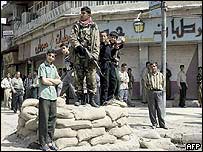
Witnesses said US troops fired into a crowd growing increasingly hostile to a speech being given by the town's newly appointed governor. A US spokesman said troops were returning fire from a nearby building and did not aim into the crowd. The incident underlines the difficulties US forces face in trying to keep the peace in a country now confronting an uncertain future. Some reports suggest up to 15 people were killed in Mosul, with between 60 and 100 people injured. A BBC correspondent in the city says it is now extremely tense. The trouble began as an angry crowd gathered outside the governor's building, demanding that Kurdish peshmerga fighters and Americans leave the city, witnesses told the BBC. The city's population is dominated by Sunni Arabs fiercely opposed to Kurdish control. Mosul's new governor, Mashaan al-Juburi - an Arab associated with the peshmerga - appears to have tried to pacify the crowd. "He said everything would be restored, water, electricity, and that the Americans [were democratic]," Marwan Mohammed, who said he was a witness, told news agency AFP. "The Americans [troops] were turning around the crowd. The people moved toward the government building, the children threw stones, the Americans started firing. Then they prevented the people from recovering the bodies," he said. But this account was contradicted by another witness who spoke to the BBC, who said the first shooting sounded like it came from a light weapon - "a Kalashnikov, not like the weapons Americans have". A US military spokesman said soldiers had been responding to fire from at least two gunmen in another building. "We're investigating," said Navy Commander Charles Owens. "All we can say now is that we did not shoot into a crowd." Kirkuk reprisals Details are also emerging of revenge attacks which apparently took place in the days following the withdrawal of Iraqi troops from Kirkuk, also in the north of the country. The human rights organisation, Human Rights Watch, which has just been on a four-day visit to the city, says Baath party officials were the targets of reprisal killings. At least 40 people died in such attacks, the organisation says. "They got caught out in clashes between [the withdrawing Iraqi government] and mainly armed civilians," said Hania Mufti, a member of the delegation visiting the city. "Some of them died in these clashes. Others were wounded, but then they were dragged out and shot dead." The organisation has also expressed concern over the plight of about 2,000 Arabs who say they were forced to leave their villages around Kirkuk. They were settled there in the 1970s as part of the Iraqi Government's campaign to "Arabise" an area which had previously belonged to Kurds. Massoud Barzani, leader of the Kurdistan Democratic Party, has condemned any attacks on Arabs by Kurds, and appealed for all Iraqi "brothers" to "safeguard the spirit of peaceful and fraternal coexistence". Pentagon challenge The Pentagon appears determined to stave off the resentments and rivalries now coming to the fore follopwing the fall of Saddam Husein's regime. Although it says major combat operations are over, the number of US-led forces on the ground is in fact growing, and now stands at 140,000, the Pentagon confirmed. It is also restructuring forces to cope better with the new challenges. But the Pentagon is still under pressure to do more to fill the security and law and order vacuum left by the collapse of Saddam Hussein's leadership. The Independent
|
||