| Front | ||
Offaly Anti-War Movement |
||
|
|
||
| Syria not under threat - 14th April | ||
|
Syria not 'next on list' says Straw
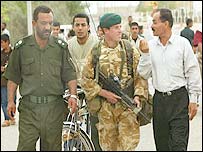
American rhetoric against Syria has become increasingly hostile, with President George Bush saying he believed it had chemical weapons. Mr Straw said there were important questions for Syria to answer, but that could be done through Syrian cooperation. UK Foreign Office Minister Mike O'Brien is visiting Damascus on Monday, while Mr Straw is in Kuwait for talks about rebuilding Iraq. As well as his claims about banned weapons, President Bush again warned Syria not to shelter fleeing Iraqi officials. Such allegations were branded groundless by a senior Syrian official on Monday. But UK Defence Secretary Geoff Hoon said he was worried fleeing Iraqi scientists might boost Syria's own banned weapons programmes. 'Questions to answer' Asked if Syria could be a new military target, Mr Straw told BBC Radio 4's Today programme: "I have made it clear and I repeat that Syria is not 'next on the list'." Mr Straw said: "Some fugitives may well have fled into Syria." And he was unsure "whether they have been developing any kind of illegal or illegitimate chemical or biological programmes". "There are questions that need to be answered." But he argued: "What is important is that Syria agrees to sit down with the US and UK and actively cooperates over these questions that have been raised about their current relations with Iraq."Mr O'Brien is meeting the Syrian foreign minister on Monday after visiting the Iranian capital Tehran on Sunday. Dr Bouthiina Shaba'an, head of media in the Syrian foreign ministry, accused Israel of spreading allegations which were "absolutely groundless". Syria had no chemical weapons and was not harbouring figures from the Iraqi regime, which had a "terrible history" with Syria, she said. Dr Shaba'an added: "Our stand against the war should not be confused with our long problem with the Iraqi regime." Weapons boost? Later, Mr Hoon said there were "no military plans for operations against Syria". The UK had last year set out its worries about Syria and other nations arms programmes, although this did not just cover chemical, biological or nuclear weapons. At a media briefing, the defence secretary said: "Our immediate concern is the risk that some of those involved in Iraq's weapons of mass destruction programmes might escape across the border into Syria, obviously boosting Syria's own efforts in those directions." He added: "We want to maintain a dialogue with Syria, but we do want to set out our continuing concerns."During his Kuwait visit, Mr Straw will meet the US interim administrator for Iraq, Jay Garner, before travelling to Qatar and Saudi Arabia on Tuesday. Reconstruction talks The Israeli-Palestinian conflict is expected to be among the issues discussed by Mr Straw and Mr O'Brien on their Gulf tours. Also on Monday Tony Blair will update MPs about Iraq in a Commons statement ahead of the two-week Easter recess. The prime minister is expected to focus on British and American efforts to maintain order and develop new political structures Local police, accompanied by British forces, have started patrolling in Basra and al-Faw in southern Iraq and moves are under way in Baghdad to recruit volunteers. Mr Straw told Today the UK had to "take responsibility for reconstruction and humanitarian assistance right across Iraq". He added: "Where you have had people living under a terror where there appears to be order on the streets but that order is imposed by the fascist, brutal methods of a police state, the moment you lift that terror there is likely to be an element of disorder "But I do not excuse it, and what we have to do is restore order. "Disorder is always disturbing and it is the responsibility of the UK troops to try and deal with it. "However, they have to ensure their own safety and security from armed gangs before they can start policing. "This is not a benign policing environment. "It is still a very difficult environment for UK troops to operate in." BBC World News
|
||