
History
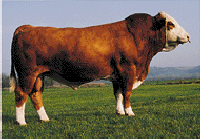
The Simmental breed originated in the Simmen Valley of Switzerland. It is an old breed dating back to the Middle Ages. The Simmental Herdbook was estabilished in Switzerland in 1806. It required a performance pedigree for milk and conformation (physical appearance). Meat and carcass traits have since been added to the performance pedigree. About one-half of the cattle in Switzerland are Simmentals. It is the most popular breed of cattle in Europe. In France it is called "Pie Rogue" and in Germany it is known as "Fleckvieh."
Simmentals were first brought into the United States from Canada in 1969. The American Simmental Association was formed in 1968. The herdbook is open to upgrading of beef and dairy stock. All animals must have a performance pedigree to be eligible for registration. The American Simmental Association has no color requirement for registration. Artificial insemination is encouraged. Heifers become purebreds in three topcrosses (7/8 Simmental blood). Bulls are registered as purebreds in four topcrosses (15/16 Simmental blood).
Traits and Characteristics
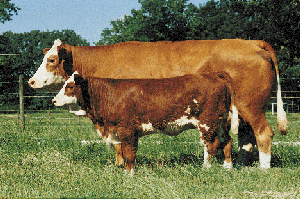
Simmental cattle have white to light straw faces with red to dark red, spotted bodies. They are a horned breed with medium-size horns. The Simmental is a large-bodied animal which is noted for being docile. Mature bulls weigh from 2,300 to 2,600 pounds. Mature cows weigh about 1,450 to 1,800 pounds. They will milk about 9,000 pounds of milk per lacation which will test abourt 4 percent butterfat.
Simmentals make extremely rapid growth, gaining about 3 pounds per day on roughage. They are thickly muscled and produce a carcass without excess fat. They are adaptable to a wide range of climates.
The Simmental was used to create another breed of cattle. This breed combines some of the traits of the Simmental and the Hereford. Here is a link to the
Animal Science Department: Oklahoma State University 1999