
History
The Texas Longhorn origanted from Spanish Andalusian cattle which were brought to Santa Domingo by Columbus on his second voyage in 1493. In the early 1500s, decendants of these cattle were taken to Mexico by Spanish explorers. As the Spanish continued their explorations, some of these cattle were taken with them into the region which became Texas. Many of the cattle escaped and adapted to the harsh environment of the southwest. It is estimated that by 1860 about four million descendants of these cattle were running wild in Texas. After the Civil War, cattlemen in Texas began rounding up the Longhorns and moving them along trails to railheads, mainly to Kansas and Missouri. By the 1880's, the Longhorn began to be replaced by European breeds of beef cattle. The Texas Longhorn was almost extinct by 1900. The United States Congress appropriated money in 1927 to estabilsh a federal herd of purebred longhorns. At that time, 20 cows, three bulls, and four calves were located and established as seed stock at the Wichita Mountains Wildlife Refuge, Cache, Oklahoma. The Texas Longhorn Breeders Association of America was established in 1964. There were about 1,500 Texas Longhorns in existence at that time. During the 1980s there has been a renewed interest in the Texas Longhorn as genetic seedstock for characteristics desirable in cattle adapted to the subtropical environment. They may also prove to be valuable in breeding programs aimed at producing cattle with leaner meat with lower cholesterol levels.
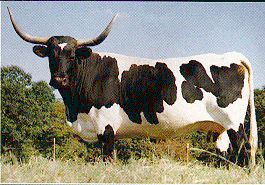
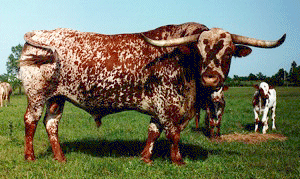
The Texas Longhorn has many shadings and combinations of colors. They have horns that curve upward and spread to four feet or more. Their legs are long and their shoulders are large and high. They have a large head with small ears and long hair between their horns. Their neck is short and stocky.
Texas Longhorns are slow maturing, have high fertility, are resistant to many diseases and parasites, and are well adapted to harsh environments. They have th ability to survive on sparse rangeland. They are noted for their easy calving ability, hardiness, and longevity.
Animal Science Department: Oklahoma State University 1999