
History
The Brahman breed was developed in the southwestern part of the United States. Between 1854 and 1926 about 266 bulls and 22 females of the Bos indicus type of cattle were imported from India. Bos indicus cattle haev a hump over the shoulders. These cattle are also called Zebu. Several strains of the Zebu cattle were bred to females from several British breeds of cattle. Early breeders selected for hardiness and ability to produce in the climate of the Southwest. Beef conformation and early maturity were also selected for in these earyl matings.
The major use of the Brahman in the United States is in crossing with other breeds. The resulting hybrids have proven to be desirable beef animals. The Brahman has been used in the development of a number of other newer breeds of beef cattle. The American Brahman Breeders Association was organized in 1924.
Traits and Characteristics
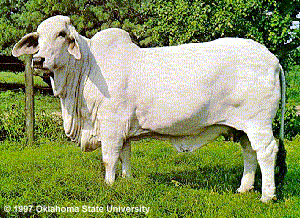
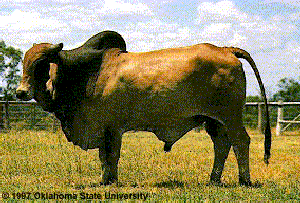
The color of the Brahman is light gray or red to almost black. The most common color is light to medium gray. Red is becoming a popular color with a number of breeders. In addition to the characteristic hump over the shoulders, Brahmans have loose skin (dewlap) under the throat and large drooping ears.
Mature Brahman bulls weigh about 1,600 to 2,200 pounds. mature cows weigh from 1,000 to 1,400 pounds. Brahman cattle have a very high heat tolerance. They are also resistant to disease and insects. They are good mothers and have an excellent ability to forage on poor range. They gain rapidly and produce a quality carcass. However, they do tend to have an unpredictable disposition.
The Brahman was used to create another breeds of cattle. This breed combines some of the traits of the Brahman and the Angus and the result is the Brangus. Another breed is the Braford which is a resulting cross of the Brahman and the Hereford. Please link to these two pages and study these breeds also.
Animal Science Department: Oklahoma State University 1999