Guitarzan: Guitar Anatomy
The Anatomy of a Guitar
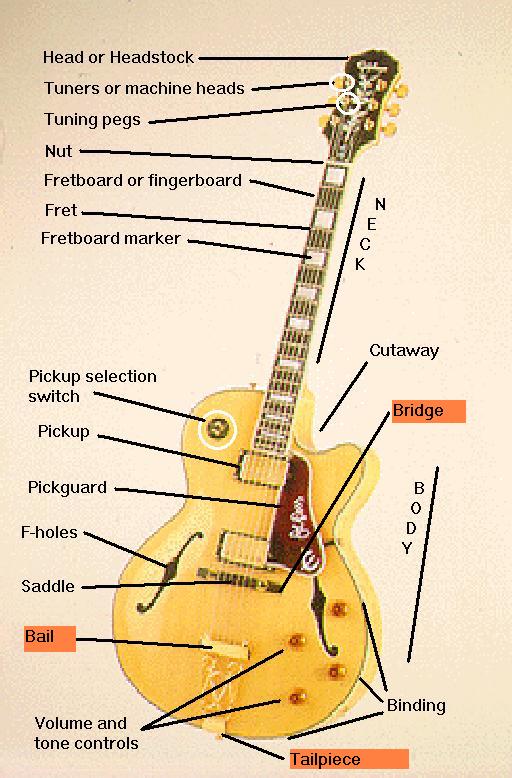
Explanation of terms:
- Headstock
The headstock holds the tuning hardware.
- Tuners
The tuners allow you tune each string to the correct pitch by adjusting the tension of the string along the neck.
- Tuning Pegs
The tuning pegs attach one end of the string to the tuners.
- Nut
The nut marks where the fretboard ends and the headstock begins.
- Fretboard
Also known as the fingerboard, the fretboard is where you play musical
notes by holding down strings at various places up and down the fretboard.
The fretboard can be made of ebony, rosewood, or plain maple.
- Fret
Frets divide the neck into segments within which you hold down strings.
Each fret produces a different pitch. Other stringed instruments like
the violin, cello, and acoustic bass have no frets.
- Fretboard Marker
Fretboard markers allow you to more easily visual where your fingers are on
the fretboard. On more expensive guitars, the fret markers can be quite
and made out of abalone shell. Cheaper guitars have dots made of plastic.
- Neck
The neck holds the frets, fingerboard, and fret markers, connecting
the body of the guitar to the headstock. Necks are usually made of
maple or mahogany, although other materials like aluminum and
plastic have been used.
- Pickup Selection Switch
For electric guitars with more than one pickup, the pickup selection
switch allows you to make one pickup more dominant than the other. This
is neccessary because the pickup closest to the neck will highlight
bass, while the pickup nearest the brige/saddle will highlight treble.
- Pickup
On electric and acoustic/electric guitars, pickups transfer the sounds
of the strings vibrating on the fingerboard to the amplifier. There are
many types of pickups, some sounding better for rock, others for jazz.
One of the most famous types of pickups are humbucking pickups.
Commonly called humbuckers, humbucking pickups help to cancel out the
annoying background hum of an amplified guitar.
- Pickguard
The pickguard protects the finish on your guitar from abrasion caused
by strumming the guitar. It serves the same purpose as a throw rug
in your foyer. On some guitars, the pickgaurd is raised off the body
of the guitar, while on other guitars, it is screwed right on to the body.
- f-holes
f-Holes are typically only found on jazz-type of guitars. They allow
an electric guitar to be semi or fully acoustic.
- Saddle
The saddle (sometimes attached directly to the bridge), is where the
length of the string can be adjusted to improve the guitar's intonation
or its ability to stay in tune all the way up the neck.
- Bridge
Like the tuning pegs, the bridge holds the other end of the strings
at the body of the guitar.
- Volume and tone controls
The volume and tone controls allow you to color the tone
of the guitar by boosting the bass and/or treble of the pickups.
- Cutaway
The cutaway allows easier access to higher frets for single string
solos.
- Binding
The binding enhances the appearnce of a guitar. More expensive guitars
have binding on the body, neck, headstock, and f-holes.
- Body
The sound of a guitar emanates from the body, more so in acoustic guitars
and less in solid body guitars. The body can be made of plywood (often
called laminate) or solid pieces of wood glued together. In acoustic types of
guitars, the body material may include combinations of maple, cedar,
spruce, mahagony, and other fine woods. Some manufacturers even use
plastic-like compounds. Solid body guitars may have maple, alder, or some
other wood for a body.