|
| Local history of Newtownmountkennedy
Mountkennedy House.
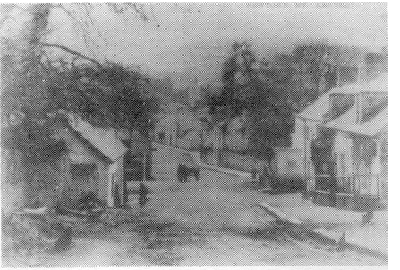
In 1769 the Newtownmountkennedy estate was bought by Lieutenant General Robert Cunningham from the Barker family. He later became known as Baron or Lord Rossmore. He immediately began investing money in the estate. Lord Rossmore also spent money on Newtownmountkennedy which was still the estate town, in fact it was his private town, as he was the legal owner of every stick and stone in it. Rossmore was considered a reasonable landlord and he provided new facilities for the village.
|
|
 |
Newtownmountkennedy in the Famine.
In 1841, the town covered an area of 50 acres. There were 113 houses spread along the single street, a few were slated and built of stone, but most of the dwellings were small thatched cabins of one or two rooms. Eight hundred and thirty persons lived in the town. The school was funded by various subscriptions, and the quality of education depended very much on how much money was available to pay a teacher. Famine struck Ireland in 1844. While Newtownmountkennedy was not spared the famine it is not recorded that anyone actually died from starvation in the town.
|
1798 Rebellion.
Newtownmountkennedy was the scene of an important battle in the early days of the great rebellion of 1978. During this period, it was feared that Ireland would be invaded by the army of France. Newtownmountkennedy was occupied by a regiment of Welsh soldiers called The Ancient Britons. They practised many cruel tortures on local people they suspected of been United Irishmen, and used the Market House in the main street as a prison and indeed as a place of execution. On May 31 1798, a local United Irishman named Michael O'Neill led an attack on the town to drive out the Ancient Britons. The battle lasted several hours and many were killed including the commander of the Ancient Britons. Poor O'Neill was later captured and later taken to the Market House where he was unmercifully beaten until he was almost dead, but in an act of last defiance he lashed out with his chains and killed three of his tormentors before he was finally shot in the middle of the street. He is buried in Kiladreenan Cemetary outside the main village. | 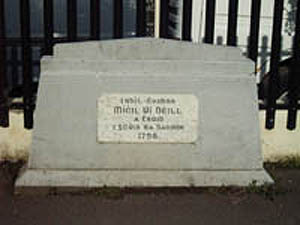 |
|
|




 Top of page