Standing on the shoulders of giants
Or having a really
good telescope
•
Early
microscope ca. 1673
•
Robert Hooke (1635-1703) in
•
wrote Micrographia in 1667
•
coined the
term “cell”
•
Anton van
Leeuwenhoek (1632-1723) in
•
improved
quality
Cell Theory
•
Schleiden & Schwann (1839) postulated theory
–
The cell
is the fundamental unit of structure and function in living things
–
All living
things are composed of cells
•
The third
basic tenet comes from Virchow claimed (1855)
powerful dictum, “Omnis cellula e cellula”
–
All cells
arise from pre-existing cells
Light microscopes (LM)
magnify up to 1500X but cannot resolve objects that are smaller than 200nm (about
0.2 microns).
See handout
Into the subcellular
•
1950s
brought electron microscopy (EM)
•
Resolution
improved hundredfold (up to 2 nm – the diameter of DNA double helix)
•
New
advances could bring resolution to 0.002nm – the diameter of an atom!
•
Researchers
viewed cell “ultrastructure” for the first time
•
Scanning
EM and Transmission EM most useful to biologists
Types of Cells
•
Two basic
types
–
Eukaryote
(“true” nucleus)
–
Prokaryote
(“before” nucleus)
•
Cell type
determines “domain of life”
•
Prokaryotes
are found in Archaea and Bacteria
•
Eukarya
include animals, plants, fungi, and protists
What’s common to all cells?
•
Plasma
membrane – maintains cell integrity, regulates traffic, serves as
protection
•
Cytosol – semi-fluid
substance that allows chemical reactions to occur
•
Nucleic
material – DNA and ribosomes
Cytosol
•
cytoplasm
includes everything in the cell except the nucleus
•
cytosol is the
soluble portion of the cytoplasm
•
Contains
about 80% water, nucleic acids, proteins, lipids, carbohydrates, pigments, etc…
•
Variable
viscosity
How to ID a prokaryote
•
Cell has
no nucleus (no membrane surrounding DNA)
•
DNA is
“naked” and circular
•
May have
cell wall, pili, flagella, mesosomes,
capsule, and photosynthetic membranes (in addition to basic cellular features)
•
Unicellular,
but may form colonies
•
Eukaryotic cells
•
Have a
well-defined nucleus
•
Complex
organelles contained in cytosol
•
May be
single- or multi-cellular
•
Exist in four
kingdoms
–
Animalia (see handouts for “typical” animal and plant
cells)
–
Planta
–
Protista
–
Fungi
•
Contains
most of the genetic material (linear chromosomes)
•
Average
diameter 5 μm
•
Separated
from cytoplasm by a double membrane (20-40 nm apart)
•
Nuclear pores
allow traffic flow
•
Fluid
interior termed “nucleoplasm”
•
Nuclear
lamina maintain the shape of the nucleus
•
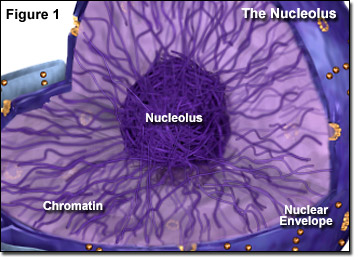
Is a region,
not a structure!
•
Site of
ribosome construction (rRNA and
proteins assembled into ribosomal subunits)
•
Subunits
flow out into cytoplasm and combine the
two (large and small) subunits to form functional ribosomes
•
Cells that
synthesize large quantities of protein have prominent nuclei and thousands of
ribosomes
•
Ribosomes
are the workbenches upon which proteins are synthesized
•
Ribosomes
may be “free” in the cytosol, or “bound” to the
ER—location dictated by type of polypeptide
•
Many
membrane-bound organelles make up the endomembrane
system
•
Vesicles
contact organelles directly, or indirectly through transfer of materials
•
Includes
the nuclear envelope, ER, Golgi apparatus, lysosomes, vacuoles, and the plasma membrane
Why all these organelles?
•
Compartmentalization
•
Organelles
help to increase internal surface area
•
Organelles
maintain duties and functions that would otherwise fall upon the plasma membrane
•
Comprises
50% of internal membrane
•
Rough ER:
appearance due to bound ribosomes
–
Functions
in protein modification and export, some membrane synthesis
•
Smooth
ER-appears smooth
–
Functions
in metabolism, and synthesis of lipids, and energy mobilization; plays key role
in alcohol and drug detoxification in liver
–
In muscle
cells, the sarcoplasmic ER holds Ca++ to be mobilized
when the muscle contracts
•
The smooth
ER includes transitional ER: sites of
vesicle formation
•
The rough
ER is connected to the nuclear envelope
•
Centre of
manufacturing, warehousing, packaging, and shipping
•
Transport
vesicles from ER will travel to Golgi for further
modifications and packaging
•
Cells that
specialize in secretion of products have extensive Golgi
apparatus
•
One side (cis side) receives material; the other (trans
side) releases end-products
•
During the
transit from cis to trans side,
products are modified. Modifications include adding sugars onto proteins
(glycoproteins) destined
for the plasma membrane.
•
Hydrolyze
proteins, fats, polysaccharides, and nucleic acids
•
Sometimes
called a “suicide bag” – involved in self-destruction of cell
•
Interior
is more acidic (pH 5) than cytosol
•
Lysosome enzymes and
membrane are made in the ER, sent to the Golgi, and
bud from both the cis and trans
side of the Golgi
•
Frogs and
fingers? Lysosomes recyle!
•
fuse with
food vacuoles to digest incoming food particles
•
destroy
or recycle damaged organelles
•
Participate
in programmed destruction of cells
Vacuoles
•
Vesicles
and vacuoles (larger version) are membrane-bound sacs with various functions
•
Food
vacuoles: from phagocytosis, fuse with lysosomes
•
Central
vacuoles: found in mature plant cells
•
Contractile
vacuoles: found in freshwater protists to pump out excess
water
•
Surrounded
by single membrane, the tonoplast
•
Tonoplast regulates
traffic of solutes and pigments, stores ions and proteins
•
Stores
destructive metabolic by-products and defensive compounds against herbivores
Mitochondria and chloroplasts
•
Are not
part of the endomembrane system
•
Both
contain a naked circular DNA molecule of their very own
•
Both grow
and reproduce as autonomous organelles
•
Both have
more in common with bacteria than with the cell in which they reside
•
Both can
move around inside the cell along cytoskeleton “tracks”
•
Mitochondrion
(sing) – mitochondria (plural)
•
Double-membrane
•
Own ribosomes
(and genetic code!)
•
Some
proteins coded for in nuclear DNA, proteins made on free ribosomes, imported
into mitochondrion
•
Number per
cell depends on cell’s function
•
Found in
animals AND plants (as well as fungi and protists)
•
A plastid found only in
plants and protists
•
Other
plastids include amyoplasts (starch storage) and chromoplasts (pigment storage)
•
Chloroplasts
develop when plastids are stimulated by sunlight (stems and leaves)
•
Contain
the green pigment, chlorophyll
•
May be visible under LM
•
Double-membrane
•
Inner
membrane system of chlorophyll-containing thylakoids
(stacked into grana)
•
Own
ribosomes (and genetic code!)
•
Fluid
interior termed stroma
•
Number per
cell depends on cell’s function
•
In animal
and plant cells
•
Single
membrane
•
Contains
enzymes that transfer H+ to oxygen
•
Produces
hydrogen peroxide which must be converted to water, this enzyme is often called
“catalase”
•
Essential
for support, motility and regulation
•
Dynamic
structure responds to pressure and inner tension
•
Provides
anchorage and movement for organelles
•
Motility
achieved through motor proteins interacting with cytoskeleton
•
Three types of fibres: microtubules, microfilaments and intermediate filaments
•
Plants and
animal cells contain centrosomes (a region from which
microtubules grow to form spindles during cell division)
•
Animal
cells contain a pair of centrioles within their centrosomes
•
Centrioles contain 9
triplets of microtubules arranged in a ring
•
Centrioles replicate
during cell division
Cilia and Flagella
•
(cilium
and flagellum – singular)
•
Similar
diameter and structure- anchored in the cell by basal body (centrioles)
•
Very
important for motility in protists (unicellular
eukaryotes) and sperm
•
Cilia are
shorter, more numerous, and have an oar-like pattern of motion
•
Flagella
are longer, only one or two per cell, and beat in an undulating motion
•
Rarely
absent from plant cells
•
Never
found in animal cells
•
Much
thicker and stronger than plasma membrane
•
Composition
is mainly cellulose, but may also contain other polysaccharides (including
pectin)
•
Aids in
protection, support, transport, and water regulation
•
Communicating
junctions are called plasmodesmata
•
Cells may
organize into tissues and organs
•
Communication
and physical interactions require special structures
Communicating
junctions: Plasmodesmata (plants) and gap junctions
(animals)
Adhering junctions: desmosomes (animals only)
Tight junctions (animals
only)