
Photorespiration (continued)
Early in Earth's history, the oxygen content of the atmosphere was not as great as it is in the present. Rubisco evolved under these conditions, so the fact that the enzyme has a higher affinity for oxygen was not maladaptive at that time. Evolution cannot foresee future problems. Plants using C3 photosynthesis cannot escape this truth.
On hot, dry, bright days, plants close their stomata to conserve water and prevent dehydration. Carbon dioxide is quickly depleted and oxygen soon accumulates in the air spaces within the leaf. These are conditions that lead to photorespiration.
When rubisco fixes carbon dioxide to RuBP, two molecules of PGA are formed. If an oxygen is fixed to RuBP, only one molecule of PGA is formed. The remaining 2-carbon fragment, glycolate, leaves the chloroplast and is oxidized in peroxisomes and in the mitochondrion. The glycolate is broken down into carbon dioxide. This oxidation does not result in the synthesis of ATP. Some crops, such as soybeans, may lose half of their carbon potential to photorespiration.

C4 and CAM plants
A change in the architecture of the leaf, and an addition to the Calvin cycle have allowed several thousands of species of plants to thrive in arid environments and minimize photorespiration. C4 plants, including corn and sugarcane, keep oxygen away from rubisco and deliver carbon dioxide to the Calvin cycle through a "shuttle".
In C4 plants, the light reactions occur in mesophyll cells producing NADPH, ATP, and oxygen. The Calvin cycle is not present in mesophyll cells which are permeable to gases. Rubisco and all Calvin cycle enzymes are sequestered in bundle-sheath cells. ATP and NADPH must enter the bundle-sheath cells to be used in carbohydrate synthesis. Bundle-sheath cells are impermeable to gases.
In order to deliver carbon dioxide to rubisco, there must first be a carbon fixation event in the mesophyll cell. CO2 enters the mesophyll cell and is fixed onto PEP to become a 4-carbon acid, oxaloacetate. The enzyme catalyzing this step is PEP carboxylase - an enzyme with no affinity for oxygen.
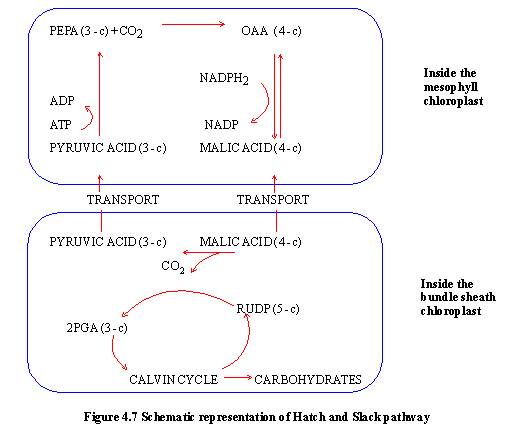
Oxaloacetate is converted to malate. The malate is shuttled into the bundle-sheath cell. A carboxyl group drops off the malate, leaving the 3-carbon molecule, pyruvate. The carboxyl group is the carbon dioxide delivered to rubisco. Pyruvate returns to the mesophyll cell and is converted to PEP, the starting material. Each turn of the shuttle consumes one ATP.
CAM stands for crassulacean acid metabolism. This pathway, used by cacti, pineapple, aloe vera and other succulents. These plants normally close their stomata during the day and open them at night to conserve water. During the night, carbon dioxide enters the leaf and is incorporated into 4-carbon acids (malate) that are stored in the central vacuole. During daylight hours, the light reactions generate NADPH and ATP, and the 4-carbon acids deliver CO2 to the rubisco in the chloroplasts. At night, the 3-carbon acids accept more carbon dioxide.

In summary, C4 plants have restructured their leaves to separate carbon fixation and the Calvin cycle in space. CAM plants have adopted an adaptation that separates carbon fixation and the Calvin cycle in time.
Whether a plant uses C3, C4, or CAM pathways, all rely on rubisco and the Calvin cycle to synthesize sugars.
Food for thought: A conservative estimate of the carbohydrate production by plants on Earth in one year - 160 000 000 000 metric tons.
Study guide (we may not have covered everything in this guide)
new leaf

visualizing photosynthesis
(ignore the incorrect chemical equation)