
overview

overview

Overview of photosynthesis
Photosynthesis is the light-dependent conversion of inorganic compounds to complex organic molecules. In two interdependent stages, light is converted to chemical energy (ATP and NADPH) and that energy produced is consumed as carbon dioxide is reduced to a simple sugar. Products of the light-dependent reactions are consumed in the light-independent reactions. The light-independent reaction occurs only in daylight but is not directly run by solar energy.
The chloroplast
leaf anatomy
chloroplast anatomy

thylakoid

The functional unit of photosynthesis in plants is the chloroplast. Chloroplasts are concentrated in the pallisade parenchyma cells of the mesophyll, but many are found in the spongy layer as well.
The chloroplast is a double-membraned semi-autonomous organelle with an extensive network of thylakoids connected by lamellae. This inner membrane system consists of the lamellae and thylakoids stacked into structures called grana (sing. granum). The thylakoid houses light energy-capturing pigments on its membrane and its inner space (the thylakoid space or lumen) serves as a hydrogen ion reservoir. All light-dependent reactions occur on or in the thylakoid.
The fluid portion of the chloroplast, the stroma, is analogous to the mitochondrial matrix. Chloroplast DNA, ribosomes, and Calvin cycle enzymes are found in the stroma. All steps of the Calvin cycle occur in the stroma. The outer and inner membranes of the chloroplast have no function directly in photosynthesis.
The nature of light
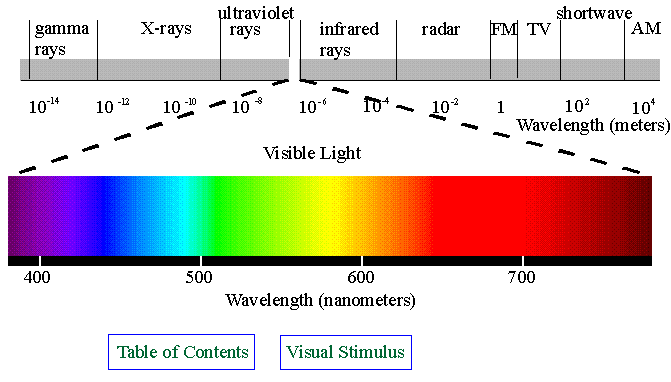
electromagnetic spectrum
Light is invisible until it hits a dark object. And then all we see are the colours that interaction produces. Energy from our Sun reaches the Earth in packets of energy called quanta (sing. quantum). Much of the electromagnetic spectrum is filtered by our atmosphere. The most important part of that spectrum to plants (and to life on Earth) is the visible portion. Colours result from different wavelengths of light. In the visible spectrum moving from red - orange - yellow - green - blue - indigo - violet, red light has the longest wavelength and violet has the shortest. The shorter the wavelength, the more energy carried in each quantum. Ultraviolet light is very energetic and much of it is absorbed by the ozone layers. Infrared light has comparatively little energy and is emitted by all objects.
actions of light

When light hits an object, three possible actions exist. The light is transmitted through the object; light is absorbed; or light is reflected. Each wavelength of light may act independently of other wavelengths so that all three possibilites may occur at the same time. In most leaves, green light is transmitted and reflected while red and blue light are absorbed by light-capturing pigments.

absorption spectrum
An absorption spectrum allows scientists to identify precisely which wavelengths of light are being absorbed by the plant. An action spectrum shows the efficiency of photosynthesis (measured in quantities of carbon dioxide taken up by the plant) under any particular wavelength.
Each photosynthetic pigment absorbs particular wavelengths. This variety in pigments allows the plants to take in as much as solar energy as is available. Chlorophylls, xanthophylls, carotenoids, and other pigments give the leaves their colour but their main purpose is to convert solar energy into chemical energy.
photosystem

A photosystem is an arrangement of antenna pigments (accessory pigments) surrounding a reaction centre that has two chlorophyll a molecules. The light-capturing portions of the pigments lie flat on the surface of the thylakoid membrane while their hydrophobic tails are firmly entrenched into the membrane core. Accessory pigments (chlorophylls a and b, carotenoids, etc) transfer energy to the reaction centre. Only the chlorophyll a pigments situated in the reaction centre are able to transfer electrons during the light-dependent reactions.
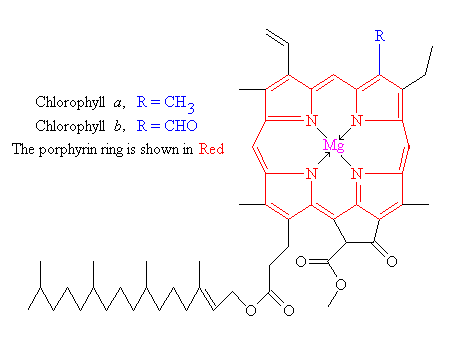
chlorophyll a and b
excited electron

When enough energy is absorbed by the chlorophyll, an electron is ejected. There are three possible outcomes of this action. The electron falls back to its ground state releasing energy in the form of light (not useful to the plant). Or the electron returns to its ground state and does some useful work on its way (more on this later). Or the electron is captured by an acceptor molecule and sent down an ETC that can generate the conditions needed to synthesize ATP.