
Energy (Section 1.3)
Metabolism is the totality of an organism's chemical processes. Metabolic pathways are of two kinds:

Catabolic - these pathways release energy as complex molecules are broken down into simpler compounds. Ex: cellular respiration
Anabolic - consume energy as simpler compounds are organized into more complex compounds. Ex: photosynthesis
One of the more fascinating aspects of metabolism is that these pathways may be coupled in such a way that the energy released during catabolism is consumed in anabolic processes.
Energy is the capacity to do work. There are many forms of energy

Kinetic energy is the energy of motion. Potential energy is the energy stored in matter due to location or arrangement. Potential chemical energy refers to potential energy stored in the bonds of molecules. (Fig 1)
One cannot study bioenergetics without a firm grasp of the two laws of thermodynamics. The First Law states that energy can be neither created nor destroyed. Energy may, however, be transferred or transformed.

The Second Law states that every transfer of transformation of energy increases the entropy of the universe. This means that no transfer or transformation is 100% efficient. Some energy is transformed into heat which is the most random form of energy. Life does not contradict the Second Law!
The Earth is an open system that continually receives the input of energy from our Sun. Free energy describes the portion of the total energy in a system that is available to do work. Heat energy is not available to organisms to do work because temperature is uniform in cells.
An easy method to calculate free energy change in a system is to subtract the initial energy from the final energy states. OR
delta G = G (products) - G (reactants)
A system or reaction in which the products have less energy than the reactants will have a negative delta G. These reactions proceed with no additional input of energy. They are spontaneous (downhill) and exergonic. Ex: cellular respiration
A system or reaction in which the products have more energy than the reactants will have a positive delta G. These reactions require additional energy to proceed. They are nonspontaneous (uphill) and endergonic. Ex: photosynthesis
At equilibrium, delta G must equal zero. But a cell with no free energy will die. There is a tendency towards chemical disequilibrium in life.
The energy currency of cells is ATP. ATP is the immediate energy source that drives uphill reactions. The three main types of work requiring ATP are transport, mechanical, and chemical.
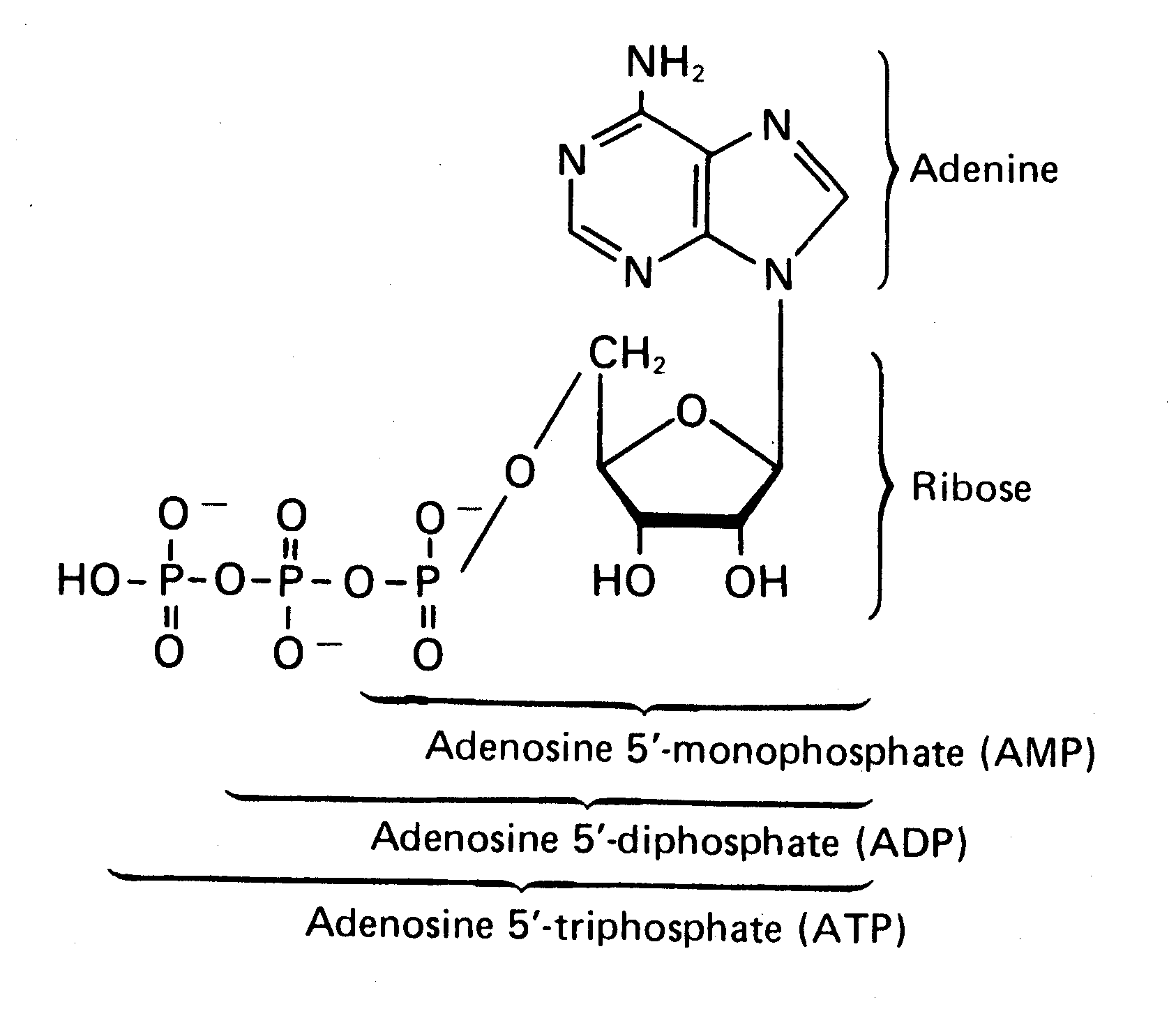
ATP is a ribonucleotide that releases energy as its terminal phosphate group is hydrolyzed. ATP - P = ADP. To replenish the pool of ATP, a source of energy is needed. Animals use the energy from the foods they eat to synthesize ATP molecules. Plants harvest the energy in sunlight to produce their own food which is then used to build up ATP levels.
ATP cycle
