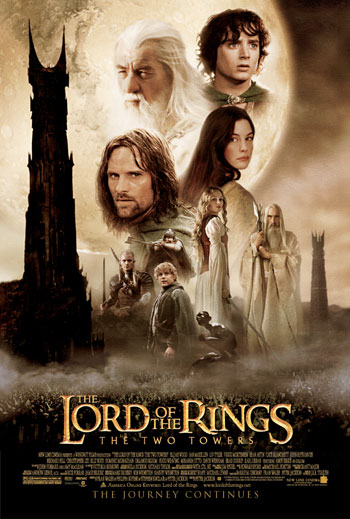
LORD OF THE RINGS: THE TWO TOWERS
Directed by Peter Jackson, and filmed in New Zealand

Let's start with a caveat: if you are one of the few people on the planet who has not yet seen "Lord of the Rings: The Fellowship of the Ring," log off now and view the extended DVD if you can. The theatrical release is also available on VHS or DVD and it truly is required viewing before seeing "Lord of the Rings: The Two Towers." If you choose to ignore this, you may follow in the footsteps of a friend of mine. An otherwise intelligent man, for some strange reason he decided to try reading the book The Two Towers without having first read The Fellowship of the Ring. He couldn't finish it without the first story's background, finding himself hopelessly lost in Middle Earth. Being lost in Peter Jackson's Middle Earth is an often enviable, occasionally harrowing place to be, and while it's certainly possible to enjoy the films without having read the books, don't expect a synopsis of the first film to begin "The Two Towers."
After a glorious fly over of snowy New Zealand Mountain peaks tinged with the dawn, the film literally plunges us back into the action of Middle Earth's War of the Ring and the now fractured Fellowship. Frodo and Sam are scrambling towards Mordor, Merry and Pippin have been kidnapped by Uruk-hai and the remainder of the Fellowship is searching for them. The sought after Ring is weighing much more heavily around Frodo's neck and the film follows the three smaller groups along not always parallel paths.
New characters join them on their journey: Treebeard (voiced by John Rhys Davies who also plays the dwarf, Gimli) joins Merry and Pippin, Gollum and later Faramir (David Wenham) cross and entangle paths with Sam and Frodo. The trio of Gimli, Legolas the elf and Aragorn the surviving mortal man of the Fellowship while searching for the hobbits, are reunited with the renewed Gandalf the White and become aware of court intrigue in the state of Rohan. Before they arrive in Edoras, the capital city of Rohan, they meet the banished Eomer (native New Zealander Karl Urban, of whom this reviewer would like to see more) and are warned of the corruption and intrigue in the diminished king Theoden's court. Embroiled in this intrigue are Bernard Hill as Theoden, Brad Dourif as Grima Wormtongue and Miranda Otto as Eowyn. From there, the story unfolds with forced marches, fantastical creatures and epic battles. "The Two Towers" has been compared to Akira Kurosawa's "Ran" for the intensity of the battle sequences and the way in which war is dramatized.
In any other film it might be possible to lose the actors in the midst of the spectacle. Not so in "The Two Towers:" most of the cast viewers met in the first film return, maintaining the same high standards. Outstanding performances and possible front runners for acting awards are Andy Serkis as Gollum, the remarkable Miranda Otto as Eowyn and Viggo Mortensen as Aragorn. Serkis as Gollum/Smeagol captures two quotes brilliantly, the first of which by Ian Hunter: "you're never alone with a schizophrenic," and the second by Ralph Blum who states a spiritual axiom when he asserts, "all significant battles are waged within the self." Miranda Otto's fine acting and luminous screen presence as Eowyn enriches a male dominated film with her power and grace. Mortensen comes more into his own in this film, fleshing out Aragorn with more humour than he had in "The Fellowship of the Ring," and assuming his leadership role with an infinitely watchable balance of thoughtfulness, compassion and ferocity when it is called for. Other noteworthy performances are Bernard Hill and David Wenham as Theoden and Faramir who each bring aching moments of personal loss in their characters' lives that ring true in the midst of the epic sweep that is "The Two Towers." Brad Dourif, perhaps most memorable thus far as the tragically fragile and fractured Billy Bibbit in "One Flew Over the Cuckoo's Nest," may again have similar exposure playing Bibbit's diametric opposite with his brilliant scenes as Grima Wormtongue.
"The Two Towers" is a pivotal film: the hinge on which the whole three film, thousand page story swings, it is long on pivotal characters but short on resolution. Gollum for example is both pivotal and pitiful and the parallels between he and Frodo as the story develops are astounding. Tolkien purists may respond with outrage, as this is the most divergent from the text of the three films. Having finished The Fellowship of the Ring, I understand now the allure of Tolkien's world and am now happily engrossed in the text of The Two Towers. " Rather than responding with outrage at the differences, I admire the approach of Christopher Lee who brilliantly portrays Sauruman, served as the Tolkien emissary on the Ring set according to Mortensen and has reportedly read the text of the Lord of the Rings annually since the books were published. Amid all the battle, intrigue and grief in "The Two Towers," there is a whisper of possible redemption, even for that most wretched of creatures, Gollum. If Gollum is capable of redemption, it lends hope to the rest of us, just as if Lee can forgive the variances between Tolkien's text and Jackson's film; I certainly can and hope others can as well.
Review by Colleen Wallace
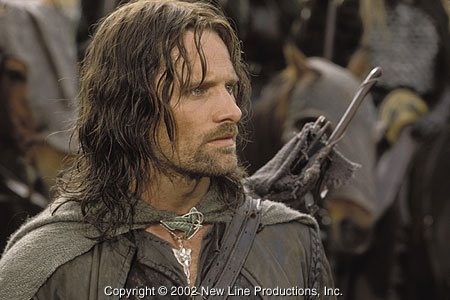
Viggo Mortensen as Aragorn/Strider in "The Two Towers"- hearts will be fluttering through all three movies.
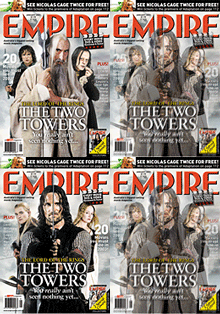
December Empire magazine features all about Two Towers, click to visit the website
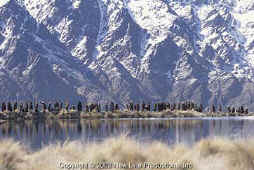
The photograph above is "so New Zealand", which really is a beautiful, wild and pristine place in many areas. As the actors said, they saw places many Kiwis haven't even seen. The South Island especially is stunningly beautiful - it is the perfect location for "Middle Earth" to exist, (though Hobbiton was in the North Island- Matamata, along with a few other locations).
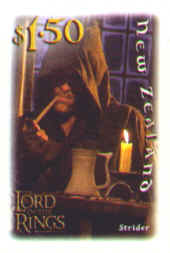
The Trilogy has become part of New Zealand's culture - there is even a series of stamps (click here to view Strider's stamp).