Memorex IBM formatted 2SHD1.44 MB Floppy DiskJeri Banks Introduction Alan Shugart invented the floppy disk drive at IBM in 1967. It is a removable disk drive that can carry data from one computer to another. The first floppy drives used an 8-inch disk. Today's 3.5-inch diskette can store 1.44 megabyte of data. Appearance This device hold data similarly to a cassette tape but looks much different; both use a thin plastic base material, called media, coated with iron oxide. This oxide is a ferromagnetic material, meaning that if you expose it to a magnetic field, it is a permanently magnetized by the field. This material is covered with a protective outer plastic case that is 3.5” wide X 3.5” tall, 1/8” thick, manufactured in various colors with a small silver piece of metal that is folded over one end and can slide to the side to expose the inner floppy disk. Parts list:
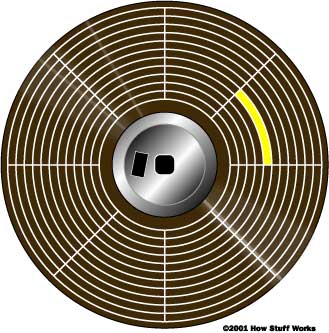
How it works: 1. A floppy disk is divided into 80 tracks per side. When the disk is inserted into a floppy drive, a system of levers called the mechanical frame opens the shutter on the diskette to allow the computer's read/write heads to touch the dual-sided diskette media.2. A small spindle motor engages the metal hub at the center of the diskette, spinning it at either 300 or 360 rotations per minute (RPM).3. As the iron oxide coated disk spins, the computers' recording head creates a magnetic pattern on the iron oxide. The pattern stores data in a form that the computer can read the next time the disk is inserted in the floppy drive.4. The read/write heads of the computer do not touch the diskette media when the heads are traveling between tracks. Each track is equally divided into 18 sectors. Each sector contains 512 bytes.5. Electronic optics check for the presence of the write protect tab, an opening in the lower corner of the 3.5-inch diskette, to see if the user wants to prevent data from being written on it.6. Since the tracks are arranged in concentric rings, the software can jump from "file 1" to "file 19" without having to fast forward through files 2-18. When the floppy disk is placed in a computer's floppy drive, The diskette spins like a record and the heads move to the correct track, providing what is known as direct access storage.7. The magnetic disk is sandwiched between the two white paper rings, which are glued down to the plastic housing, and stay still while the disk spins. They clean the disk, removing microscopic bits of dust.8. Once the diskette is ejected from the floppy drive, the mechanical frame releases the shutter and the spring forces it closed, protecting the inner floppy disk and data stored on it.The inner floppy disk:
Conclusion By the mid-1980s, the improved designs of the read/write heads, along with improvements in the magnetic recording media, led to the less-flexible, 3.5-inch, 1.44-megabyte (MB) capacity FDD in use today. For a few years, computers had both FDD sizes (3.5-inch and 5.25-inch). But by the mid-1990s, the 5.25-inch version had fallen out of popularity, partly because the diskette's recording surface could easily become contaminated by fingerprints through the open access area. Many companies manufacture today's floppy disks, however; 3M is the most well known manufacturer with the most readily available disks which are preformatted for IBM PCs. Sources • Image and some instruction courtesy of “How Stuff Works.com” 03/30/04 http://computer.howstuffworks.com • Parts list and some instruction courtesy of “Exploritorium” 3/30/04 http://www.exploratorium.edu/science_explorer/dissect_disk.html • Operation instructions courtesy of Windows 2000 MS-DOS Command Line 03/30/04 Copy writes 2002 published by Course Technology |