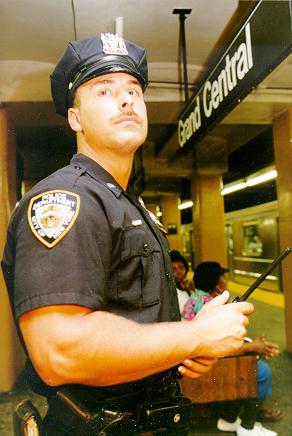
HISTORY OF THE
NEW YORK CITY TRANSIT POLICE DEPARTMENT
In 1904, the first underground train system was created. At the time it was created by two different privately owned companies. One company was called Interborough Rapid Transit (IRT) and the other was called Brooklyn Manhattan Transit (BMT). Not until 1932 did New York City create a train line called Independent (IND). These lines were run by the Board Of Transportation. Much like it's predecessors, it had a series of "station supervisors" employed to police them. These people were choosen off of the NYC Police Department Hiring list.
On November 17, 1933, six men were sworn in as NYC Railway Police and were expected to protect the people using the train and the system's property without the use or arms. In 1935, twenty "station supervisors, class B" were sworn in for police duty on the IND line as well.These 26 men were called "specials" and were expected to protect people, guard the system's property, assist in opening and closing train doors as well as announcing stops. They were soon given powers of arrest and the New York City Transit Police was formed. However, they were only allowed to arrest people on the IND lines. In 1937, an extra 160 men were brought in as part of the Transit Police. In addition to those people, there were 3 lieutenants, 1 captain and 1 inspector from the NYPD. These people were given the position of supervisor.
Three years later in 1940, IND took over the BMT and IRT lines and incorporated it into their own lines. When this happen, the once small patrol force doubled in size and required more supervisors than previously had. Later, in 1942, a test was administered for the first time. This test determine who would be promoted to Special Patrolman Grade2, which today is know as sergeant.
In 1947, the Code of Criminal Procedure was changed. This chnage gave the patrolman special police status and within the next three years there would be an increase in this number to 563. In 1953, the Transit Police came into being and assumed control over all of the subway lines.from the old Board of Transportation.
In 1949, the question as to who would supervise the Transit Police arose. Over the next five years this question was carefully looked at and ideas of merging it with the NYPD also came up while trying to decide who should run the department. In 1955 it was decided that the transit police should be their own department. A new test was established for the transit police after that.
Since then, crime started to rise and so did the numbers within the New York City Transit Police. By 1966 there were a total of 2,272 police officers within the department. The department created a plan to help reduce crime and overtime also increased it's recruits to do so. By early 1975, the New York City Transit Police had increased to 3,600 members.
In 1975, there was a large sense of pride and professionalism within the department, only to be damped by the fiscal crisis that was would create headaches for the transit police. After layoffs there were a little under 2,800 Transit Cops left. New officers were not hired again until 1980. In the early 1990s things were looking better financially and by 1994 the department had grown to 4,500 unifromed and civilian members. This made the Transit Police the sixth largest police force in the united states.