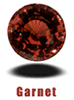
 January JanuaryGarnets come in a range of colors, though most people think of it as a dark red stone. Different types of garnets include spessartine garnets, yellowish orange to reddish orange; almandite garnets, reddish-orange to red; and rhodolite garnet, pink to purplish-red. In the past, people believed that garnet could cure heart palpitations and diseases of the blood. It was also claimed that garnets could help ward off melancholy and inspire contemplation. Garnet is found primarily in Africa, North America and India. It is fairly hard, a 7-7.5 on the Mohs scale  |
 |
| February The name amethyst comes from the ancient Greek word Amethystos, meaning 'without wine.' The stone was thought of as an amulet against drunkenness, because of its bright wine-colored, purple hue. Amethyst is actually a purple form of quartz. One legend says that the gemstone comes from Amethyst, a devotee of the goddess Diana. Diana turned the maiden into stone to protect her against Bacchus, the god of wine, who created tigers to attack her. Sorry for what he had done to Amethyst, Bacchus poured his wine over the stone, staining it purple. Amethyst is found in places such as Brazil, Canada, Sri Lanka, India, the U.S. and Australia. |
 |
| March Today the coveted color for aquamarine is sky blue, but in the 19th century, the favorite color for aquamarine was sea green. The stone's name literally comes from a Latin word for seawater. Aquamarine is a form of the mineral Beryl which was believed to ensure safe and prosperous seavoyages and to guard against storms. It was also thought to be a symbol of happiness and everlasting youth. The best quality aquamarines are found in Brazil. Other locations include Afghanistan, Pakistan, India and Nigeria. It has a good hardness, a 7.5 on the Mohs Scale. |
 |
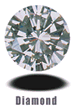
| April Diamond's are a girl's best friend...this colorless stone has long been celebrated by mankind. But why? The main reason is its incredible hardness, a whopping 10 out of 10 on the Mohs Scale. It is approximately 140 times harder than any other mineral! This means that while diamond can be shattered, it cannot be scratched by anything other than another diamond. Diamonds are found primarily in Australia, South Africa and Russia. Until the 16th century, diamond was not able to be cut and polished. But the ancient Greeks still wore diamonds in battle on their shields, hoping the stones could give them invincibility. Today, diamonds are considered a symbol of romantic love, and DeBeers has capitalized on that sentiment by coining the phrase, "Diamonds are Forever." |
 |
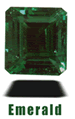
| May Emerald is the vivid green form of the mineral beryl, and is considered a fairly fragile stone. Most emeralds are oiled to fill small inclusions. The ancient Egyptians believed that Emerald stood for fertility and rebirth. The stone was also revered in ancient Rome, where many citizens wore emerald jewelry. Emeralds were used in the Middle Ages to tell the future, and were used in ancient medicine to cure poor eyesight and aid the liver. Emeralds are found primarily in Columbia, Brazil, Zambia and Zimbabwe. |
 |
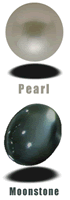
| June Pearls have been revered for their luster and beauty for centuries. They are formed when, in response to an irritant in an oyster shell, a substance called nacre is secreted to coat the irritated object. After layers of nacre form, a lovely pearl is born. Pearls have been used for centuries in Asian medicine, believed to cure indigestion, heart trouble and fever. Moonstone is a form of the mineral feldspar, and it has a glow similar to that of the moon, hence its name. Ancient Greeks and Romans believed that moonstone was connected to moon deities. It was also believed that moonstone could ward off cancer and protect travelers. Moonstone is primarily found in Sri Lanka, India and Myanmar (Burma), and Hindu legends said that moonstone was solidified moonbeams that reached earth and revere the stone as a good luck object. |
 |
| July Ruby comes from the Latin word "Ruber" meaning, appropriately, red. It is the red form of the mineral corundum (meaning that it is really red sapphire), and is second in hardness only to the diamond. Rubies from Burma are the most coveted and prized, and the king of Burma was actually called the "Lord of the Rubies." Ruby was believed to ensure physical and mental health, bring peace and guard against catastrophe. It was also said to attract and maintain love. Rubies are also found in Thailand and Kenya and rank a 9 on the Mohs scale of hardness. |
 |
| August Peridot, with its distinctive bottle-green color, has been mined on St. John's Island in the Red Sea for over 3,500 years, where ancient Egyptians thought of it as a gem of the sun. In the Middle Ages, crusaders brought this transparent to translucent gem to Europe. Legends have been passed down over the centuries that peridot brings happiness and good cheer, attracts lovers and strengthens the eyes. Peridot comes from Egypt, China, Myanmar, Brazil, Norway, the U.S. (in Arizona and Hawaii), Australia and South Africa. It has a hardness of 6.5-7 on the Mohs scale. |
 |
| September Sapphire, one of the world's most popular gems, is generally associated with the color blue. But it's made of the mineral corundum, comes in many other colors, including pink, yellow and green. Sapphires were thought to protect against sickness and misfortune, and were often worn as amulets. They were also identified with chastity and piety; it is said that King Solomon wore a Sapphire ring. Sapphire is mined in Myanmar, Sri Lanka, India, Thailand, Australia, Nigeria, and the U.S. (Montana). It has a hardness of 9 on the Mohs scale of hardness. |
 |
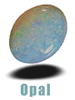
| October Opal is an opaque gemstone that is prized for its iridescence. You can find opal in a variety of colors, including white, black, and fire opal (which is orange). Opal is actually a hardened silica gel, and contains 5-10 percent water. The ancient Romans believed Opal was a symbol of hope and purity, while the Arabs thought that opals were formed by lightning strikes which produced its characteristic flashes of color. Since the 19th century, Australia has been the main producer of opal, though it can also be found in Czechoslovakia, the U.S., Brazil, Mexico, and southern Africa.Opal is rather soft, with a hardness of only 5-6.5 on the Mohs scale, so it is delicate and requires special care. |
 |
| November Topaz can be found colorless or in shades of yellow, orange, red and brown. It is also sometimes treated with irradiation to create blue topaz. Today the major sources for topaz are Brazil, Nigeria, Australia, Myanmar and Mexico. Tradition held that topaz could relieve bad dreams, calm the temper and cure madness. The gem was said to lose its color in the presence of poison, thereby protecting its owner. |
 |
| December Turquoise is the intensely-colored, blue birthstone for December. Its color is so distinct that the color was named after the gemstone. Turquoise was one of the first gemstones to be mined, discovered by the ancient Egyptians in 3000 B.C.. In the treasures of King Tut turquoise was found combined in jewels with other gemstones such as Lapis Lazuli and carnelian. But most people in the U.S. associate turquoise with native American jewelry, set in silver. The Pueblo people used to place turquoise on the floor in their homes to bring good fortune. Turquoise is found in Iran, Tibet, Mexico, the U.S., Chile, Australia, and Cornwall (England). |
 |
|

