|
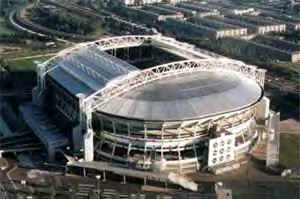
The Amsterdam
ArenA was the first European stadium built with a mobile
roof. It represents the main characteristic of the
stadium.
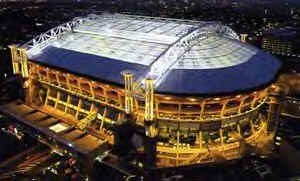
The roof is a big structure based on two cross-haired
arches on the outside. They are connected to two longitudinal
beams that are fixed in correspondence with the playing
field's rectangle. Along the arches, semi-transparent panels
can flow to completely close the stadium. The operation takes
5 to 30 minutes depending on the urgency of completion. So,
the stadium can be completely closed to host big events,
including non-sportive events like rock concerts.
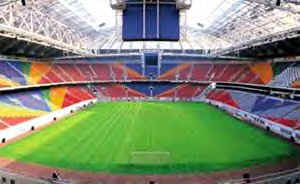
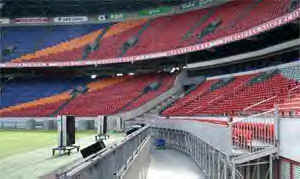
The stadium has a 51 324 seating capacity, well divided
along two rings that are close to the playing field. The upper
ring is continuous while the lower ring is elegantly
interrupted in the four corners of the stadium. The created
spaces serve as exit gates and are well harmonized with the
overall design of the stadium.
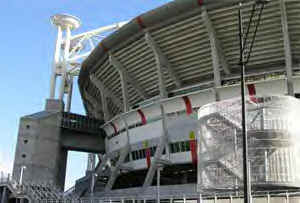
The stadium has a total height of 77 meters (253 feet) and
appears as an imposing structure. The playing field heightens
9 meters (30 feet) in respect of the ground level. Underneath
the stadium, an important highway passes that connects the
Bijlmer quarter (in which the stadium is situated) to the west
side of the city.
The Amsterdam ArenA was projected by architects Rob
Schuurman and Sjoerd Soeters. They had the roof structure
built first which created a big and uncommon empty space at
the inside of the stadium. In successive phases, the stands
were built and coloured seats were put in place to determine
the current lay-out of the stadium.
© by Angelo Spampinato |