Name _______________________________________ Period ______ Date _______
Concept Sheets 1-3 and 1-4
Flowing Electricity: Resistance, Current, and Voltage
1. Potential energy is energy that is
(moving) (stored) (being burned)
2. Electrical potential energy is also called
(voltage) (amperage) (wattage)
3. The flow of electric charge is called electric
(voltage) (current) (power)
and is measured in
(volts) (amperes or amps) (ohms) (watts)
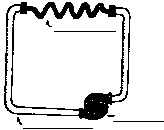
4. Look at the picture at right of a water-flow system and label each part with what it represents in an electrical circuit:
5. Which offers more resistance to water flow, a wide pipe or a narrow pipe? ______________. Similarly, which offers more resistan
ce to the flow of electrical charge, a thick wire or a thin wire? _____________ Which is usually thinner, the wire in a light bulb filament or the wire in a circuit? ____________________
6. If the filament resistance in an automobile headlamp is 3 ohms, how many amps does it draw when connected to a 12-volt battery? __________________
7. The resistance of a light inside a car is 10 ohms. How much current flows in them when connected to 12 volts? ________________
8. What is the current in the 30-ohm heating coil of a coffee maker that operates on a 120-volt circuit? ________________.
9. What is the resistance of a clothes iron that draws a current of 12 A at 120 V? _______________
10. What is the voltage across a 100-ohm circuit element that draws a current of 1 A? _______________
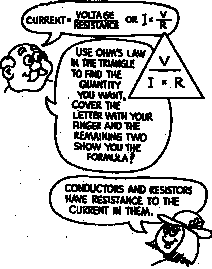
11. What voltage will produce 3 A through a 15-ohm resistor? _______________
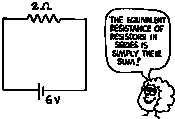
12. In the circuit shown at right, a voltage of 6 V pushes charge through a single resistor of 2 �. According to Ohm's law, the current in the resistor (and therefore the whole circuit) is ___________
13. If a second identical lamp is added, as on the left, the 6-V battery must push charge through a total resistance of _____ �.
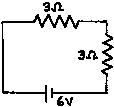
The current in the circuit is then ______ A.
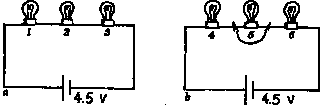
14. Circuits a and b on the right are identical, with all bulbs the same kind and size. The only difference between the circuits is that Bulb 5 has a short circuit, as shown.
a. In which circuit is the current greater? _______________
b. In which circuit are all three bulbs equally bright? _______________
c. What bulbs are the brightest? _______________
d. What bulb is the dimmest? ______
_________
e. What bulbs have the largest voltage drops across them? _______________
15. Review: A positively charged balloon will stick to a wooden wall. It does this by moving charges in the wall so that an oppositely-charged surface is created. Draw the appropriate charges on both the balloon and in the wall.