Name _________________________________ Date _______________
Per ______
Activity: Parts of an Atom
Purpose: To simulate the use of alpha particles to investigate
how atoms are put together.
Materials: regular-size aluminum pie pan, 4 glass marbles, 4 small
"super balls," 1 large "super ball," grooved ruler, flat piece of cardboard
Procedures:
Note - If you have trouble following directions, see the photos on page
119 in your textbook.
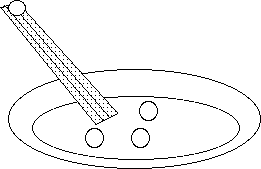
| 1. Gently press the four glass marbles into the pie pan so that they
make small indentations near the center of the pan.
2. Roll the large super ball down the grooved ruler. Try to hit
the marbles.
3. Notice what happens to the large super ball.
4. When does the large super ball change its path? ______________
Does the large super ball ever bounce back?
__________________ |
 |
5. Place the ruler at different slopes (steepnesses), and repeat steps
2 and 3. What are the differences in your observations from #4?
________________________________________________________________
________________________________________________________________
6. Now put small super balls into the indentations in the pie pan, and
roll a glass marble down the ruler. Repeat steps 2, 3, and
5. Compare and contrast the results with the results you observed
with the glass marbles.
________________________________________________________________
________________________________________________________________
________________________________________________________________
________________________________________________________________
7. Why did you get different results with the small super balls than
with the glass marbles?
________________________________________________________________
8. What effect did the slope of the ruler have on the way the rolling
ball or marble behaved? (Explain in terms of slope and speed of roll).
________________________________________________________________
9. Which has a greater effect on the way the rolling ball acts after
a collision, the mass of the rolling ball or the mass of the ball in the
indentation?
________________________________________________________________
10. How is this activity like Ernest Rutherford's experiment?
________________________________________________________________
________________________________________________________________
________________________________________________________________
________________________________________________________________
11. How is this activity different from Rutherford's experiment?
________________________________________________________________
________________________________________________________________
12. How would your observations change if all the marbles and balls
were positively charged?
________________________________________________________________
________________________________________________________________
________________________________________________________________
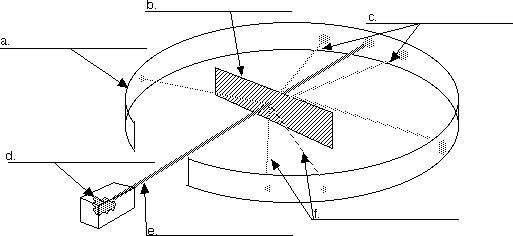
13. Label the lettered portions of the diagram below, which represents
Rutherford's experiment.