Copied
from an article in the NNGA “NUTSHELL”
Pecans:
The Challenge of Developing a Good Root System
Carl
E. Whitcomb, PhD, Lacebark Inc. 2104 N. Cottonwood Road, Stillwater, OK 74075
After
years of research and experimentation it
is clear that roots of pecans are in a class by themselves. From the time a root
first emerges from the seed, this taproot is larger in diameter and resists
development of secondary root branches more than any other species I have worked
with. My standard response for years as to how to best propagate pecans was
simply “I do not know”.
But, persistence pays off and that is no longer the case.
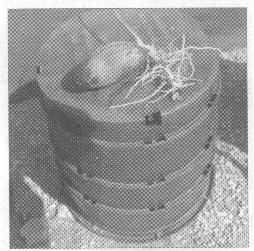
Figure below.
With other tree species such as oaks, seeds are planted directly into RootMaker® propagation trays. With pecans it is necessary to air prune the taproot near the seed, then again when roots reach a depth of 4 inches. Through a series of techniques and new technology, it is possible to produce pecans with root systems that I consider acceptable. The sequence of events is as follows:
1. Prepare
mesh bottom flats with a layer of newspaper in the bottom. Add good soil-less mix
to a depth of about 1.0 to 1.5 inches (60% coarse perlite and 40%. good
peat works well). Spread pecans on mix surface side by side, but never one on
top of the other and cover with enough additional mix to cover the nuts about
half or three fourths inch. These flats must be suspended at least 24 inches above
the floor of the greenhouse. Higher is better.
2. Watch
the flats for signs of seed germination. Where the tip of the seed is exposed
slightly, watch for root
Figure
above. This
pecan was left in the propagation flat too long. Transplanting just at the point
of air-pruning the taproot is easy, but with the secondary roots present,
transplanting is much more difficult, and kinked roots are likely.
3. Remove each nut with a blackened root tip from the flat and transplant into 18 cell RootMaker® II propagation trays. This will result in the second air-root-pruning. Insert a pencil into the mix to make a hole, and then insert taproot. Leave nut on top and water. If you wish to graft or bud the trees while still in the 18 cell cavities, use separated units. If you plan on waiting for a larger stem diameter as in Step 8, use 18 cell trays as a unit. As in Step 1, the trays must be at least 24 inches above the greenhouse floor or ground outside for good air-root-pruning.
4. The mix in the 18 cell trays is very important and it is critical that proper nutrients have been added. A mix of 60% coarse perlite and 40% peat works well OR a mix of 40% fine pine bark, 30% peat and 30% coarse perlite. To this mix, add 1.5 pounds of Micromax micronutrients and 8 pounds of Osmocote 18-6-12 per cubic yard (no substitutes). At this point, there is little or no need for dolomite.
5. Once seedlings are growing well and are in fall sun, top-dress the 18 cell trays with additional Osmocote. Use either 18-6-12 at a rate of about 6 pounds per cubic yard or 19-6-12 (which has a faster release) at about 4 pounds per cubic yard.
6. At the time of transplanting from the 18-cell trays in mid summer, seedlings are typically 16 to 24 inches tall, with stem diameters from about 1/4 to near 1/2 inch. Discard the weaker seedlings, especially those that are tall and spindly and transplant only those with good stem diameter.
8. When producing plants of larger size to sell, there are now two options:
A. Plant from 18 cells into 8 inch knit fabric containers filled with a good container growth medium placed either in cinder blocks or in a well drained field soil. Allow the plants to grow the rest of the growing season or into a second season and complete budding or grafting (Figure 2). Plants harvested from the 8 inch knit fabric containers should have fabric removed before planting into 7, 10 or 15 gallon containers.
B. Plant from 18 cells into 7 gallon RootTrapper® II or
RootBuilder® II containers for above ground production.
Allow plants to grow one to two growing seasons as required to accomplish
budding or grafting and obtain top height of 6 to 8 feet for optimum
marketability.
A well-draining container growth medium and proper nutrition and watering are essential for good growth. I use a mix of three parts ground pine bark, one part Canadian peat and one part coarse sand, amended with 1.5 pounds of Micromax micronutrients, 15 pounds of Osmocote 17-7-12 and four pounds of dolomite (which is optimum for my irrigation water). This combination provides all nutrients for a period of one growing season, over-winter and still has enough to start the second growing season. At that time topdressing with additional Osmocote is needed, but there is no need to add more Micromax or dolomite.
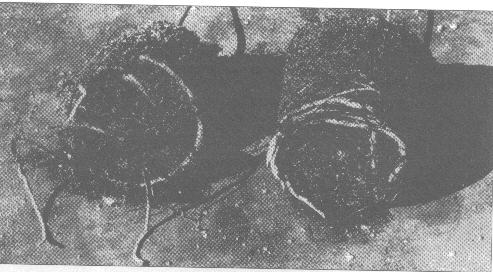
Figure above: Deformed, circling pecan root system we are used to seeing. Pecan seeds were planted in bottomless tree bands then shifted into smooth 3 gallon containers. (See Zipset Plant Bands www.stuewe.com for restarting pecans after first air-prune, then air-pruning again, then planting of bottomless tree bands into mess bag in block.)
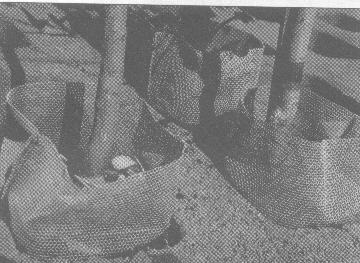
Figure above. Pecans transplanted into 8” knit containers by mid summer may reach 3 feet or more in height and possess 5/8 to 3/4” stems by the end of the first growing season.
Figure
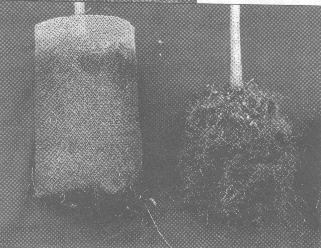
below. The plant on the left was easily removed from a cinder block. The plant
on the right was removed, stripped of fabric, washed and shaken to expose the
fibrous root system.