

Test
Biologique de Mesure du Pouvoir de Défense Antiradicalaire Global
Enregistrement à l’Agence de Sécurité Sanitaire des Produits de Santé :
V02023
KIRIAL
International, 3 rue des
Mardors, F-21560 COUTERNON
Test
Biologique de Mesure du Pouvoir de Défense Antiradicalaire Global
Enregistrement à l’Agence de Sécurité Sanitaire des Produits de Santé :
V02023
KIRIAL
International, 3 rue des
Mardors, F-21560 COUTERNON
Le Test KRL:
English
Section Below:
Il
existe, de nos jours, un intérêt croissant vis-à-vis de la biologie des
radicaux libres. Ce n’est pas seulement dû à leur rôle dans des
phénomènes aigus tels que traumatisme ou ischémie, mais aussi à leur
implication dans de nombreuses pathologies chroniques.
Il
est donc très important de pouvoir définir avec précision l’état de
défense des individus contre l’agression des radicaux libres.
Cet
état, oxydatif (ou anti-oxydatif) peut aisément être apprécié d’un
point de vue dynamique par un test global simple (brevet SPIRAL).
Les
radicaux libres constituent des espèces chimiques activées, produites in
vivo dans des conditions biologiques normales, mais des agressions diverses et
notamment les rayonnements U.V., le stress, la pollution, l’alcoolisme, le
tabagisme, etc. accroissent leur formation, conduisant à des états
pathologiques. En effet, bien que l’organisme soit naturellement protégé
contre ces radicaux libres par des systèmes de détoxification enzymatiques
ou chimiques, ces systèmes peuvent être débordés, ce débordement étant
lié directement aux facteurs génétiques, environnement, mode de vie,
pathologie, bref “à la capacité de défense de l’individu ”.
Ces
molécules très réactives exercent leurs effets nuisibles :
ü
au niveau cellulaire : peroxydation des acides gras polyinsaturés des
membranes phospholipidiques d’où formation de peroxydes cytotoxiques
entraînant phénomènes inflammatoires et mort cellulaire. De plus, les
intermédiaires radicalaires oxygénés représentent de véritables
activateurs de la carcinogenèse, des maladies cardiovasculaires, etc.
ü
au niveau extracellulaire : dégradation des principaux constituants d’où
modification de la perméabilité et de la structure des tissus, notamment de
la peau. Ces altérations contribuent à favoriser la sénescence cutanée et
le vieillissement en général.
Les
facteurs de protection de radicaux libres sont de deux catégories :
ü
Enzymatiques :
la superoxyde dismutase (SOD), catalase et le sélénium glutathion peroxydase
ü
Chimiques :
les scavengers qui bloquent les radicaux libres, les anti-oxydants qui
limitent les effets des radicaux libres (vitamine C, vitamine A, vitamine E,
vitamine K, Se, cystéine, méthionine, ubiquinone, ou coenzyme Q).
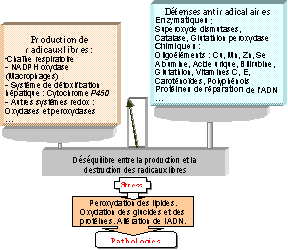
Compte tenu de l’ensemble des composés (vitamines, anti-oxydants, pro-oxydants…), des systèmes enzymatiques (glutathion peroxydase, catalase, superoxyde dismutase…) intervenant dans le système de défense anti-radicalaire, tout test spécifique ne peut apporter une appréciation globale de la capacité de résistance d’un individu vis-à-vis de l’agression des radicaux libres. Une approche globale est pourtant nécessaire car même si l’on multiplie le nombre de tests spécifiques, les résultats n’apporteront jamais une réponse tenant compte de l’ensemble des nombreuses variables mises en jeu simultanément chez l’être vivant pour sa défense anti-radicalaire.
Il
s’agit de soumettre des hématies à une agression de type oxydatif dans des
conditions strictement contrôlées et standardisées. Dans ces conditions,
les hématies mettent en jeu tout leur équipement enzymatique et moléculaire
pour résister à cette agression jusqu’à ce que la membrane cellulaire en
soit modifiée au point de laisser échapper leur contenu cellulaire. La
résistance de la population d’hématies testée s’exprime donc par le
temps de libération de 50% du contenu en hémoglobine.
L’intérêt
médical de ce test est qu’il reflète de façon globale le potentiel de
défense d’un individu vis-à-vis de l’agression des radicaux libres
impliqués dans de nombreuses pathologies et qu’il permet d’apprécier
préventivement à une pathologie le glissement du capital de défense de l’individu
vers une valeur basse pré-pathologique qui tient compte de tous les facteurs
positifs (vitamines, capital enzymatique de défense…) ou facteurs négatifs
(tabagisme, alcoolisme, stress, alimentation déséquilibrée, pollution,
etc.).
Ce
test permet de suivre l’évolution positive ou négative d’une
prescription, sur l’état de défense de l’individu vis-à-vis des
radicaux libres. Nous avons d’ailleurs utilisé ce test pour le suivi du
pouvoir anti-radicalaire de molécules pharmaceutiques, in vitro et in vivo
permettant par exemple de connaître l’effet négatif éventuel lié à un
métabolite, même si le métabolite incriminé n’est pas encore identifié
(intérêt pour la recherche pharmaceutique).
Ce
test tient donc compte du patrimoine génétique d’un individu vis-à-vis de
sa défense anti-radicalaire, de son mode de vie, de situations d’agressions
connues ou inconnues et se présente comme un test de première intention pour
la médecine préventive, d’entretien, de dépistage et de suivi
thérapeutique.
Ce
test global du pouvoir de défense anti-radicalaire qui tient compte à la
fois de tous les facteurs de risques liés à l’environnement, au mode de
nutrition, au mode de vie en général, sans oublier l’influence du
patrimoine génétique de l’individu représente en fait “l’épreuve
d’effort de la cellule”.
Dr
Michel PROST
Principe du test
Il
s’agit de soumettre un échantillon de sang ou une suspension d’hématies
à une agression radicalaire dans des conditions strictement contrôlées et
standardisées. Tous les systèmes enzymatiques et chimiques de l’échantillon
se mobilisent pour protéger l’intégrité des cellules jusqu’à leur lyse.
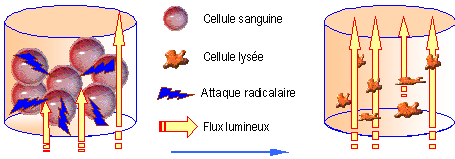 L’analyse,
réalisée dans des microplaques de 96 puits, permet le traitement d’un
nombre important d’échantillons. La mesure de la diminution de l’absorbance
permet de suivre la disparition progressive des cellules. La résistance du
sang à l’attaque radicalaire est exprimée par le temps nécessaire à la
lyse de 50% des cellules sanguines.
L’analyse,
réalisée dans des microplaques de 96 puits, permet le traitement d’un
nombre important d’échantillons. La mesure de la diminution de l’absorbance
permet de suivre la disparition progressive des cellules. La résistance du
sang à l’attaque radicalaire est exprimée par le temps nécessaire à la
lyse de 50% des cellules sanguines.
Les
résultats sont standardisés en E.A.R. (Efficacité
Anti-Radicalaire)
de manière parfaitement reproductible (CV < 4%).
Le
test KRL permet une mesure de l’état des défenses antiradicalaires
globales d’un individu, l’étude spécifique de ses défenses plasmatiques
ou l’analyse du pouvoir pro- ou antioxydant de nombreux composés.
English Section:
SOME
APPLICATIONS OF THE KIRIAL'S KRL TEST
I- IN VITRO APPLICATIONS
1- Assessment of the total antioxidant capabilities of compounds
Global antiradical potential of lipophilic and hydrophilic chemical
antioxidants
Ø A lipophilic compound which known antiradical properties such as butyl
hydroxy toluene (BHT) increased the red blood cell resistance against
oxidative stress [3, 4].
Ø
We have also assessed the total antioxidant capacity of Trolox, a
water-soluble synthetic analogue of vitamin E.
Total antiradical potential of natural antioxidants
Ø Bovine serum albumin (BSA), which has radical scavenger and metal chelating
effects, strongly delayed free radical-mediated blood cell lysis. Free
radical-induced oxidation of BSA reduced its antioxidant effect.
Ø Soluble chain-breaking antioxidants such as uric acid, mannitol and cystein are very effective in delaying hemolysis [3, 4].
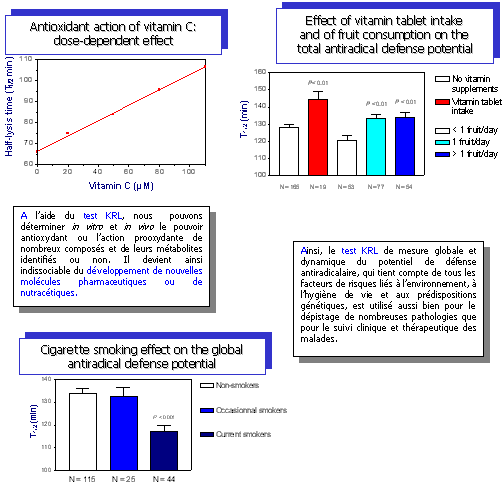
Ø The global free-radical scavenging properties of vitamin C is assessed with our dynamic biological test [3, 4], also see the test presentation document). It is noteworthy that like other reducing agents, vitamin C in high concentration has a prooxidant action.
Ø Unlike chemical tests such as the 2,2-diphenyl-1-picrylhydrazyl (DPPH) test, our test allows the assessment of the indirect antioxidant effect of folic acid and pyridoxine (vitamin B6) whereas these vitamins do not have free radical scavenger properties. They are unable to trap the radical DPPH (unpublished results not shown). Others B-group vitamins such as thiamin (B1), riboflavin (B2), pantothenic acid (B5), cobalamin (B12) do not delayed free radical-mediated blood cell lysis.
Ø
With our system, we have also assessed the total antioxidant capacity of
vitamin E, of carotenoïds and of numerous polyphenols and stilbenes (results
not shown, see references [12, 13]).
Evaluation of the global antiradical capacity of plant extracts or mixtures of
not identified compounds
Ø Our system, which can serve as a model for the antioxidant defense
recruitment that will take place when free radicals are generated in blood,
really gives us information how potential antioxidants act against an oxidant
stress in blood. Numerous aromatic plant extracts have been tested and their
total antioxidant capabilities have been compared (see references [12, 13] and
the summary of an oral communication "Application à l'évaluation de
l'activité protectrice antiradicalaire de divers extraits de plantes
aromatiques"). In particular, we have shown that grape pip extracts (OPC)
and green tea extracts (OFT) reduced the whole blood susceptibility to free
radical aggression.
Ø Extracts of wine polyphenol have also a high total antioxidant capacity.
Ø We have studied the total antiradical potential of different red wine. Whereas white wine had no detectable antioxidant effect, red wine increased the whole blood resistance to free radical attack. Moreover the antioxidant potential of twelve different wines has been compared with the help of our test and with the DPPH test. The antioxidant activity of wine has been then correlated with their flavonoïd content. The results obtained with our test are correlated with those obtained with the DPPH test and with the concentration of wine polyphenols, resveratrol and tannins. Therefore, these results confirm that the free-radical trapping activity of flavonoïds present in wine is in part responsible for its antioxidant action.
Ø Using our test, we have compared the total antiradical potential of a plant (Anthemis nobilis) extracts before and after an irradiation of the plant several months ago. Irradiation had impaired the total antioxidant potential of the plant extract [3, 4]. This also accounts for a collagen preparation tested before and after collagen irradiation [3, 4]. Moreover, a lack of the antioxidant capabilities against free radical aggression has been shown in senescent conifers compared with healthy conifers ([5]). Thus with the help of our test we can evaluate the antiradical effectiveness of a plant according to congenital factors, development state, nutritional supplies and environmental factors (gaseous pollutant level, light exposition, climatic variations, altitude…).
Ø
The antioxidant effect of mixtures of unidentified food supplements has also
been determined in vitro. We have compared the antioxidant effectiveness of
two mixtures of unidentified food supplements for pigs. The results showed the
greater effectiveness of "amiporc" as compared to "nutriporc".
Moreover, antagonistic and synergistic actions between different food
supplements have been observed in agreement with the results obtained in vivo.
2- Studies of the metabolic alterations of cells induced by different
compounds
Ø Cells can be modified in vitro and their total antiradical potential
compared with our test. For instance, pre-incubation of erythrocytes (or whole
blood) with diamide which is know to cause partial depletion of glutathione
leads to an impaired resistance of cells to free radical attack [3, 4].
Partial inhibition of catalase an enzyme involved in the detoxification of
free radical by sodium azide also increases the susceptibility of cells to
oxidant stress [3, 4].
Ø
Moreover, cells can be modified in order to increase their global antioxidant
defense potential. We have shown that pre-incubation of whole blood with folic
acid gradually increased its resistance to free radical aggression. Thus, the
antioxidant effectiveness of folic acid was improved after a pre-incubation
with blood cells. By contrast, we were not able to detect a time-dependent
improvement of the antioxidant effectiveness of pyridoxine (unpublished
results).
3- Assessment of the total antiradical potential of plasma or other biological
fluids
ü Incubation of "standard" erythrocytes (or "standard"
whole blood) with different plasma samples allowed the dynamic evaluation of
the different antioxidant capabilities of plasma [3, 4].
ü
Other biological fluids could be also tested using our test, an example is
given by an experiment conducted with saliva obtained from a smoker before and
after cigarette smoking [3, 4]. Thus, our dynamic biological test can be used
to determine the total antioxidant status of human plasma or other biological
fluids according to therapeutic treatment, to various pathological situations,
to congenital and environmental factors, nutritional habit and lifestyle (see
"in vivo applications"; assessment of the global antiradical defense
potential (intra- and extra-cellular antioxidant status) of humans according
to these different situations and factors).
II- IN VIVO APPLICATIONS
1- Assessment of the global antiradical potential of humans or animals during
a therapeutic treatment: Effectiveness of treatments with nutrients,
pharmaceutical drugs, plant extracts and nutraceuticals
Ø Our test may help to determine with individual specificity the negative or
positive development of a therapy. Thus treatments could be personalized
according to Spiral's test response. We have analyzed the total antioxidant
defense potential of animals receiving several intramuscular injections of
vitamin E. This treatment increases the total antiradical potential of rats.
By contrast, animals, which were fed a vitamin E-deficient diet, have an
impaired antioxidant defense potential [3, 4].
Ø Studies of the action of different human food supplements in rats showed antagonistic and synergistic actions between mixtures of these supplements. The use of "complément 1 + complément 2" would be the more effective in the improvement of the total antioxidant status in human.
Ø
We have studied the effectiveness of vitamin supplementation in elderly
subjects. First, in agreement with the involvement of free radicals in aging,
our results clearly showed that elderly subjects have a reduced antioxidant
potential as compared with young people. Second, vitamin supplementation
improved the global antioxidant defense status of elderly people. We have
observed a reduced susceptibility of erythrocytes and whole blood cells
against free radical attack. On the other hand, we were not able to detect an
improved total plasma antioxidant status (TAS) using the chemical Randox's
test which measures the total peroxyl radical-trapping activity of plasma in
Trolox equivalents [11, 14].
2- Global human or animal resistance against oxidant stress in various
pathological situations
Ø Our test may help to detect acute processes such as trauma and ischemia and
free radical-mediated diseases such as cardiovascular disease, diabetes,
cancer and inflammatory disease. We showed that streptozotocin-induced
diabetic rats have an impaired total antioxidant defense status as compared to
control rats [4,5].
Ø Global antiradical defense potential of atherosclerotic patients are highly reduced as compared to matched control subject [3, 4]. Moreover, we have analyzed the total plasma antioxidant status of a patient suffering for coronary disease. Our results showed an impaired plasma antioxidant status of the patient as compared to a control subject. In addition we observed a slight recovery of the plasma antioxidant capacity 24 hours after the coronary attack.
Ø We have also shown that a virus infection conducted to a high impairment of the total antioxidant defense potential (see the test presentation document).
Ø By means of our procedure, we have studied the total antioxidant defense potential of erythrocytes from rats fed a folic acid deficient diet as compared to control rats. Our results showed that, as vitamin E deficient rats, folate deficient rats have an impaired total antioxidant potential [6]. In addition we have shown that this prooxidant effect of folate deficiency is mediated by hyperhomocysteinemia which is now recognized as an important cardiovascular risk factor ([9, 10]). Thus, with the help of our test we can detect inadequate vitamin intake, which can cause free radical-mediated disease.
Ø We can also detect impairment of the human's or animal's antiradical potential caused by an iatrogenic treatment. We have studied the effect of an oral contraceptive treatment of rat. Our results showed that the oral contraceptive treatment induced a prooxidant state [7]. In addition, this prooxidant effect of oral contraceptive is enhanced by a folate deficiency [8]. We were also able to detect a proxidant effect of an anticarcinogenic treatment (ICT). Our results showed that the whole blood resistance to free radical attack is impaired after an ICT treatment.
Ø The oxidant stress induced by cigarette smoking has been detected with our biological test. Red blood cells from smokers are more susceptible to free radical attack than those from non-smokers [3, 4]. In addition the whole blood antioxidant defense potential of smokers is reduced as compared to non-smokers (see the test presentation document).
Ø
Prolonged physical exercise has been reported to produce circulating free
radicals. Although they are very difficult to determine due to their very
short half life, by means of our test it was possible to show a prooxidant
effect of a long distance race in a trained healthy subject [3, 4].
3- Lifestyle and nutritional habit effects on the total antioxidant potential
of healthy subjects
Ø Our test may be useful as a precocious diagnosis to identify subjects who
are at risk for free radical-mediated disease. We have conducted a clinical
study on 189 healthy subjects in order to investigate the effect of lifestyle
and nutritional habit on the whole blood resistance to oxidant stress. Most of
the obtained data are exposed in the test presentation document.
Ø Our results showed that men have a higher antioxidant defense potential than women. In addition, we were able to detect with our biological test that current sport practice, vitamin tablet intake or fruit consumption increased the total antiradical defense potential of subjects.
Ø
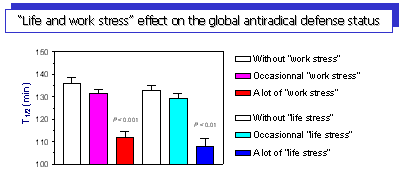
By contrast, we found that cigarette smoking and that "life and work
stress" both impaired the individual's antioxidant capacity. Thus, taking
into account numerous factors such as nutritional habit and lifestyle but also
environmental factors and congenital predisposition our test could be used as
a first assay in preventive medicine.
Exemples d'
Applications de Test KRL
1.
Prost, M. 1989. Utilisation de générateur de radicaux libres dans le
domaine des dosages biologiques. FR patent 2,642,526.
2.
Prost, M. 1992. Process for the determination by means of free radicals
of the antioxidant properties of a living organism or potentially aggressive
agents. US patent 5,135,850.
3.
Blache, D., M. Prost, and J. Raffi. 1991. In vitro biological test of
resistance to oxidation: Application to identification of irradiated food. In Potential
New Methods of Detection of Irradiated Food. Commission of the European
Communities, Luxembourg, pp. 105-116.
4.
Blache, D. and M. Prost. 1992. Free radical attack: Biological test for
human resistance capability. In Proceedings of the IX College Park
Colloquium on Chemical Evolution: A Lunar-Based Chemical Analysis
Laboratory (LBCAL). C. Ponnamperuma and C. W. Gehrke, editors. NASA,
Washington D.C., pp. 82-98.
5.
Guillemaut, P., F. Weber-Lotfi, D. Blache, M. Prost, B. Rether, and A.
Dietrich. 1992. Conifer decline in the northeast of France:
Characteristic changes in chloroplast protein pattern and absence of
anti-oxidative defense capability point to an involvement of ozone. Physiologia
Plantarum 85:215-222.
6.
Durand, P., M. Prost, and D. Blache. 1996. Pro-thrombotic effects of a
folic acid deficient diet in rat platelets and macrophages related to elevated
homocysteine and decreased n-3 polyunsaturated fatty acids. Atherosclerosis
121:231-243.
7.
Durand, P. and D. Blache. 1996. Enhanced
platelet thromboxane synthesis and reduced macrophage-dependent fibrinolytic
activity related to oxidative
8.
stress in oral contraceptive-treated female rats. Atherosclerosis
121:205-216.
8.
Durand, P., M. Prost, and D. Blache. 1997. Folic acid deficiency
enhances oral contraceptive-induced platelet hyperactivity. Arterioscler.
Thomb. Vasc. Biol. 17:1939-1946.
9.
Durand, P., S. Lussier-Cacan, and D. Blache. 1997. Acute methionine
load-induced hyperhomocysteinemia enhances platelet aggregation, thromboxane
synthesis, and macrophage-derived tissue factor activity in rats. FASEB, J.
11:1157-1168.
10.
Durand, P., M. Prost, and D.
Blache. 1998. Folate deficiencies and cardiovascular pathology. Clin.
Chem. Lab. Med. 36:419-429.
11.
Girodon, F., D. Blache, A. L.
Monget, M. Lombart, P. Brunet-Lecompte, J. Arnaud, M. J. Richard, and P. Galan.
1997. Effect of two-year supplementation with low dose antioxidant
vitamins and/or minerals in elderly subjects on levels of nutrients and on
antioxidant defense parameters. J. Am. Coll. Nutr.
16:357-365.
12.
Rustan, I. 1996. Contribution
à l’étude du pouvoir antiradicalaire de produits naturels. [Ph D Thesis]. Université
d’Aix-marseille.
13.
Connaulte, J. 1999.
Contribution de substances endogènes et exogènes au pouvoir antioxydant et
antiradicalaire de fruits sec. [Ph D Thesis]. Université
d’Aix-marseille.
Méthode D'Analyse KRL - BREVET SPIRAL
Sunyata Spa™ Marc Enregistre - Concept Sunyata Inc.
Fabricant du Produit: Confidentielle - QC Canada
 Cliques
Ici: Pour Retourner Au Menu Principal (Home: Main Menu)
Cliques
Ici: Pour Retourner Au Menu Principal (Home: Main Menu)