Lecture 5. Work Behaviour Across Cultures
|
Outline q Cultural differences of managerial styles q
Dimensions of work-related attitudes
|
|

In what ways does organizational
behaviour vary across cultures? Researchers have found culturally based
differences in people's values, attitudes, and behaviours. Each of us has a set
of attitudes and beliefs - a set of filters through which we see management
situations.
Figure 1
shows how managers' beliefs, attitudes, and values affect their behaviour. To a
certain extent, beliefs, attitudes, and values cause both vicious and benevolent
cycles of behaviour. Douglas Mc-Gregor, an American management theorist, gave
us examples of this pattern in his "Theory X" and "Theory
Y".
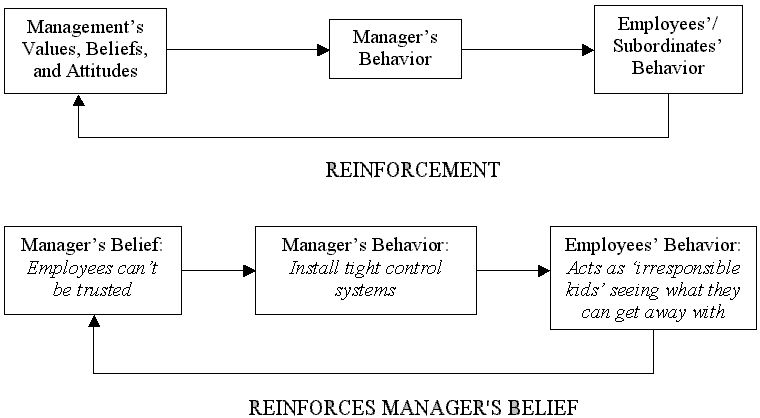
Theory X managers do not trust their
subordinates and believe that employees will not do a good job unless closely
supervised. The employees, realizing that management does not trust them, start
behaving irresponsibly. The manager, observing this behaviour, becomes more
distrustful of the employees and installs even tighter control systems.
According to McGregor, the manager's belief that employees cannot be trusted
leads to the employees' irresponsible behaviour, which in turn reinforces the
manager's belief that employees cannot be trusted.
According
to McGregor's Theory Y, managers who trust their employees give them overall
goals and tasks without instituting tight control systems or close supervision.
The employees, believing that management trusts them, do their best work
whether or not the manager is watching. The manager, seeing that the employees
are present and working, becomes even more convinced that they can be trusted.
Managers' attitudes influence their own behaviour, which in turn influences
employees' attitudes and behaviour, which then reinforces the managers'
original attitudes and behaviour.
Dimensions of Work-related Attitudes
Differences in work-related
attitudes exist across a very wide range of cultures. Geert Hofstede, a
Dutch researcher, found highly significant differences in the behaviour and
attitudes of employees and managers from different countries who worked for the
multinational company - differences that did not change over time. Hofstede
found that national culture explained more of the differences in work-related
values and attitudes than did position within the organization, profession,
age, or gender. In summarizing the most important differences, Geert Hofstede
found that managers and employees vary on four primary dimensions:
- individualism/collectivism
- relationship between the individual and the collectivity,
- power
distance - distribution of power in society,
- uncertainty
avoidance - relative comfort with uncertainty about the future, and
- masculinity/femininity
- society's endorsement of "masculine" or "feminine"
qualities.
Another compelling description of
how cultures differ has been developed by a Dutch economist and consultant, Fons
Trompenaars revealed seven dimensions of culture five of which are relevant
to the business areas. They provide the most practical way for managers to
consider how cultural differences influence their organization, functional area
or specific project. Over a 10 year period, Trompenaars administered research
questionnaires to over 15,000 managers from 28 countries. These five dimensions
are:
- Universalism
versus Particularlism - societal versus personal obligation
- Individualism
versus Collectivism - personal versus group goals
- Neutral
versus Affective relationships - emotional orientation in relationships.
- Specific
versus Diffuse relationships - degree of involvement in relationships.
- Achievement
versus Ascription - legitimation of power and status.
Universalism
versus Particularlism (Fons Trompenaars)
Universalism means essentially that
what is true and good can be discovered, defined and applied everywhere.
Particularlism means that unique circumstances and relationships are more
important considerations in determining what is right and good than abstract
rules.
A clear example of this dimension in
business is the role of the contract in different cultures. While weighty
contracts tend to be a way of life in universalist cultures, more particularist
cultures tend to rely on relationships with people they hold in high regard for
enforcement of a deal. Encounters between universalist and particularlist
business people may result in both sides being sceptical of each other's
trustworthiness.
Business areas affected by universalism/particularlism
|
Universalism |
Particularlism |
|
|
Individualism/Collectivism (Geert Hofstede & Fons Trompenaars)
This is the most often discussed
dimension of culture and also one of the most important in which cultures
differ. Individualism exists when people define themselves as
individuals. It implies social frameworks in which people are supposed to take
care only of themselves and their immediate families. Collectivism is
characterized by tight social frameworks in which people distinguish between
their own groups ("in-groups," such as relatives, clans, and
organizations) and other groups. People expect in-groups to look after their
members, protect them, and give them security in exchange for members' loyalty.
Determinism characterizes such
collectivist cultures as
Collectivist cultures control their
members more through external societal pressure - shame - whereas
individualistic cultures control their members more through internal pressure-
guilt. Members of collectivist cultures place importance on fitting in
harmoniously and saving face. Members of individualistic cultures place more
emphasis on self-respect.
Business areas affected by individualism/collectivism
|
Individualism |
Collectivism |
|
|
Neutral
versus Affective relationships (Fons Trompenaars)
All human beings have emotions, but
this dimension concerns the different ways that cultures choose to express
emotions. In affective cultures, expressing emotions openly is more
"natural", whereas more neutral cultures believe that emotions should
be held in check so as not to cloud issues or give the appearance of being out
of control.
There is a tendency for neutral
cultures to consider anger, delight or intensity in the workplace as "unprofessional'.
Conversely, affective cultures would probably regard their neutral colleagues
as emotionally dead, or as hiding their true feelings behind a mask of deceit.
This dimension determines two fundamental questions: should emotions be
exhibited in business relations? Is emotion a corrupting influence on
objectivity and reason? Americans tend to exhibit emotion yet separate it from
'objective' and 'rational' decisions. Italians and southern European nations in
general tend to exhibit and not to separate.
Business areas affected by neutral/affective relationships
|
Affective |
Neutral |
|
|
Specific
versus diffuse relationships (Fons Trompenaars)
This dimension deals with the degree
of involvement individuals are comfortable with in dealing with other people.
Every individual has various levels to their personality, from a more public
level to the inner, more private level. There are cultural differences, though,
in the relative size of people's public and private 'spaces' and also in the
degree to which they feel comfortable sharing those parts of their personality
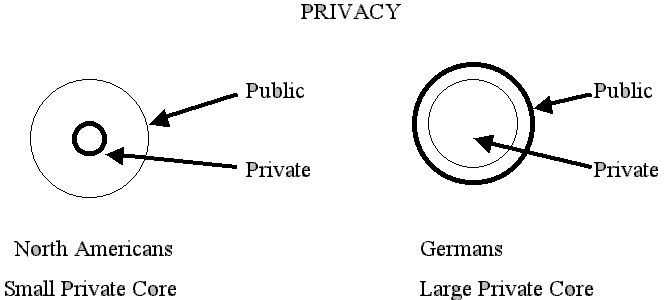
with other people. In specific cultures, people tend to have a large public
area and a smaller private area. In more diffuse cultures, the private 'space'
is usually larger while the public area is smaller and somewhat more carefully
guarded. While diffuse cultures may come across as cool initially, once in the
more closely guarded public space, the private space is more accessible than in
specific cultures. In other words, the whole individual tends to be involved in
relationships in diffuse cultures.
For example, the circle diagrams in Figure 2 compare the more specific North Americans with
the more diffuse Germans. North Americans are characterized by a small,
intimate private layer that is well separated from the more public outer
layers. In
Doing business with culture more
diffuse than one's own appears very time consuming. In specific cultures business
is done only in a mental sub-division called 'commerce' or 'work', which is
kept apart from the rest of life. In diffuse cultures, everything is connected
to everything. Personal preferences reveal character and form friendships. They
also make deception near to impossible. The initial investment in building
relationships is as important, if not more so, than the deal in some cultures.
Business areas affected by specific/diffuse relationships
|
Specific
|
Diffuse
|
|
|
Achievement
versus ascription (Fons
Trompenaars)
This cultural dimension of how
people relate to each other deals with how status and power in a society are
determined. Each society is presented both with characteristics assumed by a
person as a birthright and with those that are left to be filled in through
competition, personal effort or luck. Status can be based either on what
someone does, or on what someone is. Cultures differ in the ways they have
solved this dilemma. Religion seems to have been a very great influence on
their solutions. The achievement orientation, like so many modern Western
values, developed fully in the environment of the Protestant Ethic. An aspect
of Calvinism is the insistence that people must constantly work to improve
themselves. Each individual is supposed to be devoted to valued stressing
accomplishment, ambition and striving to do better. The Protestants were even
more achievement-oriented than the Catholics, who also valued hard work and
ambition highly. St Benedict's "Laborare et orare" translates as
"to work is to pray".
These values are not shared by traditional
Buddhist, Hindu and Judeo-Christian beliefs. For the Buddhist, salvation comes
not through a higher form of worldly life, but a withdrawal from the world.
Consequently, the world and its achievements not only have no religious
sanction, they are antithetical to religion.
In achievement-oriented countries, a
business person is evaluated by how well they performed an allocated function.
In ascriptive cultures, status is attributed to those who "naturally"
evoke administration from others, i.e. older people, males, highly qualified
persons and/or persons skilled in a particular technology or project deemed to
be of national importance.
While achievement-oriented
organizations justify their hierarchies by claiming that senior people
"achieve more" for the organization because their authority,
justified by skill and knowledge, benefits the organization,
ascription-oriented organizations justify their hierarchies as central to
creating the power to get things done. This may consist of power through people
and be participative. There is great variation within ascriptive cultures in
the form that power takes. Whatever form power takes, the ascription of status
to persons is intended to be exercised as power and that power is supposed to
enhance the effectiveness of the organization.
Power
Distance (Geert Hofstede)
The second dimension, power
distance, measures the extent to which less powerful members of organizations
accept the unequal distribution of power. To what extent do employees accept
that their boss has more power than they have? Is the boss right because he or
she is the boss (large, or high, power distance) or only when he or she knows
the correct answer (small, or low, power distance)? Do employees do their work
in a particular way because the boss wants it that way (high power distance) or
because they believe that it is the best way to do it (low power distance)?
In high power distance countries,
such as
Uncertainty
Avoidance (Geert Hofstede)
The third dimension, uncertainty
avoidance, measures the extent to which people in a society feel threatened by
ambiguous situations and the extent to which they try to avoid these situations
by providing greater career stability, establishing more formal rules,
rejecting deviant ideas and behaviour, and accepting the possibility of
absolute truths and the attainment of expertise.
Lifetime employment is more common
in high uncertainty avoidance countries such as
Individuals' concepts of the
organization vary markedly in their power distance and uncertainty avoidance
orientations, depending on which country they are from. Organizations in
countries such as
Employees in high power distance and
low uncertainty avoidance countries such as
Masculinity/Femininity
(Geert Hofstede)
Hofstede defines masculinity
as the extent to which the dominant values in society emphasize assertiveness
and the acquisition of money and things (materialism), while not particularly
emphasizing concern for people. He defines femininity as the
extent to which the dominant values in society emphasize relationships among
people, concern for others, and the overall quality of life.
According to Hofstede's definitions,
masculine societies define gender roles more rigidly than do feminine
societies. For example, women may drive trucks or practice law and men may be
ballet dancers or house husbands more easily in feminine societies. The
Scandinavian countries are most feminine; the United States, slightly
masculine; and
Swedish expatriate managers often do
not have the opportunity to explain their desire for balancing professional and
private life to their foreign colleagues. Swedes frequently surprise their
international clients when they expect the work week to end at
Hofstede's
masculinity/femininity dimension has important implications for motivation in
the workplace. Japanese "quality circles," for example, primarily
strive to achieve maximum quality (masculinity/ high uncertainty avoidance);
whereas the innovative Swedish work groups at Volvo attempt to enhance job
satisfaction and flexibility/femininity/low uncertainty avoidance). Because
feminine societies also tend to create high-tax environments, extra money often
fails to strongly motivate employees (

Are Organizations
Becoming More Similar?
Are organizations becoming more
similar worldwide or are they maintaining their cultural dissimilarities? Is
the world gradually creating one way of doing business; or is the world really
a set of distinct markets defined by equally distinct national boundaries, each
with its own culturally unique approach to business?
The question of convergence versus
divergence has puzzled the international management field for years. If people
around the world are becoming more similar, then understanding cross-cultural
differences will become less important. If people remain dissimilar, then
understanding cross-cultural differences in organizations will become
increasingly important.
To
clarify this issue, John Child, a British scholar, compared organizational
research across cultures. Reviewing a myriad of cross-cultural studies, he
found one group of highly reputable researchers repeatedly concluding that the
world is growing more similar and another group of equally reputable
researchers concluding that the world's organizations are maintaining their
dissimilarity. Looking closer, Child discovered that most of the studies
concluding convergence focused on macro level issues -such as the structure and
technology of the organizations themselves - and most of the studies concluding
divergence focused on micro level issues - the behaviour of people within
organizations. Therefore organizations worldwide are growing more similar,
while the behaviour of people within organizations is maintaining its cultural
uniqueness. So organizations in
Organization Culture
And National Culture
Over the last decade, managers and
researchers increasingly have recognized the importance of organization culture
as a socializing influence and climate creator. Unfortunately, our
understanding of organization culture has tended to limit rather than enhance
our understanding of national cultures. Many managers believe that organization
culture moderates or erases the influence of national culture. They assume that
employees working for the same organization - even if they are from different
countries-are more similar than different. They believe that national
differences are only important in working with foreign clients, not in working
with colleagues from the same organization.
Does organization culture erase or
at least diminish national culture? Surprisingly, the answer is no:
employees and managers do bring their ethnicity to the workplace. As described
earlier, Hofstede found striking cultural differences within a single
multinational corporation. In his study, national culture explained 50 percent
of the differences in employees' attitudes and behaviours. National culture
explained more of the difference than did professional role, age, gender, or
race.
Even
more strikingly, Laurent found cultural differences more pronounced among foreign
employees working within the same multinational organization than among
employees working for organizations in their native lands. After observing
managers from nine Western European countries and the United States who were
working for organizations in their native countries (e.g., Swedish managers
working for Swedish companies, Italian managers working for Italian companies,
etc.), Laurent replicated his research in one multinational corporation with
subsidiaries in each of the ten original countries. He assumed that employees
working for the same multinational corporation would be more similar than their
domestically employed colleagues, but instead he found employees maintaining
and even strengthening their cultural differences. There were significantly
greater differences between managers from the ten countries working within the
same multinational corporation than there were between managers working for
companies in their native countries. When they work for a multinational
corporation, it appears that Germans become more German, Americans become more
American, Swedes become more Swedish, and so on. Surprised by these results,
Laurent replicated the research in two other multinational corporations, each
with subsidiaries in the same nine Western European countries and the
Summary
Laurent's
research documents a wide range of cultural differences in work-related
behaviour and beliefs. Hofstede's four dimensions - individualism/collectivism,
power distance, uncertainty avoidance, and masculinity/femininity - highlight
the most important differences for organizations. To manage effectively in a
multinational or a domestic multicultural environment, we need to recognize the
differences and learn to use them to our advantage rather than ignoring them or
allowing them to cause problems. First, we investigated some of the ways in
which we perceive, describe, interpret, and evaluate cultural differences. Then
we are going to explore some of the ways in which organizations can best use
those differences to their advantage. The myth of the transnational organization-the
organization that is beyond nationality in its design and operation - remains,
in reality, a myth.