THE IMPACT OF CULTURE ON DOING BUSINESS INTERNATIONALLY
|
Outline |
|

Cross-Cultural Management: Introduction
The growing importance
of world business creates a demand for managers sophisticated in international
management and skilled at working with people from other countries.
Cross-cultural management studies the behaviour of people in organizations
around the world and trains people to work in organizations with employee and
client populations from several countries. It describes organizational
behaviour within countries and cultures; compares organizational behaviour
across countries and cultures; and perhaps most importantly, seeks to
understand and improve the interaction of co-workers, clients, suppliers, and
alliance partners from different countries and cultures. Cross-cultural
management thus expands the scope of domestic management to encompass the
international and multicultural spheres.
With the increasing amount of international trade, there is a need
understand the way that other nations operate their businesses. Often, there is
also a need to understand more about the other nations themselves. Once there
is an understanding of the way business operates in other nations, the
benefits and problems of working with them can be understood. As a result
decisions can be made regarding whether to work with other nations and whether
any special conditions or approaches are required.
A whole body of literature has appeared that documents cultural blunders
in international business efforts. The long lists of errors are accompanied by
the lists of do’s and taboos for international businesspeople. However,
they can’t cover everything and the lists of intercultural errors will
continue to grow because someone did not understand the why rather than the what of culture [Beamer L. & I. Varner,
p.2.]. Front-stage culture is easiest to observe and react to. At the front of
the stage, interactants can respond to cultural cues and modify their own
behaviour, creating a transactional culture between them. At the same time,
individuals’ own cultural backgrounds give rise to the backstage cultural
behaviours. These are not so easily observed by others as are the front-stage
behaviours, but they underlie what others do not see. Back-stage behaviours are
usually unconscious and include the way people make decisions, respond to
deadlines, accomplish tasks, rank events by importance. If you understand the why of culture, you can explain
back-stage behaviour.
The why is the essence of a people’s
culture. If you understand why people value some things, you can make good
guesses about why they value other things. If you understand why they behave a
certain way, you can interpret other behaviour with a degree of accuracy. Once
you have an insight into what people think is important and how they behave,
you can do business with them.
What is Culture?
Geert Hofstede, the
author of research in intercultural communication and organisational practices,
refers to culture as ‘the software of mind’. Beamer L. & I. Varner take that computer analogy
further and say that culture is the
operating environment that enables software programs to run. Culture is
like DOS or Unis or Windows: it is what enables us to process information in
various specific applications. The metaphor of windows is very appealing to describe culture: culture is a mental
set of windows through which all of life is viewed.
Many definitions of
culture exist in the literature. Gudykunst & Kim (1984) equate culture with
a theory "for interpreting the world and knowing how to behave"
(p.13). Edward Hall (1966), a key researcher into cultures wrote ‘Culture
[is] those deep, common unstated experiences which members of a given culture
share, which the y communicate without knowing, and which form the backdrop
against which all other events are judged. Hofstede suggests that culture is
"to human collectivity what personality is to the individual" (1984,
p.21). Brislin (1993) suggests that it consists of ideals, values, and
assumptions about life that are widely shared among people and that guide
specific behaviours. To Samovar and Porter (1972) culture "manifests
itself both in patterns of language and thought and in forms of activity and
behaviour. These patterns become models for common adaptive acts and styles of
expressive behaviour which enable people to live in a society within a given
geographical environment at a given state of technical development" (p.3).
Finally, Condon and Yousef (1975) remind us that "we cannot separate culture
from communication, for as soon as we start to talk about one we are
almost inevitably talking about the other, too" (p.34)
Culture can't be defined
specifically because its meaning is different for each individual. It is
dependent on the circumstances in a society someone grows up and any other
influences in daily life. The definition of culture develops with the
individual's experiences. If a person is talking about its culture, just a
personal view how this particular person understands culture can be expected.
Scientists often try to find a definition for what culture is, like Kroeber and
Kluckholm (1952) who identified 164 definitions.
There are no definitions
which describe the term culture precisely. Culture varies obviously from
country to country. If you talk about a nation's culture there are often
prejudices involved. Which definition or explanation ever is chosen they have
all one in common: they are all based on personal experiences. This is
definitely the best way to prove and find out something about a culture.
Researchers depend on firsthand observation and experiences to understand
various types of culture. As well as managers, if they want to be international
and competitive.
Being able to operate in a multicultural environment it is important to know
and be aware of the cultural differences and peculiarities. It is obviously not
enough to categorize Italians as people spending most of their time in the sun
while eating pizza and drinking wine. There is more that has to be learned to
become successful in a foreign market. A major challenge for managers is to
overwhelm their myopic view. It takes time to develop an open attitude
and a cultural sensitivity which enables managers to look carefully to the
foreign market and point out the customers needs there and not transferring the
domestic market needs.
A bad example for what management can do wrong if not
looking specifically to the foreign market is Eurodisney in Paris/France. The
Disney management definitely ignored many basic questions they should have
asked themselves before launching this project. One of their mistakes was also
related to a cultural aspect. E.g. Eurodisney prohibit drinking alcohol inside
of the park. Especially the French visitors were embarrassed about that where
drinking wine to a meal belongs to the typical French culture. Disney has
changed the regulation later on but in the beginning they didn't respect or
take the foreign culture into account.
To understand the
differences between domestic and global management, it is necessary to understand
the primary ways in which cultures vary. After cataloguing more than one
hundred different definitions of culture, Kroeber and Kluckholn (31:181)
offered one of the most comprehensive and generally accepted definitions:
Culture consist of patterns, explicit and implicit of
and for behaviour acquired and transmitted by symbols, constituting the
distinctive achievement of human groups, including their embodiment in
artefacts; the essential core of culture consists of traditional (i.e.
historically derived and selected) ideas and especially their attached values;
culture systems may, on the one hand, be considered as products of action, on
the other, as conditioning elements of future action.
Culture is the coherent,
learned, shared view of a group of people about life’s concerns that
ranks what is important, furnishes attitudes about what things are appropriate,
and dictates behaviour. [Beamer L. & I.
Varner, p.3]
Culture is therefore,
- A shared system of meanings. Culture dictates what groups
of people pay attention to. It guides how the world is perceived, how the
self is experienced and how life itself is organized. Individuals of a
group share patterns that enable them to see the same things and this hold
them together. Each person carries within them learned ways of finding
meaning in their experiences. Culture is something (as in the case of
morals, laws and customs) that shapes behaviour, or … structures
one's perception of the world. In order for effective, stable and
meaningful interaction to occur, people must have a shared system of
meaning.
- Relative. There is no cultural absolute. Different
cultures perceive the world differently and have different ways of doing
things, and there is no set standard for considering one group as
intrinsically superior or inferior to any other. Each national culture is
relative to other cultures' ways of perceiving the world and doing things.
- Learned. Culture is derived from one's social
environment, not from one's genetic make-up. The older members of the group
try to pass it on to the younger members.
- About groups. Culture is a collective phenomenon that is about
shared values and meanings.
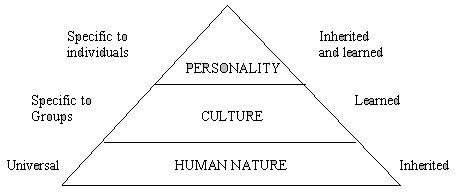
Managers frequently see
culture as "the collective programming of the mind which distinguishes the
members of one human group from another … the interactive aggregate of
common characteristics that influences a human group's response to its
environment". The noted business author and scholar Geert Hofstede
explains that it lies between human nature on the one side and individual
personality on the other. Figure 1.1 shows three levels of uniqueness in human
mental programming. In general, we see people as being from different cultures
if their ways of life as a group differ significantly, one from another.
Figure 1.1
THREE LEVELS OF HUMAN MENTAL PROGRAMMING
|
|
What culture is NOT
- "Right" or "wrong".
- Inherited
- About individual behavior. There are wide variations in individual
values and behavior within each national culture.

Different Layers of Culture
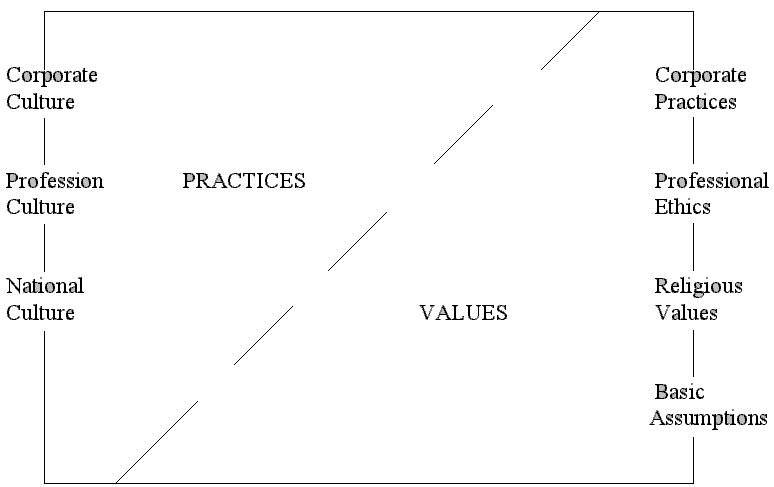
Each person carries around several
layers of cultural 'programming'. It starts as a child when one learns basic
values: what is right and wrong, good or bad, logical and illogical, beautiful
and ugly. This 'first level' of culture is the deepest and will vary according
to the culture in which we grow up. Many psychologists believe that one's basic
values are in place by the age of about 10 years, and that they are not easily
changed.
Other layers of culture are learned
or 'programmed' in the course of one's education, through professional or craft
training and in organizational life. Some of the aspects of culture learned
later have to do with conventions and ethics in one's profession. These layers
are more ways of doing things, or practices, as opposed to fundamental
assumptions about how things are. (Figure 1.2)
Figure 1.2
LAYERS OF CULTURAL "PROGRAMMING"
Source:
Adapted from Hofstede, G., Cultures and Organizations.
Much
is written about constant change cultures undergo. Agents of change include
global companies like Coca-Cola or Sony. It is true that popular culture
– or its widely consumed products such as music, food, clothing, etc.
– does constantly change. But back-stage culture, the values, attitudes,
and behaviours that have been learned from birth, change very little and very
slowly.
Most significant change in social organization
occurs with economic change. A study of many generations; values will be
necessary to demonstrate that cultures actually change, and that the change is
more than proceeding and receding emphases on values that exist within the
culture. Technology is called the agent of cultural change as it is the way
humans relate to their environment. Meanwhile, cultures appear to remain
unchanged at deep levels and only change on the surface. This is front-stage
behaviour, where popular culture thrives.
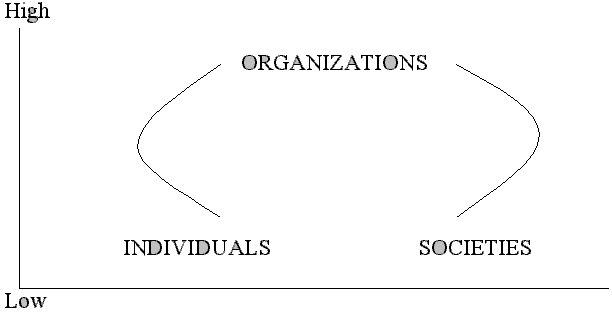
Figure 1.3
CHANGE CAPABILITY
Source:
Edited by Evans P., Doz, Y. And Laurent, A., Human Resource Management in
International Firms
Because
of the timing and sequence of learning these values and ways of doing things, their
capacity for change is also very different. The diagram shown in Figure 1.3
illustrates change capability. Individuals and societies have a lower
capability for change than do organizations.
Typical Reactions to Unfamiliar Cultures
The most common response to cultural diversity is to
choose somehow not to accommodate it. Human reaction is to reject difference.
We insist on sameness and require people to conform to us. Or we deny
difference, choosing not to see it even when it is there. It is much more
comfortable to believe that your own culture is all you will ever need to know,
that it cannot be improved upon than to embark upon a riskier openness.
Assumptions of superiority. A universal response to differences in cultures is:
‘of course they’re different, but we’re better.’ What
this does is minimize difference by making it unimportant compared to
one’s own culture. Most cultures assume their own values and practices
are superior to those of the rest of the world.
Parochialism
Parochialism
means viewing the world solely through one's own eyes and perspective. A person with a parochial perspective does not recognize other people's
different ways of living and working nor that such differences have serious
consequences. People in all cultures are, to a certain extent, parochial.
Recently journalists, politicians, and managers alike have decried Americans'
parochialism. Americans speak fewer foreign languages, demonstrate less
interest in foreign cultures, and are more naive in international business
situations than the majority of their trading partners. In The Tongue-Tied
American, United States Congressman Paul Simon deplored the shocking state of
foreign language illiteracy in the
A 1975 Dun's survey
found that only a handful of the 87 chairmen and presidents of the 50 largest
American multinational corporations could be considered career internationalists.
Of 87 top executives, 69 had had no oversees experience at all, except for
inspection tours. Whereas almost two-thirds (62%) of US executives today see
'emphasizing an international outlook' as very important for the CEO of
tomorrow, only a third (35%) consider experience outside of the United States
as very important, and fewer than one in five (19%) consider foreign language
training as very important. By comparison, 82 percent of non-United States
executives consider an international outlook as very important for future CEOs;
twice as many (70% versus 35%) consider experience outside their home country
as very important, and more that three times as many (64% versus 19%) consider
foreign language training as very important.
Why have many Americans
ignored the need to think and act globally? Americans' parochialism is
understandable and at the same time unfortunate. Because the
The
The
The
Germans live in
The
[J.H.Goring
1909 nursery rhyme, quoted in Hofstede,
Cultures
and Organisations, p. 235]
Business
people can generally depend on this: Members of other cultures, deep down in
their heart of hearts, are convinced their own culture is the right one. People everywhere tend to
assume their own culture is right and normal, and to assess all other cultures
by how closely they resemble their own. Most people, especially those with
little experience of other cultures, believe their own culture (ethnicity) is
at centre of human experience – hence ‘ethnocentrism’. The closer another culture is to your own,
the truer it seems to be. Along with the preference for cultures that are
similar to our own is the view that difference is dangerous, or even wrong.
Thus ethnocentrism may lead to complacency. We may not make an effort to look
further that our own culture, and we may see little importance in understanding
other cultures.
Business
organizations that have proven they can succeed in one culture often adopt an
ethnocentric position: we know how to make it work for us at home, so we can
make it work for us anywhere. After all, learning another culture takes time,
effort, and resources. It’s much easier for an organization to operate
from an ethnocentric position. But unfortunately it may be much costlier.
Assumptions of Universality
One
of the common comment you often hear from travellers to foreign countries is,
‘they may talk (dress, eat, etc.) differently, but underneath
they’re just like us.’ But this is profoundly mistaken and
potentially dangerous. People underneath are NOT alike. As culture is the whole
view of the universe from which people assess the meaning of life and their
appropriate response to it, they begin with different operating environments,
run different software, have different database and process information
differently.
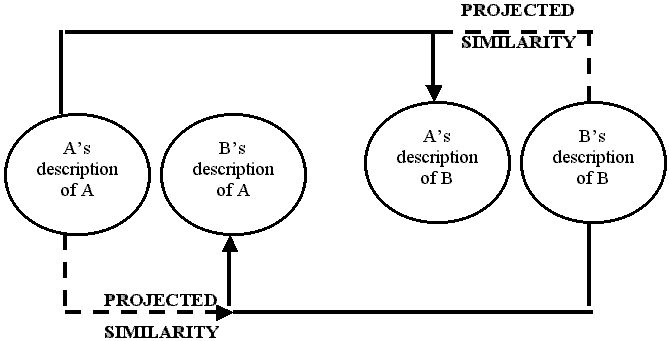
Projected cognitive similarity
(Figure
1.4) refers to the assumption that people are more similar to you than they
actually are, or that a situation is more similar to yours when in fact it is
not. Projected similarity reflects both a natural and a common process. American
researchers Burger and Bass worked with groups of managers from fourteen
different countries. They asked each manager to describe the work and life
goals of a colleague from another country. In every case the managers assumed
that their foreign colleagues were more like themselves than they actually
were. People may agree on goals – for example, the corporate goals of
organization – but they may expect to reach those goals by different
methods.
Projected
similarity involves assuming, imagining, and actually perceiving similarity
when differences exist. Projected similarity particularly
handicaps people in cross-cultural situations. As a South African, I assume
that my Greek colleague is more South African than he actually is. As an
Egyptian, I assume that my Chilean colleague is more similar to me than she
actually is. When I act based on this assumed similarity, I often find that I
have acted inappropriately and thus ineffectively.
Figure 1.4
Projected Similarity
At the base of projected similarity
is a subconscious parochialism. I assume that there is only one way to
be: my way. I assume that there is only one way to see the world: my way. I
therefore view other people in reference to me and to my way of viewing the
world. People may fall into an illusion of understanding while being unaware of
... [their] misunderstandings. "I understand you perfectly but you
don't understand me" is an expression typical of such a situation.
Or all communicating parties may fall into a collective illusion of mutual
understanding. In such a situation, each party may wonder later why other
parties do not live up to the "agreement" they had reached.
Most international managers do not
see themselves as parochial. They believe that as world travellers they are
able to see the foreigner's point of view. This is not always true.
While it is important to understand
and respect the foreigner's point of view, it is not necessary to accept or
adopt it. A rigid adherence to our own belief system is a form of parochialism,
and parochialism underlies projected similarity.
Business is
multicultural; no organization can afford to go along believing that members of
different cultures are all seeking to conform to one culture, or that one day
differences will cease to exist. Therefore, the key for business is to find ways for people who think
differently to work together.
Importance of self-knowledge
Know
thyself;
Know thy
enemies:
One hundred
battles;
One hundred
victories
SunTzu,
Chinese martial philosopher
The best
response for business across cultures is openness to what may be learned about another
culture and drawn from it in order to communicate more effectively with its
members. The same openness needs to be applied to one’s self and
one’s own culture.
In order to
understand the other person you have to understand yourself. It isn’t
easy because most what makes up a culture is absorbed unconsciously in the
growing-up process of socialization. The transparent nature of culture windows
is the basic difficulty in coming to terms with one’s own culture. The
more deeply embedded cultural valued and attitudes are, the less conscious they
are and the harder they are to examine. As Hall says in describing a man in a
foreign environment, ‘The more that lies behind his actions…, the
less he can tell you’ (Hall Beyond
Culture, p.116).
Most people
assume that what they take for granted as natural
is what everyone on this planet also considers natural. Most people only
discover when they come into contact with something different that the ideas
they hold as absolute truths are actually culture-based positions when basic
assumptions are challenged one typical response is to find the other
culture’s assumptions are irrational.
Ethnorelativism
Intercultural
sensitivity is not natural. It is not part of our primate past, nor has it characterized
most of human history. Education and training in intercultural relations is an
approach to changing our ‘natural’ behaviour. With concepts and
skills developed in this field, learners will transcend traditional
ethnocentrism and explore new relationships across cultural boundaries.
According to Hoopes (1981) ‘the
critical element in the expansion of intercultural learning is not in the
fullness with which one knows each culture, but the degree to which the process
of cross-cultural learning, communication and human relations [has] been
mastered (20).’ He lists the following stages of intercultural
learning: ethnocentrism, awareness, understanding, acceptance/respect,
appreciation/valuing, selective adoption, and, in the end, assimilation, adaptation,
biculturalism, multiculturalism.
Fundamental
to ethnorelativism is the assumption that cultures can only be understood
relative to one another and that particular behaviour can only be understood
within a cultural context. There is no absolute standard of rightness or
‘goodness’ that can be applied to cultural behaviour. Cultural
difference is neither good nor bad; it is just different, although some
cultural behaviours may be more adaptive than others to particular
environmental conditions. One’s own culture is not any more central to
reality than any other culture, although it may be preferable to a particular
individual or group. Stages of ethnorelativism begin with the acceptance of
cultural difference as inevitable and enjoyable, through adaptation to cultural
differences with intercultural communication skills, to the final stage of
integration in which ethnorelativism may be synthesized into a coherent and
workable new identity.
Central to
any intercultural communication skill is the ability to experience some aspect
of reality differently from what is ‘given’ by one’s own
culture. One of the best exercises for developing such empathy and reducing
parochialism and projected similarity is role reversal. Imagine that you are a
foreign businessperson. Imagine the type of family you come from, the number of
brothers and sisters you have, the social and economic conditions you grew up
with, the type of education you received, the ways in which you chose your
profession and position, the ways in which you were introduced to your spouse,
your goals in working for your organization, and your life goals. Asking these
questions forces you to see the other person as he or she really is, and not as
a mere reflection of yourself. It forces you to see both the similarities and
the differences, and not to imagine similarities when differences actually
exist. Moreover, role reversal encourages highly task-oriented businesspeople,
such as Americans, to see the foreigner as a whole person rather than someone
with a position and a set of skills needed to accomplish a particular task.
Interacting with Other Cultures
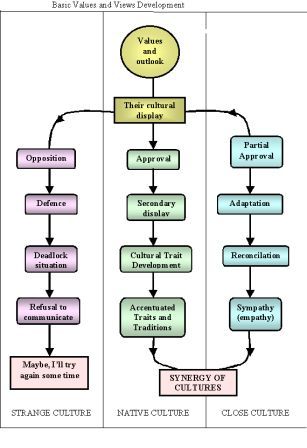
Figure 1.5 shows various scenarios according to which our
views on the life develop depending on the culture in which we try to establish
them. It is difficult to estimate people by the way they look: majority of
businessmen are dressed the same. Only when we say or do something the other people can understand how
we live. Our actions or words can be described as the cultural display
or event as they serve to show our cultural aims. If an Italian is half
an hour late for a foreign business meeting, in his own native culture it will
cause no indignation: others also behave like that. However, in
Intercultural Transitions
The
‘Culture Shock’ is
one of the inevitable experiences of immersion in a new and unfamiliar culture.
It‘s important to know that culture shock and its symptoms are normal and
to be expected in cross-cultural immersion experiences.
Culture
shock is the sense of dislocation along with the problems, psychological and
even physical, that result from the stress of trying to make the hundreds of
adjustments necessary for living in a foreign culture.
The first
stage of experiencing a new culture is usually euphoria (or honeymoon).
This stage, when everything about the exciting new adventure is wonderful,
generally lasts no longer than two weeks.
The second
stage is usually a downturn as disillusionment
and frustration arise. This stage
people usually refer to when they use the term ‘culture shock’.
This is the sense of dislocation that results from finding out that
inadequacies exist in your understanding, your mental road map, for navigating
in this new culture. Inevitably there are disappointments, in yourself and in
others; inevitably you make mistakes. People experience psychological and
physical symptoms of culture shock: depression, irritation, hostility and
suspicion towards members of their host culture, chronic fatigue, lack of
energy, etc. this stage can last longer than the first euphoric stage –
perhaps months.
The third
stage is adjustment. As the expatriate
sees both sides and learns more about how the other culture works, he or she is
able to cooperate more effectively with the members of the host culture. At
this stage business can probably be conducted successfully.
The fourth
stage, integration (maturity), occurs when the expatriate
becomes fluent enough in the other culture to move easily within it and not be
thrown by the different attitudes, beliefs, and values and by the behaviours
they generate. At this stage the expatriate is able to identify with the host
culture. Businesses whose employee achieves integration in another culture may
feel at some risk: they may worry that their employee, who is now so at home in
another culture, does not totally represent them anymore.
Most
people who work in another culture, regardless of the length of the stay,
experience all four stages of culture shock. Furthermore, the longer one stays,
the more cycles one goes through; the fourth stage leads to another euphoric
stage, followed by frustration and disappointment, followed by adjustment and
so on.
Types of Migrant groups
- sojourners - travellers, voluntary;
usually limited period of time and with a specific purpose. Educational
exchanges, corporate personnel, etc.
- immigrant - mostly voluntary movement
seeking a better life, or to be with family, or to find jobs or money or
opportunity. "Choice" is relative but some measure of it is
present for the immigrant.
- long term refugees - forced to relocate permanently, usually due to economic,
political, social, or natural disaster.
- short term refugees - forced to relocate for shorter periods of time (though sometimes
indefinitely). The difference is they usually intend to return.
Existing Models of
Adaptation
- Anxiety & Uncertainty Management Model (Gudykunst) - sees ambiguity as the key to managing
intercultural relationships. The goal of communication is seen as reducing
ambiguity and its consequent anxiety. predictive uncertainty -
can't predict what the other culture will do in reaction to something. explanatory
uncertainty - you can't explain why the culture will react in a given
way. This model helps us to understand how we negotiate new cultural
contexts by decreasing uncertainty and anxiety.
- U-Curve Theory of Adaptation
(Sverre Lysgaard) - argues that adaptation follows a "U-Curve."

- Transition Model - Janet Bennett talks about
culture shock as a smaller category fitting within "transition
shock" - other transitions e.g. aging also produce similar crises and
shocks. One assumption of the transition model is that all transitions
involve loss as well as change - experiencing the new first involves
losing the old.
"Fight
or flight" - most people adapt to abrupt transitions to new situations by
leaving or by fighting against perceived threats. Such responses can be useful
and productive, but in more extreme forms can be hostile and counterproductive.
- Communication System Model (Young Yun Kim)
- argues that stress and anxiety provoke adjustment and eventually growth.
This process occurs through communication. Communication helps the
adaptation take place, but it can also increase culture shock because it
increases exposure to the other culture.
Three stage
process of adaptation:
§
taking things for granted
(and surprise when that doesn't work - expectations can be wrong)
- making sense of new patterns through communication experiences
- understanding new information
Individual
Influences on Adaptation.
Certainly race, class, gender,
personality, age, and other factors will all play a role. The environment or context
might be seen as more or less "friendly" to adaptation. It can help
if the new environment is closer to the home culture (e.g. Americans going to
the
Modes
of Adaptation
- assimilation - "melting pot" - loss of old culture and complete
embrace of the new
- separation - can be voluntary (e.g. Amish or Hasidim)
or involuntary (e.g. apartheid).
Separation involves the maintenance of a distinct and separate culture
from the dominant culture.
- integration - daily interaction with the
new culture while maintaining a strong sense of cultural distinction.
(e.g. Armenians in US cities).
- marginalization - the culture is out of touch
both with new and old cultures - usually b/c they have been pushed to the margins
by the dominant culture, or in some cases been practically exterminated
through genocidal policies (e.g. many native Americans experience this).
Reentry. Often reentering the old culture creates a new
cycle of adaptation (the "W" curve).
The Culture Triangle
Thus,
culture has been defined in many ways, including the following:
·
A collective programming of the
mind.
·
The method society evolves to solve
problems.
·
Everything we take for granted
·
Patterned ways of thinking feeling
and reacting, acquired and transmitted mainly by symbols, constituting the
distinctive achievements of human groups including their embodiment in
artifacts; the essential core of culture consists of traditional ideas and
especially their attached values. In many ways, culture could be described as
the personality of society
·
The way we do things round here.
In a corporate environment culture
usually means the behaviors and beliefs, norms and values which employees have
in common. An investigation into what
lies at the heart of cultural differences leads into history, sociology,
philosophy, theology, mythology, in fact every branch of the humanities.
Some of the differences may seem
superficial: dress, etiquette, food, hours of work. You can get used to them
while you get on with the business. Some of the differences may be an
improvement: people are more courteous, service is better. Others can be
irritating, like the convention of punctuality. The least dangerous differences
are the obvious ones: we notice them and can make adjustments. The dangerous
ones are those that lie beneath the surface. Beliefs about the role of the
boss, the function of meetings, the relevance of planning, the importance of
teamwork, the very purpose of an organization are often taken for granted among
colleagues. Yet they are very different even among close neighbors. Outward
similarities between European business goals can conceal real differences in
how they should be realized.
What determines how people behave
and how they interact? In what way do they differ from company to company and
country to country? And which differences get in the way of working effectively
together?
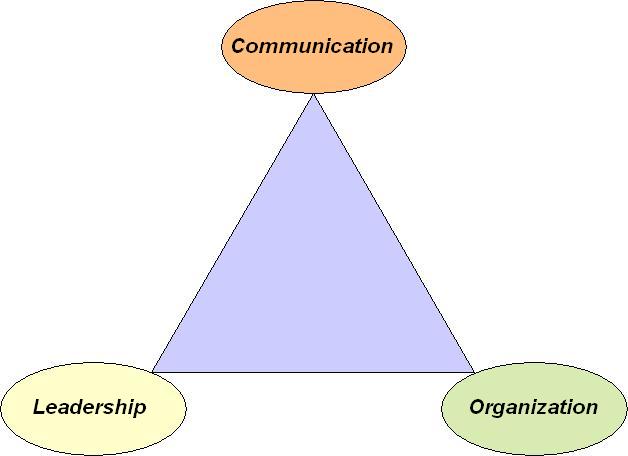
Three categories of behavior
predominate: communication, organization and leadership.
These can be depicted in the Culture Triangle (see Figure 1.6).
Communication
is centered around language. But it extends into non-verbal communication and
other behaviors which give messages about our expectations and beliefs.
The other two categories relate to values.
The first is a set of values about organization and the role of
individuals within it. How is work organized? How do you forecast and plan? How
is information gathered and disseminated? How do you measure results?
The second is a set of values about leadership.
Who has power? How do you get it? How do you exercise it? What is authority
based on? Who takes decisions? What makes a good boss?
Figure
1.6. The Culture Triangle
|
|
There is a spectrum of belief in
each of these dimensions which combine to influence how people behave towards
each other.
Several
thousands national and regional cultures in the world may be conventionally
divided into three groups: monoactive (task-oriented, clearly
planning the activity), polyactive (people-oriented, talkative
and communicative) and reactive (introvert, respect-oriented
listeners). These kinds of cultures are discussed in detail in the topic Understanding Other Cultures.
Business Cultures
Businesses often reflect the values
of the cultures and countries in which they developed. There are many varieties
of what may be referred to as ‘industrial cultures'. Industry can be
examined from a variety of standpoints to show how the same situations can be
seen differently, not only because of occupational position and organizational
structure, but also because of different cultural perspectives. Business and
management are integrally bound up with questions of strategy, perceptions of
risk and the interplay of cultures at different levels: organizational,
occupational, ethnic and national.
The way all organizations work and
do business is influenced by the work-based culture that surrounds them. Some
of the cultural influences come from the nation or region in which the
organization is based. Other cultural influences are related to the industry or
market in which the organization operates.
Being aware of the influences
of culture on organizations will help people understand the way the various
parts of their organization works, as well as their customers and suppliers.
Understanding the culture will allow improved processes to be developed, as
well as establishing better relationships for the short and long term.
Investigations have shown that there
are two distinct types of culture which organizations need to be aware of:
|
|
National Culture
- Which encompasses all characteristics and influences upon the
individual or group, whether they come from national, social, work, or religious
origins. |
|
|
Business Culture
- Which encompasses only those characteristics and influences
which relate to the work, or business, of the individual or group. |

A business culture can be loosely defined
as the atmosphere that permeates a business. Business culture is a business ‘feel’
or how it is sensed. Since we cannot accurately define business culture many
owners and managers think it is all hot air. Just because we cannot define
something precisely does not mean it does not exist.
Organizations which are
fundamentally different to each other frequently have to work together, whether
through mergers, alliances or other types of joint venture. The organizations
which need to work together must understand the business culture of the
participants, whilst being aware of the specific ways in which they prefer to
manage and operate their business. This knowledge will help to ensure that
appropriate partners are selected for the work involved. Understanding the
other participants working methods can also reduce the occurrence of problems
between the partners, and provide methods of resolving them when they occur,
improving chances for success of the work.
In the world of business, where the bottom line is about both human
capital and profitability, diversity arises in various forms:
|
|
The merging of two or more cultures: This
could involve two large computer firms now working together due to a merger.
It could involve the emerging need for two divisions within a company to work
closely together, when they are located in and populated by two or more
national groups. Not only language differences, but also communication
patterns, planning methods, ways of rewarding employees, value placed on
time, and many other factors may differ dramatically--creating
misunderstanding and other difficulties. |
|
|
The wish to help leadership teams become less
male-oriented: Historically male patterns of
leadership begin to shift as the leadership team becomes more
gender-balanced. Antiquated, but still active, stereotypes and prototypes
suddenly appear and interfere. |
|
|
The work culture changes as new management
arrives: An organization run by the founders group
grows, and the next generation begins to lead. The former culture, familial
and possibly patriarchal, is shocked by the emergence of a business culture
seen as "strict." Promotions, raises, and complaints are more
formal, replacing the "open door" policy of the
"parent-leader." |
|
|
Consensus becomes difficult due to diverse
understandings: Pacing and work rhythms differ
remarkably between cultures, particularly across national groups. Consensus
is more difficult to achieve |


Summary
This chapter began with a glimpse at why
cross-cultural management issues matter to modern organizations. The culture
was defined as coherent, relative, learned and shared. Then three levels of
human mental programming were described, as well as typical reactions of people
to unfamiliar cultures, such as assumptions of superiority, ethnocentrism, and
assumptions of universality.
The chapter also considered the importance of
self-knowledge and the concept of ethnorelativism as the effective way to
understanding other cultures. It also covered the challenges of interacting
with other cultures, including culture shock and reverse culture shock,
existing models of adaptation. The concept of culture triangle and that of
business culture were introduced.
The next chapter is going to look into the ways how
culture functions and how it ranks values, furnishes attitudes and dictates
behaviours.
Questions for Reflection
- Think
how national differences can serve as a source of competitive advantage
for a global economy.
- Why
should an international executive understand cultural differences?
- In
which ways is your culture parochial? In which ways is it ethnocentric?
Give concrete examples from situations that you have actually observed or
that you have read about in press.
- Even
though the
- Comment
on the following: A Canadian businessman bows to a Japanese businessman,
although the Canadian would not bow to his fellow countryman; a Taiwanese
businesswoman may kiss the cheek of a Brazilian businessman on first
meeting, but would not kiss the cheek of a Taiwanese man or woman. What
does such behaviour show in terms of interaction with another culture?
- In
reading the international press, identify a situation that involves people
from more than one culture. Analyse the behaviour of participants in view
of front-stage and back-stage culture.
Key Terms
|
Accommodate adjustment ambiguity
attached values assimilation awareness biculturalism capacity for change coherence competitive advantage core of culture cultural blunder cultural diversity cultural sensitivity culture shock empathy ethnocentrism |
ethnorelativism euphoria expatriate frustration fundamental assumptions host culture inadequacies integration immersion maturity marginalization melting pot monoactive monolingualism multiculturalism parochialism perception |
polyactive prejudice programming of the mind
projected cognitive similarity reactive re-entry relocate response role reversal tolerance transitions shared values self-defeating sense of dislocation sojourners suspicion uncertainty |