|
|
Contributing
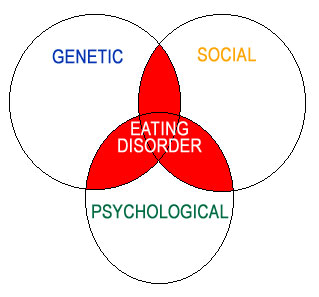
Factors: There are many thoughts and viewpoints on the causes of anorexia and bulimia, which are as varied and different as the sufferers themselves (Friedman, 2000). Therefore, a few of the main known predisposing factors will be described even though there are many more which are just as significant. Individuals suffering from anorexia or bulimia may express other ideas or thoughts for their developing an eating disorder. Psychological Factors: decreased self-esteem, feelings of inadequacy, feelings of lack of control, depression, anxiety, loneliness Psychosocial Factors: troubled family/ interpersonal relationships, difficulty expressing emotions/feelings, history of being teased re .body size, history of sexual/physical abuse Social Factors: culture that glorifies thinness, narrow definitions of beauty (perfect body means thinness), cultural norms that value people for their physical appearance and not for their inner qualities Other: still researching the biochemical/biological causes, chemicals that control appetite and hunger have been found to be unbalanced (NEDA, 2002) More in-depth look at some causes: Family: It is thought that girls from homes where parents had rigid ideas of who their daughter should be, and had enforced a lot of control over their daughters, prevented them from really developing a strong sense of self. (Pipher, 1995). Levenkron (2000) agree with this idea and feel that if girls are not at peace with their relationships with their parents they may feel that their childhood has �incomplete� aspects, which may prevent them from feeling ready for independence from home. Therefore, they develop this fear of independence, loss of parental protection, fear of fitting into the world with a career, and of intimacy, which are all adult activities. Therefore, developing an eating disorder acts as a way to keep them from dealing with these fears. They also tend to come from families that have difficulties expressing emotions and don�t deal well with conflict. Maine (1991) believes that it is the relationship between father and daughter that can be a factoring the development of an eating disorder. He believes that girls have an inbred desire to be emotionally connected with their fathers. If they do not have this connection then this longing may translate into preoccupation with food and weight. Society: It is unfortunate, but our society today is believed to play a definite role in the development of eating disorders in women because of the messages given to women and the emphasis that thinness equals beauty. In fact Levenkron (2000), mentions that females born into a culture of feminine thinness are more prone to develop anorexia or bulimia. Society teaches girls that they are to be nurturers, understanding, compliant, and most importantly, pretty (Friedman, 2000). They learn to be silent in conflict rather than risk open conflict that could lead to rejection, isolation, and violence. Instead they learn to take care of the emotional needs of others instead of themselves, which leads to loss of self. By listening to the needs of others they are encouraged to repress their feelings and only say �nice� things. With these restrictions that often come about near adolescence, girls associate these restrictions with the weight gained in puberty, so they deflect feelings onto their body and use �fat� as a code for hidden, underlying feelings (Friedman, 2002). Media: It is hard for anyone to think about the media and not equate it as a causative factor in the development of an eating disorder. There are images everywhere of thin models, who have grown thinner over the years (National Eating Disorders Association [NEDA], 2002). Different diets and weight loss products are advertised everywhere. As a fact, it is estimated that women�s magazines have 10.5 times more advertisements promoting weight loss than those for men (NEDA, 2002). These messages are reaching women and girls, which makes them feel that their bodies are not the right shapes and they need to be thin in order to be acceptable (Friedman, 2002). A person cannot get away from this tidal wave of pressure which gives the message that thin is beautiful and should be desired, especially for women. Admittedly, the media does not cause eating disorders, but it certainly intensifies a person�s preoccupation with food and weight, which is a key part of the start of anorexia and bulimia (Friedman, 2000).
References National
Eating Disorders Association. (2002). Treatment of eating disorders. Retrieved
Pipher,
M. (1995). Hunger Pains: The modern woman�s quest for thinness.
Toronto:
|

|
Treatment: Often times it is difficult for a person with an eating disorder to want to seek treatment because they are in denial that they have a problem and because it is helping them in some way. An eating disorder serves a purpose for the person who has it. Therefore, giving it up means giving up something they have come to trust and rely on, and means dealing with the emotions and feelings underneath, which they may not be ready to deal with (Crook, 1992). In some cases because they are medically in jeopardy, some people will have to go into treatment before they are ready (Levenkron, 2000). Weight restoration needs to be done before psychological treatment because nutritional deficiencies make it even harder for them to deal with their emotions since they have difficulty functioning mentally (Crook, 1992). There are a variety of ways of treating anorexia and bulimia. Each method has its benefits and drawbacks and it is up to the person seeking treatment which method to utilize. Either way recovery is very difficult and requires a tremendous amount of effort and is very frightening for the person dealing with the eating disorder. Unfortunately, even with treatment Levenkron (2000) states that 70% of people never recover completely. NEDA (2002) also points out that the most effective long lasting treatment of an eating disorder is some form of psychotherapy or counseling along with attention to the obvious medical and nutritional needs. Furthermore, NEDA (2002) states that the sooner girls and women are diagnosed and receive treatment the better the long term prognosis. Few aspects of treatments: Counseling: This type of treatment involves a psychologist, psychiatrist, or counselor who understands about eating disorders and can identify important issues that need attention, and can help develop a treatment plan. The therapist works with the client to help them identify the psychological issues underlying their eating disorder, helps the client replace destructive thoughts with more positive ones, and focuses on improving clients� personal relationships (American Psychological Association, 2002). Consultation with dietician/Nutritional Rehabilitation: The dieticians� role is very important for the person with an eating disorder. Dieticians play a key role in helping clients reach their ideal weight and help devise a healthy meal plan that will help them gain weight at a healthy rate and eventually reach their goal weight. They also need to educate the client regarding establishing a well-balanced eating plan and correct false beliefs about food (Crook, 1992). Medication: Often times those that suffer with eating disorders also deal with other problems, such as anxiety, obsessiveness as well as depression, and self-mutilation. Therefore, medication often help deal with these other issues and help to make psychotherapy more effective (Levenkron, 2000). Examples of some of the medications include antidepressants such as Zoloft and Prozac, and benzodiazapines or antianxiety agents such as valium and lorazapam. Certain selective serotonin reuptake inhibitor antidepressants have been shown to help with weight maintenance and for resolving mood and anxiety symptoms (NEDA, 2002.) Family Therapy: This therapy involves family members and the person suffering from an eating disorder and facilitated by a therapist. It is used to help identify and change behaviors that foster anorexia and bulimia. Issues that are �taboo� can be said in front of the therapist who can help analyze the issues and help to bring about solutions to resolve the problems, as well as identify problems in communication between family members (Levenkron, 2000). Support Groups & Group Therapy: This is usually done in adjunct to psychotherapy. It is useful because many people suffering with eating disorders feel alone with their problems and do not know whom to trust. However, in these groups people dealing with the same issues surround them. This method of treatment provides good peer support, and allows little room for �fooling oneself� because the other group members know exactly the way that eating disorders work and the secrets that often go along with them (Levenkron, 2000). Hospitalization: If a patient is in medical danger for example, due to low blood pressure, electrolyte imbalances and nutritional status, then they might need treatment to correct these problems in an acute setting such as the hospital (Levenkron, 2000). Hospitalization also helps to stop the cycle of restriction and bingeing and purging through regular meals and snacks and nutritional supplementation when necessary (NEDA, 2002). Out-patient is often used when the client is diagnosed early and they are not in as critical medical danger. Therefore, group treatment; psychological and nutritional counseling might be a better option (Levenkron, 2000.)
|