| SCABIES |
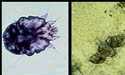
| What is scabies? A tiny mite has infested humans for at least 2,500 years. It is often hard to detect and causes a fierce, itchy skin condition known as scabies. Scabies is an infestation of the skin with the microscopic mite Sarcoptes scabei. Infestation is common, found worldwide, and affects people of all races and social classes. Scabies spreads rapidly under crowded conditions where there is frequent skin-to-skin contact between people, such as in hospitals, institutions, child-care facilities, and nursing homes. The microscopic mite that causes scabies can barely be seen by the human eye. A tiny, eight-legged creature with a round body, the mite burrows within the skin. Within several weeks the patient develops an allergic reaction. This results in severe itching, often intense enough to keep sufferers awake all night. Attracted to warmth and odor, the female mite burrows into the skin, lays eggs, and produces secretions that cause allergic reactions. Larvae, or newly hatched mites, travel to the skin surface, lying in shallow pockets where they will develop into adult mites. If the mite is scratched off the skin, it can live in bedding up to 24 hours. It may be up to a month before a newly infested person will notice the itching, especially in people with good hygiene and who bathe regularly. What are the signs and symptoms of scabies infestation? ? Pimple-like irritations, burrows or rash of the skin, especially the webbing between the fingers; the skin folds on the wrist, elbow, or knee; the penis, the breast, or shoulder blades. ? Intense itching, especially at night and over most of the body. ? Sores on the body caused by scratching. These sores can sometimes become infected with bacteria. The earliest and most common symptom of scabies is itching, especially at night. Early on, little red bumps, like hives, tiny bites, or pimples appear. In more advanced cases, the skin may be crusty or scaly. Scabies prefers warmer sites on the skin such as skin folds where clothing is tight. These areas include between the fingers, on the elbows or wrists, buttocks or belt line, around the nipples, and on the penis. Mites also tend to hide in, or on, the skin under rings, bracelets or watchbands, or under the nails. In children, the infestation may involve the entire body, including the palms, soles, and scalp. The child may be tired and irritable as a result of loss of sleep from itching or scratching all night long. Bacterial infection may occur secondarily with scabies due to scratching. In many cases, children are treated because of infected skin lesions rather than for the scabies itself. Although treatment of bacterial infections sometimes provides relief, recurrence is almost certain if the scabies infection is not treated. How did I get scabies? By direct, prolonged, skin-to-skin contact with a person already infested with scabies. Contact must be prolonged (a quick handshake or hug will usually not spread infestation). Infestation is easily spread to sexual partners and household members. Infestation may also occur by sharing clothing, towels, and bedding. Who is at risk for severe infestation? People with weakened immune systems and the elderly are at risk for a more severe form of scabies, called Norwegian or crusted scabies. How long will mites live? Once away from the human body, mites do not survive more than 48-72 hours. When living on a person, an adult female mite can live up to a month. Can I get scabies from my pet? No. Pets become infested with a different kind of scabies mite. If your pet is infested with scabies, (also called mange) and they have close contact with you, the mite can get under your skin and cause itching and skin irritation. However, the mite dies in a couple of days and does not reproduce. The mites may cause you to itch for several days, but you do not need to be treated with special medication to kill the mites. Until your pet is successfully treated, mites can continue to burrow into your skin and cause you to have symptoms. How soon after infestation will symptoms begin? For a person who has never been infested with scabies, symptoms may take 4-6 weeks to begin. For a person who has had scabies, symptoms appear within several days. You do not become immune to an infestation. How does the doctor diagnose a scabies infestation? Many cases of scabies can be diagnosed by dermatologists without special tests. Diagnosis is most commonly made by looking at the burrows or rash.To confirm scabies your dermatologist can perform a painless test that involves applying a drop of oil to the suspected lesion. The site is then scraped and transferred to a glass slide which is then examined using a microscope. A diagnosis is made by finding scabies mites or their eggs.A skin scraping may be taken to look for mites, eggs, or mite fecal matter to confirm the diagnosis. If a skin scraping or biopsy is taken and returns negative, it is possible that you may still be infested. Typically, there are fewer than 10 mites on the entire body of an infested person; this makes it easy for an infestation to be missed. What is the treatment for scabies? Several lotions are available to treat scabies. Always follow the directions provided by your physician or the directions on the package insert. Apply lotion to a clean body from the neck down to the toes and left overnight (8 hours). After 8 hours, take a bath or shower to wash off the lotion. Put on clean clothes. All clothes, bedding, and towels used by the infested person 2 days before treatment should be washed in hot water; dry in a hot dryer. A second treatment of the body with the same lotion may be necessary 7-10 days later. Pregnant women and children are often treated with milder scabies medications. Who should be treated for scabies? Anyone who is diagnosed with scabies, as well as his or her sexual partners and persons who have close, prolonged contact to the infested person should also be treated. If your doctor has instructed family members to be treated, everyone should receive treatment at the same time to prevent reinfestation. How will I have symptoms after the treatment? Itching may continue for 2-3 weeks, and does not mean that you are still infested. Your doctor may prescribe additional medication to relieve itching if it is severe. No new burrows or rashes should appear 24-48 hours after effective treatment. |
 |
 |
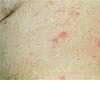 |
| scabies on the chest |
| scabies on the sole of the foot |
| Turn up your volume for music. |