THE BECKONING DARKNESS
By Beverley Sinclair
The Georgia Straight, March 24, 1995
[Beverley's fine article, which was a great honour for me, won the 1995 Western Magazine Award in the Biography category. Its contents are largely true. - LG]
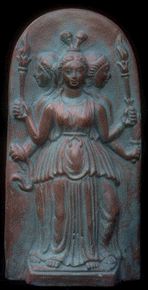
The classical goddess Hekate.
She beckons.
By Beverley Sinclair
The Georgia Straight, March 24, 1995
The classical goddess Hekate.
She beckons.
It's a wonderfully mysterious place we live in. If you have certain belief commitments already, remain light on your feet as we consider these things.
-Leonard George
December 1993: clinical psychologist Leonard George, 36, walks down the hall of Scarborough Centenary Hospital to visit his mother, Helen, 73. He can hear her calling long before he reaches her room.
"Sacrifice," she cries. "Sacrifice..." George muses on how bizarre it would seem to a stranger for this woman to be calling for sacrifice while battling the pneumonia that fills her lungs, the pain of the broken hip that brought her here, the mental confusion caused by too many evenings of too much rye. He turns into her room and speaks to her gently. "Sacrifice died years ago, Mom."
He takes out the pictures he brought to help her connect with life outside the hospital: himself, his sister Marilyn and her son and two daughters. But the only one she wants to see is the one of Sacrifice, her companion for many years. Sacrifice - the lrish setter who came into the family along with one of Leonard George's former girlfriends and stayed long after the girlfriend was history. George doesn't fully understand why the dead dog is a source of comfort to his mother now, and, as with so many other mysteries of life, he knows he never will. He puts the family pictures away and sets the photograph of Sacrifice on the window ledge overlooking Lake Ontario.
She dies on Boxing Day. When George leaves to return home to Vancouver, he and his sister hug each other for the first time since they were children.
A few months later, George wakes up in the middle of the night in his apartment at 11th and Granville. He's awake enough to know all the reasons for what he sees looking back at him. He knows what the psychiatric literature says about such things. He knows that grief manifests itself in mysterious ways. He knows the mechanisms of the brain that could be responsible for this. He also knows his mother's presence when he feels it - the presence of the woman who was there that night when he was 10 and saw with him the unexplainable lights in the sky; the woman who, with his father, encouraged his studies of things that would have seemed bizarre and alarming to most parents of their generation; the woman who was with him in Greece when he climbed the huge rock at Delphi's oracular site to sit where legends say the priestess sat to foretell the future. His mother is standing now at the foot of his bed, not a wispy, transparent, B-movie depiction of a ghost but a three-dimensional image, looking just as she did before she broke her hip. She's there, silent, for 15 seconds.
"It's called a hypnopompic hallucination", he observes today, sitting in the living room of his Deep Cove home. A Coast Salish transformation mask of the creature George considers his totemic animal - the raven - watches over him from above the fireplace. "It's a type of hallucination that can occur as you awaken from sleep, with visions and sounds so intense they can be mistaken for perceptions of external events." He shrugs his shoulders.
"But I call it Mom."
"Hypnopompic hallucination" is the 13th listing under H in Leonard George's recently released first book, an encyclopedic collection of unusual experiences. Alternative Realities: The Paranormal. the Mystic, and the Transcendent in Human Experience is dedicated to Helen George. His second book, scheduled for publication later this year, is dedicated to his father, Earl - killed by a heart attack at 73 in 1982 - and to a maternal ancestor, George Wishart, burned at the stake for heresy in 1546. Crimes of Perception: An Encyclopedia of Heresies and Heretics examines schools of thought and individuals who have challenged accepted reality throughout human history. Were such a book to be written by someone else in the future, Leonard George, a member of the Vancouver Hospital and Health Sciences Centre psychology departutent, could very well be in it, a product of his upbringing, his discipline, his intellect - and of the solitude, the darkness, the dreams of Raven...the countless unknowns.
He was 13 when his father, a railway clerk, came home from work one day and handed him, with no explanation, a red plaster statue of the Buddha. A seed, intentionally or not, was planted, like one carried by a bird to the precise spot in the forest where shade will be needed years later. While attending the University of Western Ontario, George immersed himself in the rigourous discipline of Tibetan Buddhism. It took him four years to complete the ngondro practice, which includes 100,000 repetitions of a 100-sylIable mantra and 100,000 full prostrations. After a few months his knees gave out, but once he recovered he was doing more than 1,000 prostrations every day. This was not something he talked about much with his university friends, who knew him as an exceptionally bright student completing his master's thesis on schizophrenia. They also didn't know he attended meetings of groups investigating paranormal experiences.
"At some point I decided not to hide," George says, in a conversation in his office at the hospital. "My unorthodox work is conducted to the same standards as my orthodox work. Why should critically grounded work be dismissed?"
Both the orthodox and the unorthodox have figured in the papers he's written and the courses he's taught since he received his PhD in clinical psychology at the age of 27: cognitive behaviour therapy, clinical hypnosis, chronic-pain management, schizophrenia, Hindu and Buddhist theories of mind, the psychology of unusual experiences. the role of visions in shamanism, alternative-reality traditions in western culture, spirituality and psychotherapy - he's even done an NBC interview on vampires. The literature he makes available to students in his UBC evening classes on unusual human experience is similarly eclectic: psychiatry's bible, the Diagnostic and Statistical Manual of Mental Disorders; a book called Possession: Demoniacal and Other; and several issues of the Skeptical lnquirer, a publication that challenges claims of the paranormal.
About one person in five claims to have had an out-of-body experience, up to one in three reports having seen an apparition, and four in 10 have had what they consider to be a mystical experience. These figures represent a much higher percentage than can be explained by mental disorders. "There's a large construct of society that is completely skeptical and a large construct that is completely credulous about these things", George says. "I can do both".
His thesis adviser warned him that doing both - particularly teaching at the Institute for Parapsychology in North Carolina in 1980 - could ruin his career. He was wrong.
A year and a half ago, George had a job interview with Merv Gilbert, the head of Vancouver Hospital's psychology department. "Well, Leonard," Gilbert said, smiling a little as he glanced at George's curriculum vitae (which includes his stint at that North Carolina institute, as well as his work in an Ontario hospital's psychiatric department and other "mainstream" positions). "Are you a nut?"
"I'm glad you asked that," George said. "I promise not to do any exorcisms before 5 p.m."
A few months later, he began working at Vancouver Hospital. He works primarily in the psychiatric ward, the back-pain clinic, and the burn unit. He's part of the assessment team for psychiatric patients, making diagnoses and determining levels of cognitive function. In the back-pain clinic, he meets with patients to help them understand the impact of pain on their lives and how to manage both the pain and the resulting stresses more effectively. In the burn unit, he assists patients with processing the trauma of their injuries and using their own resources - mental imagery and relaxation - to cope with the pain. He combines his clinical psychology training and experience with an encyclopedic understanding of various views - scientific, spiritual, and culturaI - on pain, healing, death, and transformation. And, true to his word, he doesn't do exorcisms before 5 p.m. Or after. Never has.
Leonard George's approach to exploring the human psyche defies labelling as surely as do the unusual human experiences that, to all but the most incurably logical, hover just out of reach on the other side of rational understanding, like the source of a flash of black wing seen or sensed during a solitary walk in the woods.
Of the vision of his mother after her death and his repeated dreams about his deceased father, George says: "What do I make of them? I don't know. They don't make me believe in survival of the dead, but they remain important and meaningful experiences to me."
The search for meaningful experience is on, and the people doing the searching are largely those of the baby boom, the generation that rejected traditional religion (60 per cent of Canadians had ties to an organized religion in the '5Os; 30 percent do today) and that squirms a little at the word religion being applied to what they're engaged in now. Many also wince at the words new age, wanting to dissociate themselves from an amorphous mass of beliefs that embraces everything from channelling to colon-cleansing as a path to enlightenment. The term of choice is spirituality.
Personal proclamations of belief in a "higher power" are regularly made these days, not from church pews but by those in 12-step recovery or cancer support groups, by friends walking the sea-wall. The spiritually inclined are voracious readers: in recent years one-quarter of the titles on a typical New York Times best seller list have been on spiritual subjects. One of them, The Road Less Travelled, by M. Scott Peck, has been there for almost 600 weeks. Another, The Celestine Prophecy, a poorly written adventure novel about the search for nine insights into the meaning of life, sold more than 1.5 million copies in seven months last year - 70,000 of them in Canada - and still tops best-seller lists. The monks of the Santo Domingo de Silos monastery in Spain released a recording of 1,300-year-old chants that became one of the best-sellers of all time.
When Benedictine monks can chant their way to the top of the charts; when 30 Toronto stock analysts, scientists, and businesspeople gather for monthly meetings of the Global Intuition Network; when Tourism Vancouver produces a print ad with "SPIRITUAL" appearing in the sky over the North Shore mountains; when Time has a cover story that says 69 percent of Americans believe in the existence of angels...something is going on.
"The baby boomers who rejected traditional religion in the '60s got married, had kids, got the mortgage, and then realized it's not necessarily that fulfilling. So they're looking around," says Douglas Todd, 41, the Vancouver Sun's religion/ethics writer. "People are trying all sorts of things because of exposure to religious pluralism, like Buddhism and other practices of the global village," he says. "There's a desire for an experiential sense of the divine, not a set of rules. They're looking for an emotional hit."
Given that those in this same population bulge are facing the deaths of
parents and their own mortality, there's a strong push to look for answers to life's big questions. Most of those who are looking are, like Todd,
not seeking instant answers from one
belief system. "I'm open to whatever I can learn from any new faith or tradition," he says, although he reserves his respect for those thinkers who test their ideas against logic.
Those who dismiss anything that doesn't pass the test of logic have their doubts about the burgeoning exploration of spirituality. "All of these things are comforting beliefs serve to allay anxiety," says Barry Beyerstein, 47, chair of the Society of B.C. Skeptics, executive member of the Committee for the Scientific Investigation of Claims of the Paranormal, and SFU associate professor of psychology. He started questioning the traditional Lutheran religion of his family when Sunday school teachers told him that Noah managed to get two of everything stuffed into a boat. He's been skeptical about claims of the divine, paranormal, and supernatural ever since. "People tend to believe what their culture believes and what they grew up with," he says, "whereas science is universal." Science, he says, proves that anomalous human experience is a result of unusual brain function combined with a person's belief systems and cultural upbringing, and he maintains that there's no evidence any mysterious force is at work.
"Two people can have exactly the same experience and one will say, 'That's an interesting thing going on in my brain,' and the other will say, 'I've seen God,'" he says.
Some, though - including some scientists - say both, with varying understandings of the G word.
Two years ago, the National Institutes of Health in the U.S. created the Office of Alternative Medicine. One of its first grants went to researchers measuring the power of prayer in the recovery of drug abusers. Half the doctors polled by MD magazine agreed that prayer is effective and beneficial in treating people, and the majority said they had on occasion prayed for their patients. The latest edition of psychiatry's Diagnostic and Statistical Manual of Mental Disorders includes a new category, spiritual emergencies, alerting psychiatrists to patients who might be going through a nonpathological crisis of the spirit and require assistance with philosophical issues rather than medication or hospitalization. Last May, 180 psychiatrists and social workers attended a conference called Psychotherapy and Spirituality at the Kripalu Yoga Ashram in Massachusetts; in Vancouver, 700 people paid $149 each for an afternon with Deepak Chopra, a former Boston endocrinologist who advocates meditation and visualization to promote physical healing.
Other cultures' understandings of life's mysteries are working their way into North American consciousness the way Raven of Native American legends works magic, as the "trickster" - prompting unexpected twists of perception and presenting ways to see the world through new eyes.
Leonard George walks to the burn unit in the basement of Vancouver
Hospital's Heather Pavilion. Here are people whose minds are addled with pain. Many have horrific nightmares and extreme emotions - signs that the mind is struggling to digest what has happened and is grasping for some sense of meaning in the midst of agony, disfigurement, and loss. He enters the room of a 12-year-old boy whose burned hands, arms, and chest have left him in excruciating pain. George looks for a way to connect with the child and manoeuvre through the shyness the boy feels, as he did at that age and still sometimes does.
"I like your Star Trek figures," George says, sitting down in the chair by the bed. "Who's your favourite character?"
"Captain Jean-Luc Picard."
They talk for a few minutes about the show and hit on one episode they've both seen, in which Captain Picard (good guy) is captured by the Cardassians (bad guys), who torture
him in an effort to extract secrets. The hero doesn't break.
"I know something about how Captain Picard dealt with the pain," George says. "You want to know that, too?"
"Sure."
"Tell me about your pain. Help me experience it. What does it feel like?"
"It burns."
"If zero meant you had no pain and 10 meant it was the worst pain you could ever imagine anyone ever having, what number is it right now?"
"Eight."
"What do you see when it hurts like that?"
"Like fire. Bright-red flames."
"You know what Captain Picard would do? He'd change that. First he'd close his eyes and see those bright-red flames. You want to try that?"
The boy closes his eyes and George encourages him to relax and take deep, slow breaths into his belly. He wants to take this mental journey with the boy, so he breathes that way too and visualizes what the boy tells him about the pain.
"Do you see the flames?"
"Yes, they're red."
"What does it smell like?"
"Bad."
Is there any sound?"
"Hissing."
"See yourself now with a big hose, spraying cool water over the flames. Aim the hose at different parts of it and notice the hissing sound getting softer and the flames going down."
He watches the boy's eyes moving under his closed eyelids, his relaxed muscles and slow breathing, while the two of them envision the water dousing the flames. They leave a small one flickering but under control, then let the image go while the boy rests a while in the respite from pain. He opens his eyes.
"Remember that scale I asked you about before?" George asks. "What number is it now?"
"Three."
"That's very exciting - you can do what Captain Picard did. But I bet he didn't learn it overnight. How long did he train for?"
"Years. At the Starfleet Academy."
"Do you think as you practise this more it will work even better?"
"Yes."
They play with the Star Trek figures for a while before George leaves. The next day, when he comes to say hello to the young patient, the boy's 10-year-old brother says he wants to learn Captain Picard's trick. George coaches him to alter his "bad feelings" - described by the child as a blue light in his mind's eye - by relaxing deeply and seeing himself turn a big dial that changes the light to yellow.
In many of the world's cultures, it's believed that some children between about eight and 12 years old are tapped on the shoulder by an experience that encourages them to become mediators between the human and spirit worlds. In western culture, such ideas are typically ignored, frowned upon, or explained away, Regardless, George maintains, that tap on the shoulder still comes to some.
"There's a subgroup of every population where some developmental process relating to this starts to awaken around that age," George says. "It's like an invitation, a calling to experience reality in a different way. An invitation to mystery and wonder."
Some hear the invitation, some don't. George heard it, loud and clear. It came from the darkness...and the ravens flying through his dreams.
As a child, George wanted to shoot out the streetlights when they
were installed on his family's road in rural Pickering, Ontario. He throve in the dark, felt comfortable in it. He saw the neighbours clustered around the glow of their TV sets, avoiding the dark. Other kids were afraid of what might be in the darkness, but he was intrigued by it, wanted to know what
was there that seemed to be calling him and why it beckoned him, day and night, to the woods behind his house. That's where he felt a connection with something he didn't understand but craved, where he felt at home but yearned for more, where he had a powerful dream or vision or fantasy or something over and over again: he's wandering in a dimly lit underground maze, garden, perhaps a huge cave, with glowing things like mushrooms everywhere. There's a stone altar in the centre with a mask on it. he walks to the altar and puts the mask on...
Three times as a child, he almost died. When he was six, a neighbourhood kid pushed him facedown in the water-filled ditch on their street and sat on him. He was on the verge of drowning when the boy's brother pulled the bully off him so he could breathe. When he was eight, a boy he now calls a "young psychopath" strangled him almost to unconsciousness, until George's sister was able to rescue him. The finger marks stayed on his throat for several days. A few months later, he was gripped by a combination of illnesses, including scarlet fever and German measles. The high fever, hallucinations, and nightmares continued for weeks. No one told him they thought he was going to die, but he knew it when his mom gave him his birthday present - a used walkie-talkie set - in March, even though he wouldn't turn nine until July.
Several months later, he was outside the United Church with two other boys after a Cubs meeting, waiting for his mom to finish choir practice in the basement. She came up to meet him just as it happened, so they all saw it: a strange light about the size of a quarter on the horizon, a pink disc followed by a triangle of green lights. They watched it for a couple of minutes while it moved across the sky and out of sight over the opposite horizon. They all saw it. None of them had any idea what it could be.
"You know, I don't even believe that story myself,' he observes now in his darkened living room, the raven mask glowing in the firelight. "Memories are highly unreliable. There's no way of knowing which parts are artistic licence and which are factual." All he knows is that whatever happened that night sparked something that led him, as a boy, to the grocery-store pulp-fiction stands and their books with embarrassing titles like Flying Saucers on the Attack.
As a very young child, George wanted to be a paleontologist or an anthropologist - his suggestion for a word in a Grade 1 spelling quiz was Australopithecus. His literary tastes led him to Jung by the time he was 14, and he knew then, without question, that he wanted to be a psychologist and explore the mysteries of the human mind and experience.
The Beckoning Darkness is the title of Leonard George's lecture series this term at UBC. The subject of one lecture is near-death experiences. The screen at the front of the room is filled with an enlargement of part of a l6th-century Hieronymus Bosch painting depicting a classic image of death - a tunnel, light, and divine beings.
George begins, as he always does in these talks on unusual human experiences, with history and science. Stories of being on the brink of death and returning come from throughout history and all the world's cultures. The fact that the content of near-death experiences is variable leads most researchers to believe they are the result of brain dysfunction combined with the person's expectations and beliefs. The vast majority of peopIe who have had such an experience have a very different view, though, generally feeling that it was what they experienced it to be - a brush with the reality of death and a return to life. Virtually all report feelings of extreme joy during the experience and resume their lives with a greatly increased sense of compassion and awareness of the value of their lives.
"The near-death experience has the potential to change people more powerfully than anything we know about," says George. "We bang away at 20 years of therapy and never make changes like this. That's part of the fascination with NDEs among therapists."
Some suggest the NDE is a defence against the terror of dying, that the mind organizes the elements of the experience into a comforting fantasy - case closed. Others say the feelings of joy are a result of the body's release of large quantities of endorphins, nothing more. George is well-versed in the science that supports these views, and he does not discount them, but he feels that the answer lies not in accepting them at the final answer but in asking more questions.
"The scientific model is a valuable tool," he says, leaning on the lectern, "but it's often waved around as an icon of legitimacy. People say 'Studies have shown...scientists say...' and we give it the final word so we don't have to think about it anymore. I don't want to be put in the position of making metaphysical claims. I'm describing experience. Make your own conclusions."
The 35 students leave the fluorescent lights of the classroom and walk into the darkness, mostly quiet and wondering about life and death and the mystery of both.
The shadow of his mother's death a year ago still casts itself over George's days, and he continues to regret that his last conversation with his father was a trivial telephone chat. He mentions this to 35 Ministry of Social Services office workers attending a talk he was invited to give on dealing with the death of parents. "There are no experts on this," George tells them. "We're all in the soup together on this one."
He speaks of the bubbling cauldron of grief that can bring all sorts of things to the surface, including - unexpectedly - moments of intense joy. "At some times of grief, the past is too painful, so is the future. You turn to yesterday and shut down. You turn to tomorrow and shut down. All that's left is the present. Then you see this flower, and it's beautiful, it's luminous. And you've caught a glimpse. This is a possibility. That it can arise in a moment of darkness suggests it's there all the time, always accessible," he says.
"It comes through attunement of attention," he adds. "But you can't chase after it." He gathers up his notes. "All you can do is set the table."
Then he returns to his home at the base of Mount Seymour to listen to Bach or Leonard Cohen and drink a glass of cabernet from Languedoc, France, where he once spent a long night alone, surrounded by the remains of a remote castle lit by the dozens of candles he'd brought. Perhaps he'll think about the invitation to speak to B.C. Children's Hospital psychologists about unusual childhood experiences... or about his planned book on recovery from extreme physical trauma... or his desire to write one about the historical shifts in the accepted boundary between reality and imagination.
Or maybe he'll go alone to the woods behind his home, in case the ravens come.