By Leonard George
Sermon given to The Unitarian Church of Vancouver
Sunday, July 23, 2000
Blaise Pascal wrote his famous Pensees during the last year of his short and eventful life. He died in 1662, aged 39. His lifespan ran right through the heart of the period when Modern Science was beginning to define itself � its "adolescence", so to speak (Galileo died when Pascal was 19; Descartes died when he was 27; and when Pascal himself died, Newton was 19). Pascal too contributed to early modern science (building a computer, discovering the relationship between altitude and air pressure, formulating "Pascal�s Law" of fluid pressure, and more). But in an atmosphere of growing scientific triumphalism, Pascal was perhaps the first to detect and express a shadow cast by the new world view, a bleakness of vision that has become a central theme of modern experience. He could thus be called the First Voice of Modern Consciousness:
"When I consider the short duration of my life, swallowed up in the eternity before and after, the little space which I fill, and even can see, engulfed in the infinite immensity of spaces of which I am ignorant, and which know me not, I am frightened, and am astonished at being here rather than there; for there is no reason why here rather than there, why now rather than then. Who has put me here? By whose order and direction have this place and time been allotted to me? The eternal silence of these infinite spaces frightens me. �
"When I see the blindness and the wretchedness of man, when I regard the whole silent universe and man without light, left to himself, and, as it were, lost in this corner of the universe, without knowing who has put him there, what he has come to do, what will become of him at death, and incapable of all knowledge, I become terrified, like a man who should be carried in his sleep to a dreadful desert island, and should awake without knowing where he is, and without means of escape. And thereupon I wonder how people in a condition so wretched do not fall into despair."
**************************
Pascal�s despair has become pathognomonic of the modern age, and in fact is part of one of the great paradoxes of our time.
Consider: Over the past five hundred years, scientists have discovered many things. Which discovery is the best attested, the most strongly confirmed, of all? I believe there is one grand finding supported by every scientific field: that we, as individual human beings, are deeply entwined with, even continuous with, our environments.
In terms of physics and chemistry, the substances out of which we are made are the same as those comprising our world � there is no distinctive "human matter". We and the physical world interpenetrate. In terms of biology, we are revealed by science as part of the great tree of life that began to evolve on this planet about four billion years ago; even the structures within our cells appear to be the descendants of creatures that long ago swam in there and got comfortable, then lost the ability to live outside. So we and all the vast Life of the planet interpenetrate. In terms of social science, we build our experienced world together, through mutual constant communication with our fellow social animals on a thousand levels, only a few of which are ever conscious. We interpenetrate each other.
If we take all these physico-chemical / biological / social environments and join them together, we have � the universe. In this sense, the whole thrust of Modern Science attests, we are profoundly merged with the cosmos. Now this sounds rather mystical, and that is fine. But here is the paradox: many people, from Pascal on, have felt not warmed but chilled by the vision of science. They feel alienated, disconnected, rendered meaningless and lost rather than found. Science popularizers through the 20th century bemoaned and tried to rectify this alienation. Stephen Jay Gould, for instance, acknowledged that so many people find the science-unveiled world to be "cosmically depressing". Richard Dawkins devoted his latest book Unweaving the Rainbow to discussing and dismissing the problem (in his usual brilliant, insensitive and ultimately unconvincing manner).
The paradox in a nutshell: Modern Science helps us to Know our connectedness; but, for many, it interferes with our ability to Feel it.
Burning question: Is this paradox a necessary feature of modern scientific consciousness? Or is it the result of historical contingencies, and perhaps resolvable without violating the evidential rigour of the scientific attitude? The answer to this question lies in the past. And, maybe, so does the resolution of the paradox itself.
The knowledge-tradition we call Modern Science gradually became distinct from other ways of knowing in the period spanning the 16th � 18th centuries, an age anointed (since 1913) the Scientific Revolution. This phrase conjures a heroic narrative of scientists vanquishing the darkness of superstition and ignorance in the service of a rational enlightenment. Such a narrative began to be scripted in the mid 1600s, and became canonical by the mid 1700s. But in fact matters weren�t nearly so tidy.
Actually there were many variants of proto-modern science at first, a broad spectrum of belief about what it means to be scientific. By the Enlightenment period, Modern Science had evolved an "establishment" voice that told the privileged version of the origins and boundaries of science. History, as always, was written by the winners. The disenfranchised or shall we say "heretical" sciences largely fed back into the occult streams of Western culture.
[Two interesting parallels with this process: First, the origin of Christianity. For the first four centuries A.D., there were hundreds of Christianities � that is, diverse schools of thought concerning what Christ means. It was not until 381 A.D. that one particular Christian brand � Catholicism � became the state religion of the Roman Empire, and the only legal form of spirituality. Ever since, orthodox Christian institutions have tried to erase all viability, indeed all trace, of the alternative Christianities. Second, over five hundred million years ago, in the early Cambrian Period, British Columbia�s Burgess Shale fossils tell us that there was an astonishing explosion of life forms within the primordial sea. Under the hammering of natural selection, the hundreds of Cambrian phyla (the general "blueprints" of organic structure) rapidly collapsed to the thirty-nine or so phyla that still swim, crawl, slither, hop, fly and promenade today.]
Histories of Modern Science often start with a Swiss man, born in 1493 and christened Phillipus Aureolus Theophrastus Bombastus von Hohenheim (who mercifully renamed himself Paracelsus, but was still so full of words that those of similar verbosity are known to this day as "bombastic"). He challenged his peers to burn their books of ancient authority, and to read the "Book of Nature" with fresh eyes. This empirical attitude marks him as modern. But Paracelsus held that the mission of science was twofold � to explore both the outer and the inner realities of existence. The external realm was to be probed through test and observation. The truths of the domain within the soul could be seen only with the Imagination. He distinguished between mere fancy or fantasy (the mental flotsam we sense drifting through the backwaters of the mind) and True Imagining, when the mind�s eye views objects that are not perceptible physical things, but that are real nonetheless. The two categories of real objects � sensory and imaginal � together comprise the world awaiting our exploration, taught Paracelsus.
This distinction between the outer and the inner, and within the inner between false and true imagination, was not original to Paracelsus. It is an age-old teaching found in the traditions of alchemy and magic, both of which were mastered by Paracelsus. This scientific stream, emphasizing the complementarity of inner and outer, subjective and objective, imaginal and empirical exploration, became loosely known as "hermetic" science after the legendary figure Hermes Trismegistus, who symbolized occult mastery. Many of the men who later feature in the heroic narrative of Modern Science had more than a passing involvement in the hermetic current. Aside from Paracelsus himself, Copernicus, Kepler, and most notoriously Newton had hermetic sympathies. Sir Isaac�s legacy required extensive laundering before he could serve as the poster boy of the "Newtonian" Enlightenment. Eighteenth century science writers suppressed the fact that Newton apparently devoted more of his energies to alchemy and prophecy than he did to physics. (According to John Maynard Keynes, Newton was "not the first of the age of reason, but the last of the magicians".)
Through the 1600s - Pascal�s century � the community of scientists struggled to mould a clear sense of identity. How was the new science different from (superior to) the older ways of knowing? Adolescents often define themselves in radical distinction from their parents. Modern Science was no exception. And one of the main points of contrast between antique and novel, quaint and cool, was True Imagining. Rules for assessing the validity of findings concerning the outer world were being worked out; for instance, the notion of the scientific experiment as a formal act of manipulating and measuring variables. But the hermetic scientists generally failed to establish how one is supposed to tell a true imagining from a false one. The potential for self-delusion was obvious (even though some of the hermeticists� discoveries later proved stunningly accurate. For example, Giordano Bruno was the first scientific "revolutionary" to grasp that the stars were actually distant suns, around which planets revolve, some of which likely harbour life. He gained this insight through Imagination, not observation. For his trouble he was burned at the stake in Rome.)
The imaginal validity problem proved to be too thorny. The most vocal apologists of the new science chose to conflate true imagining with false. The entire sphere of imagination, the whole interior life of humanity, was labelled sheer fantasy � excluded as a legitimate means of knowing anything. Modern Science was cast as the opposite of "True" Imagining. Sir Francis Bacon wrote that imagination and emotion were like grime on the mirror of the scientist�s mind. For a clear reflection of Nature, the dirt of fancy and feeling must be scoured off. Pascal himself, so attuned to his zeitgeist, defined "imagination" in the Pensees as "that deceitful part in man, that mistress of error and falsity, the more deceptive that she is not always so; for she would be an infallible rule of truth, if she were an infallible rule of falsehood." Pascal puts his wise finger squarely on the criterial problem of sorting false and true imaginings. By the latter 1700s Voltaire in his Philosophical Dictionary could frame imagination as "seeing that which is not". And Franz Mesmer�s claims of healing via animal magnetism could be discredited, not because mesmerism did not achieve results but because experiments demonstrated their cause to be imaginary. Paracelsus and Mesmer serve as bookends for the saga of True Imagining�s official demise.
So what? Bacon and Pascal and Voltaire were right, weren�t they? Isn�t the exorcism of "true" imagining, with its attendant delusional potential, a benefit? Ah, but what about the cost? What if the abandonment of True Imagining is precisely where we lost the Feeling-link to the universe?
With regard to the external world, scientific research has verified that we are objects linked to other objects, together comprising the grand object we call the cosmos. But if the things we meet in our inner spaces are never taken as seriously as outer things; if "subjective" means in effect "sealed off" from reality; then we will not feel equally connected and validated inside and outside, completely "at home in the cosmos". We will know our connectedness, but we will have a harder time feeling it.
It is notable that so many of the ancient ways of helping people feel "relinked" (Latin religio, from which is derived "religion") involve taking imagined objects seriously. The most revered mythologies, theologies and spiritual experiences through history feature encounters with what secular consciousness would today reduce to figments of the imagination. Such experiences are still available. They continue to happen both spontaneously and sought. But our ability to weave them into our modern being may often be blocked by the fact that they are imaginary, not objective, therefore by contemporary standards unreal. "Mere" imagination.
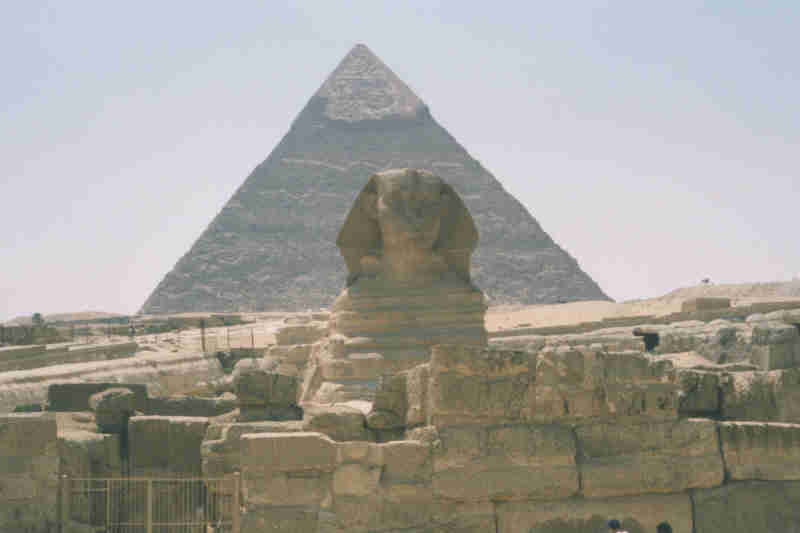
Can we somehow slice the knot the hermetic scientists could not untangle � the problem of defining criteria for sorting true from false imagining? And thereby resolve the Knowing / Feeling paradox posed by Modern Science? Perhaps we can - with a little help from the land of the Sphinx.
The tradition known as Neoplatonism began in Alexandria, Egypt in the third century AD, and spread through the domains of the Roman Empire. The roster of renowned pagan Neoplatonists would include Plotinus, Porphyry, Iamblichus, Proclus, Damascius. These men are largely forgotten today. But their voices, though drowned by the roar of subsequent history, are worth listening to. Because they spoke of True Imagining, and of how to tell the real from the unreal in the realm of Imagination and what lies beyond.
Here is a proposition inspired by those sages of old. It begins with the premise that, in some profound and inconceivable way, we are all included in a single Truth or Reality. (The Neoplatonists called this Reality the One.) Now many of us have had experiences in which our awareness of this unity seems enhanced, briefly or permanently. And, if we accept our premise, there is no reason to doubt the validity of such moments of awareness � they are in accord with reality, which is what "validity" means. These experiences are alluded to in Neoplatonic writings. And from these passages I�ve culled three common features of experiences that orient the mind toward the One. We can call them the "three Cs":
Note that these are features of Feeling, not of Knowing (at least in the external sense). But if we encounter, within or without, something that evokes in us these features of Feeling, we can be confident that it is reflecting the interconnected Reality so amply attested by five hundred years of Modern Scientific Knowing. In this sense, on the level of Feeling, experiences that include the three Cs can be said to be valid or true.
The three Cs, then, could serve as our criteria of True Imagining. Mental images that stir our intuitions of Connection, Communion and Compassion link us to the cosmos from the inside, through Feeling, just as the scientific Knowing of our objective existence links us to the cosmos from the outside. There needn�t be a conflict between reality as Known and reality as Felt. They are, after all, the same reality � the reality of connectedness.
Knowing and Feeling complement each other; each has its place. Neoplatonists like Iamblichus who pondered this point decried attempts to use True Imagining to gather empirical knowledge, in the sense of divinatory or paranormal activities. Learning the secrets of the external world was left to reason and sensory experience. But only a wondrous encounter with the numinous Presences of the inner world can fully awaken us to the dimension of connectedness that is neither rational nor sensory, which can only be Felt. And hermetic scientists, New Agers, fundamentalists, skeptics and mystics only fall into confusion when they fail either to distinguish True from False Imagining, or the claims of Imaginal Feeling from those of Sensory Knowing.
These arcane notions are obscure today. But they have had their adherents over the centuries. The nineteenth century American Transcendentalist Ralph Waldo Emerson, a deep student of Unitarianism and Neoplatonism, wrote that if the writings of Iamblichus were widely read it would lead to "a revival in the churches".
Imagine that.
***************************
The Varieties of Religious Experience was the title of a lecture series given in Edinburgh by the American psychologist William James in 1901 � 1902. Here we have a scientist, one of the founders of modern psychology and a great commentator on consciousness, posing a question still only partially answered:
"Our normal waking consciousness, rational consciousness as we call it, is but one special type of consciousness, whilst all about it, parted from it by the filmiest of screens, there lie potential forms of consciousness entirely different. We may go through life without suspecting their existence; but apply the requisite stimulus, and at a touch they are there in all completeness, definite types of mentality which probably somewhere have their field of application and adaptation. No account of the universe in its totality can be final which leaves these other forms of consciousness quite disregarded. How to regard them is the question �"