“I thought that beauty alone would satisfy. But the soul is gone.
I can't bear those empty, staring eyes.”

This page summarizes the plot of White Zombie and offers brief backgrounds on the movie and the d20 System sourcebook.
This page summarizes the plot of White Zombie and offers brief backgrounds on the movie and the d20 System sourcebook.
Rebuffed, but not one to take no for an answer, Beaumont asks zombie master Legendre (Bela Lugosi) to temporarily turn Madeleine into a zombie, so Neil, believing she is dead, will return to the United States and Beaumont will be free to woo her once Legendre restores her to life.
Beaumont and Legendre set their plan in motion immediately after Madeleine and Neil are married. Legendre performs a magical ritual using a wax doll and one of Madeleine's scarves, and she appears to die in Neil's arms. Shortly after she is interred, Beaumont and Legendre visit her crypt, take the body, and Beaumont relocates his household to the crumbling coastal fortress where Legendre lives, so he can win Madeleine's heart away from prying eyes.
Meanwhile, a drunken, despondent Neil discovers that Madeleine's body is missing from the crypt. Seeking out Dr. Bruner (Joseph Cawthorne), the missionary priest who both married them and conducted Madeleine's funeral, for help, he learns that something more sinister than simple grave-robbing has occurred: Bruner believes that Madeleine has fallen victim to the evil spells of a zombie master, and that she may still be in alive, existing as one of the Living Dead. Neil, unsure what to believe, sets out with Bruner to locate the zombie master.
At Legendre's clifftop home, Beaumont has started to regret his actions. He is disappointed with Madeleine's emotionless state and he is even starting to feel a little guilty. When he asks Legendre to undo his spell, the zombie master instead tricks Beaumont into consuming the magical powder that starts the process of turning a person into one of the Living Dead.
As Beaumont slowly becomes a zombie, Legendre has the servants killed, and reveals that he had always intended to keep Madeleine as one of his Living Dead.
A short time later, Neil and Bruner find their way to Legendre's home. As they seek the easiest way to access it, Neil succumbs to his grief and Bruner leaves him at their camp to continue exploring on his own. However, Neil soon finds his mind filled with a vision of Madeleine, and he stumbles deliriously up the mountain to the fortress. After making his way inside, Neil collapses.
Legendre senses Neil's presence and commands Madeleine to kill
him. However, the bond of love is stronger than the zombie master's magic,
and she hesitates long enough for Bruner to disarm her.
Neil and Bruner confront Legendre and his Living Dead on a cliff-side
terrace. The Living Dead almost force Neil over the wall, but Bruner knocks
Legendre unconscious and the leaderless zombies go over the wall instead
and plummet to the sea below.
Neil takes Madeleine in his arms, and she seems to recognize him momentarily, but then Legendre revives and she re-enters her zombie state. Bruner and Neil turn to face him, but he throws an entire phial of the enchanted zombie dust at them, causing them to fall back, choking.
As Neil and Bruner struggle to recover, Legendre reasserts control
of Madeleine, but the semi-zombified Beaumont throws himself at Legendre
and both men tumble over the cliff to their deaths. With Legendre dead, Madeleine awakens, restored to
normal.
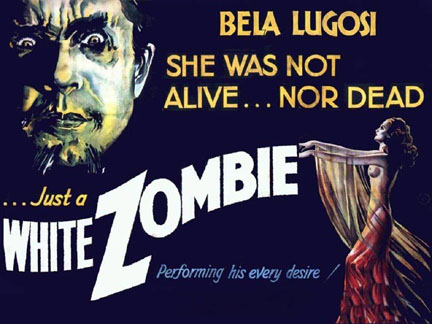
White Zombie was an independently produced movie that was made
for around $50,000 and shot over a two-week period at Universal Studios,
using already standing sets. Despite its rushed production schedule,
budgetary constraints, and mostly negative reviews from critics at the
time of its release in August of 1932, White Zombie was a hit with American
and international audiences.
The level of commercial success was not high enough to allow
the production team of Edward and Victor Halperin to repay loans issued
by Sherman S. Krellberg and his Amusement Securities Corp. in a timely
fashion. Even before White Zombie's initial run had ended, the brothers
lost all control of their creation. (The success of White Zombie did open
doors at the major studios for them, however.)
After the films initial run ended, Amusement Securities Corp. continued to reissue the film at regular intervals, usually as part of a double bill with another horror film. With the advent of television, White Zombie became a mainstay of late-night and Saturday afternoon fright-fest programming.
By the 1960s, the film was believed to exist only in severely edited, decayed 16mm formats, but then film distributor Frank Storace became aware of an original nitrate print in the possession of Stanley Krellberg-and that along with it was some ten minutes of footage that had been cut after initial press screenings of the film. Storace wanted to create a “restored” version of the film, but after Krellberg died, he was denied access to the material. The stock was decaying at the time, and it is believed that those scenes are now forever lost.
White Zombie runs just over an hour, a typical length for a B-movie
dating from the period it was made. It was shot from a script by Garrett
and produced and directed by Victor Halperin. At present, there are at
least three distinctly different versions of “White Zombie” commercially
available on DVD or VHS tape. The version closest to the one that was originally
released to theaters in 1932 is available from the Roan Group as the first
entry in their “Archival Entertainment” series. Another good version can
be had from Alpha Video.
A manuscript was completed, a cover commissioned, screen captures produced, and typesetting begun. The book was to run 48 pages and be illustrated with original art, movie stills and maps. Things were going so well that Miller even started promoting the book before it completely finished, announcing an October 2007 release date on a variety of gaming websites and RPG industry news outlets. But, in the final stages of production, the book ran into trouble.
Like the movie upon which it was based, d20 Modern White Zombie
was a low-budget affair. Miller found himself unable to get maps that were
up to his standards on the meager budget he had at his disposal. After
two failed attempts, he looked at upping the payment to a possible cartographer,
but by then it was clear that the d20 System market was softening and possibly
even failing completely. With the book some 90% complete, Miller shelved
the project and moved onto other things.