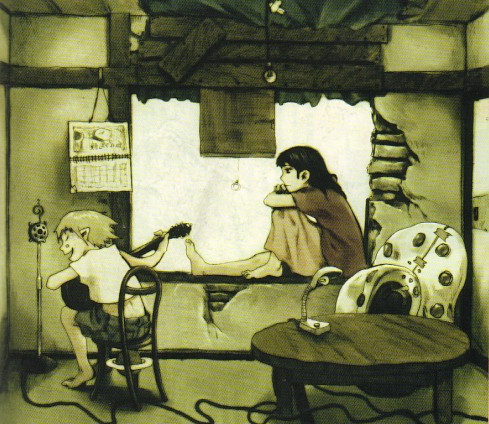
Right next to where you are crying.
Right next to where I am blue.
Dry wind is lying in the city with the gloomy people.
Come on over here!
It’s dangling with bright abandon and a strength to be… so-what?
I can't be so close to sadness, because I'm not surrounded by people.
Like a person in a happy mode.
I can't change anything, so I can at least manage this.
Like a person in a happy mode.
This is the middle of the earth where I was born on the beach.
This morning, I mimic a peddler and dance with a small god.
Come on, come on everybody…
Come on, come on please…
Everyone will grow up and pass away eventually
But they will be born again, so it will be merry.
Pleasant things…
Happy things…
Sad things…
All erased in the sun’s music.
The first episode of the series does not have a dedicated opening credit sequence. Instead, the credits run over the opening scene of Mayuko waiting for the butcher’s price to go low enough for her to be able to afford to purchase his leftover pork, and over the first views of the interior of the Enohana Bathhouse, the surrounding village of Enohana, and the narration of one of Mayuko’s diary entries--an entry that introduces the viewers to the big picture of the near-future world that the story takes place in.
"I was going to cram school when I realized I was living with NieA, a strange alien who had settled down inside the closet of my room," Mayuko writes. "Now, there are so many aliens all over Japan. But nothing has changed or been effected. No one really cared anymore, once we realized that this strange thing had become ordinary." These sentences are the first hint of a theme that becomes increasingly clear as the series progresses.
Later episodes have a standardized credit sequence that feature the song "Come On Over Here,"/ "Koko Mode Oide" which provides an even greater insight into the world and themes of the series. At first look, the imagery of the sequence seems surprisingly dark. Sure, the first episode established Mayuko as a struggling student who had to work several jobs just to keep from being completely wiped out by her impoverished situation, and while the twitchy, unpredictable antics of her Alien “roommate” don’t make her life any easier, the tone of that first episode certainly didn’t seem like the series warrants jump-cuts of the main characters posing for mugshots, mysterious lights at the top of the stairs to Mayuko’s room, and imagery that makes it look like NieA might be drowning.
This opening credits sequence, however, is very appropriate. As the series unfolds, it becomes increasingly clear that the characters in the story are almost all trapped in rather miserable circumstances, either unwilling or unable to overcome their own weaknesses, fears, or the pressures from society in general. The world at large ignored the magic the aliens may well have represented because they could not be fit into the narrow shelves upon which people had to exist. Society is even sapping the magic from the aliens themselves, making them conform to it instead of adjusting to accommodate them.
NieA_7 is © yoshitoshi ABe / NieA Project.
Used without
permission. No challenges to ownership or infringement intended.
Page created by Steve
Miller, April 22, 2003