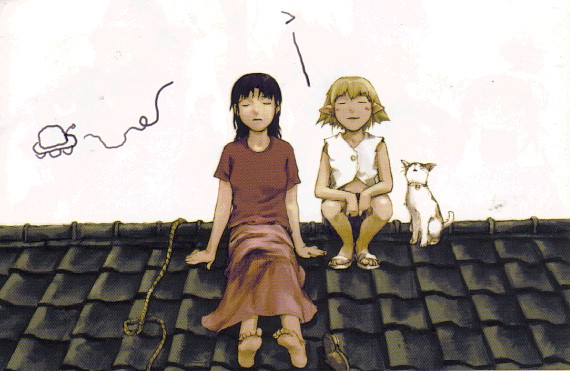
Enohana is a rural community that has seen better days. It is situated on a series of low hills between a river and a bay, and is a collection of crumbling buildings, closed factories, and junk yards. It is obvious that this is a community that’s been hit hard by the ongoing depression referenced in the series and that it has been fading away for a number of years.
Enohana is an older community, situated between a river and a bay, a location which was easily defended in the days of foot-soldiers and cavalry troops. At one point, the town’s economy seems to have been divided between farming and heavy industry. On one side, it is surrounded by rolling fields, some which still may be cultivated but others which have been used for dumping of trash and worthless scrap. On the bayward-side of the town, however, there was once a stretch of heavy industry that has left the earth polluted and toxic. Extensive dumping of illegal waste hasn’t helped the environment there any. The factories are long-closed and only decaying smokestacks remain, and a reclamation and environment clean-up project.
During the early episodes of the series, Enohana is shown to be virtually deserted, all of its shops closed and homes seemingly abandoned. This is, of course, because Mayuko’s movements about the town are limited to the early morning hours. Later, we get to see a little more of the town’s life—children start appearing in the streets, and we see a few scenes of women shopping and other common activities taking place. By doing this, the filmmakers heighten Mayuko’s growing sense of isolation and alienation while she is growing increasingly depressed. When they start showing us the citizens of Enohana, the world seems more lively and it underscores her growing optimism and restored zest for life.
The Enohana Gate is where the bus that takes citizens to the other nearest town and the train station. The stop consists of a small weather shelter, a bench, and a sign containing the bus rates and schedule.
The stop draws its name from a no longer extant defensive structure that probably stood where now just a bridge now crosses the river on one side of the town of Enohana. The bridge and bus stop serves as the main connection to the world beyond Enohana and Mayuko catches the bus to the train station here in almost every episode. The bridge is also a spot where she occasionally goes to think, watching the water flow past in the river below. (Mayuko goes to the bridge in Episode Seven while wandering the town after she cancels out on Chiaki and the group date, as she is slipping need into depression.)
The Enohana Gate area--the bridge and the river being most obvious--are also featured in the End Titles sequence of Episodes 1-12.
The Enohana Bathhouse is a traditional sento (Japanese for "public bath") that has fallen on hard times as modern life is increasingly leaving it irrelevant. First, modern technology has made it so ever-more homes have their own private baths. Second, modern life is so hectic that people don’t socialize as much in general, and the media has also taken the role of passing along information and gossip among people.
Both inside and out, the bathhouse is the very model of a traditional bathhouse. It is a small collection of structures with a private garden, surrounded by a wall. A staff entrance gives access to the garden and kitchen and the upstairs living facilities for the staff. The public entrance opens into both the men’s and women’s baths, which are decorated with the traditional murals of Mount Fuji. The baths are heated by a wood-burning furnace and the soaring smokestack is one of Enohana’s most visible landmarks.
The majority of the series takes place in the bathhouse facility. Mayuko, NieA, and Momo Enoshima live on the premises, with Mayuko and NieA sharing a room and each of them believing they were the first ones living there. (NieA actually lives in the closet.)
Located in the farmlands beyond Enohana, the immense Crater was created when the Alien mothership crash-landed on Earth. Once the Mothership vanishes, it remains the only major reminder that the Aliens have arrived on Earth through some catastrophe.
An unpaved trail leads from Enohana to the edge of the Crater, where a handmade sign announces, “Under Alien Residential Area Below.” A set of stairs have been carved into the steep crater wall, permitting descent to the shantytown that serves as home to a small, but thriving community of Under aliens. They don’t appear rich, but they seem content and friendly to visitors who venture into the Crater. Presumably, the community is mostly self-sufficient, as few aliens aside from NieA and Chada are seen in Enohana. The community has produced at least one person who enjoyed some degree of success—the one-time popular alien TV star Geronimo Hondo.
Within a few years after the aliens landed, nature reclaimed the Crater, turning what should be a blasted wasteland into a lush forest that is surrounded by flower-filled fields. The Under alien village is located near the Enohana-ward edge of the crater, and the sense is that the residents rarely visit the forest. When Mayuko, Mr. Yoshioka, and NieA visit the Crater in Episode Two, Mayuko remarks that “it is a mysterious landscape when you think about it.” He replies that he’s gotten used to it because it’s been that way for the last 20 years.
The exchange illustrates the almost unnatural disregard that many have for the aliens and their arrival, as no one even seems to care that the landscape recovery that should have taken centuries happened in a few short years. Despite themselves, the crew at the Enohana Bathhouse discover that the secret behind the rapid greening of the Crater was due to the “cosmic fuel” that is pooled in many parts of it; while highly flammable, the substance also spurs the growth of plants. Even the Under aliens who live in the Crater seem oblivious to the miraculous properties of the substance—but that might be because they take it for granted and fail to recognize that the world beyond their home doesn’t see the sort of rapid plant growth that they enjoy.
This is another of Mayuko’s workplaces. It’s a small restaurant in Enohana that is decorated like a western diner. Opened by Shuhei Karuta in fulfillment of his life-long dream, his intent was to specialize in European cuisine, but most of his costumers want Japanese or Korean cuisine, and Shuhei is more than happy to cook whatever they order. In the end, Shuhei’s flexible attitude helps make the restaurant succeed, with most of the business being delivery and take-out orders. Mayuko works as the delivery girl. Karna is a regular customer for takeout orders… at least when her money situation looks bad.
Aside from Mayuko, the restaurant is staffed by Shuhei, who is the cook and manager-in-name, and his young daughter Chie, who works as the waitress and who often seems like the actual manager despite the fact she’s still in grade school. In the early episodes of the series, the restaurant is doing so poorly that Shuhei can’t afford to pay Mayuko for her labor but instead gives her free meals while she works. As business picks up, Mayuko works harder, but she is rewarded for her labor as Shuhei pays her both back wages and her ongoing salary.
The establishment is named after Shuhei’s daughter, much to her distress. (She considers it an old-fashioned gesture, and she’d much rather that he had named it something slightly more trendy.) Shuhei is a single father and he lives with Chie in simple quarters behind the store front and its small kitchen. Like many older Japanese low-rent apartments and structures, the building does not house bathing facilities, so Shuhei and Chie are regulars at the Enohana Bathhouse.
Standing alone on a desolate field between Enohana and the Crater, AM 11 PM 7 is a convenience store operated by alien businessman Chada. It is located in a curious three-story structure that is shaped vaguely like an onion… or perhaps a head adorned with a turban. Atop it spins an elaborate sign sporting the store’s name.
The ground level contains the store itself. According to Chada, it is an honest business that adheres to all laws and labor standards. It also features a variety of specialty foods, most of them involving curry in one form or another, with the “loss leader” curry milkshake being perhaps the most noteworthy. The second floor houses a meeting room decorated in a garish, pseudo-traditionally Indian style. The Enohana Alien Meetings, and the attendant food fights between Karna and NieA are held here. The third floor gives access to the sign via a ladder. Presumably, it is used for storage.
The name of the store is a play on the ever-present American convenience store chain 7-Eleven. Like Chada’s store, many 7-Eleven’s offer a wide variety of food items. Like everything Chada (and other aliens) get up to in the series, the AM 11 PM 7 is a not-entirely-successful attempt at emulating aspects of human culture. In the case of Chada, he has tried to turn himself into the perfect model of the stereotypical Hindu immigrant by opening a small store as so many of them do.
This is the Tokyo school where Mayuko and Chiaki both are preparing for their college entrance exams tests in the fall. It is a large, modern structure located near a train station. Cram schools are fairly common in Japan, and they are becoming even more-so as the country continues to move in and out of recessions. Well-paying jobs are scarce, so the competition for them is very steep and one way to have an advantage over other applicants is to have a degree from a renowned school. However, the competition to get into these schools is also fierce, and that’s were the cram schools come in. They provide college entrance exam preparation courses that last as much as a full academic year, a prime feature of which are mock exams that give students a real and detailed sense of how well they will do when they take the real thing when they go onto apply to college.
Many teenagers, like Mayuko attend cram schools before even making an attempt at taking the college entrance exams in order to improve their chances to have high enough entrance exam test scores so they can get into a prestigious college and thus have a better chance at a job at a “good” company once they graduate. Others attend cram schools because they are hoping to retake the college entrance exam in hopes of improving unsatisfactory scores. Some of these students attend college and cram school at the same time.
NieA_7 is © yoshitoshi ABe / NieA Project. Used without
permission. No challenges to ownership or infringement intended.
Page created by Steve
Miller, July 3, 2003