| The Curse of Frankenstein (1957)
Director: Terence Fisher In this first movie in Hammer's Frankenstein cycle, scientific genius Victor Frankenstein embarks on his life-long quest to be the first human being to create life. He is initially aided and abetted by a fellow scientist, his boyhood tutor, but as Frankenstein turns to murder in order to ensure his success, the assistant turns against him. Soon, Frankenstein's cold-blooded schemes are spinning out of control, and all his evil is turned back upon him. The technical aspects of the film are top-notch, the acting by all the principals is excellent, and on every other level this is a fine horror film. Although Christopher Lee is present as the creature Frankenstein creates,
the real monster is Victor Frankenstein, a man who becomes consumed first
by ambition, then arrogance, and eventually madness. Cushing's portrayal
of Frankenstein, however, makes this monster personable and likable�the
viewer almost wishes at times that he succeeds in the end. This effect
is further enhanced by the fact that the film actually provides a solid
reason for why Victor Frankenstein is the way he is.
For reviews and more information, click
here.
|
| Revenge of Frankenstein (1958)
Director: Terence Fisher Although Baron Frankenstein seemed certain to pay for his sins against man and nature at the end of the first film, Hammer and director Fisher nonetheless managed to save the mad doctor for an intelligently written and solidly directed sequel. Assuming a new identity and becoming the new head of a hospital for the poor, he builds a body for his crippled assistant from parts amputated from his patients. Unfortunately, body battles mind for supremacy and turns the newly ambulatory man into a murderous cannibal. This is one of those rare sequels that is as good as the original. Cushing's
Frankenstein is once again a likable character, showing himself to be the
only man of medicine in a town who cares about the health of the poor...
even if his concern is largely derived from a desire to keep a steady supply
of raw materials available for his experiments. Once again, Cushing is
supported by a strong cast and a great script. If there's anything that
dissapoints me about this this film, it's that Frankenstein didn't really
get revenge on anyone. When I first heard that this film was a direct continuation
of "Curse of Frankenstein," I thought the people who stood by and let him
go to the guillotine would also return, but they are no where in this story.
But, that's a quibble that doesn't make the actual movie any weaker.
For reviews and more information, click
here.
|
| Frankenstein Created Woman (1967)
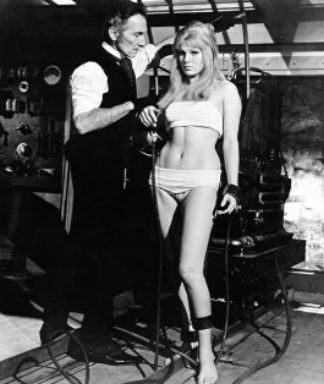
Director: Terence Fisher "Frankenstein Created Woman" is one of the most unusual Hammer films. Although obstensibly a horror film, it is probably better described as a poetic mood piece steeped in gothic romanticism. As such, it ranks among most intelligent of all Frankenstein films. The usual elements of a Frankenstein story are all but missing here, and the mad doctor isn't creating a terrible patchwork man, but instead a beautiful woman. What's more, he endevours to inhabit the body with a soul. The story is a quirky one, but it has all the elements of a great gothic tale--dark secrets, tragic love, and ultimate justice.� While Cushing doesn't have as much screentime in this film as in other
entries in the series�Frankenstein is more of a catalyst for the film's
events than its focus�he gives a performance that is equal to the one in
"Curse of Frankenstein." It may even be better than his original portrayal
of the character, as something truly different is done with Victor Frankenstein
in this film. While all the perfomances here are all superb, Cushing's
more gentle portrayal of the fiendish doctor truly shines.
For reviews and more information, click
here.
|
| Frankenstein and the Monster From Hell (1974)
Director: Terence Fisher Victor Frankenstein has buried his old identity and taken control of an insane asylum that serves as a rich source of parts for his continuing experiments. With the help of a young medical student who has read Frankenstein's 20-year-old texts on his early efforts, Frankenstein creates a creature from parts of the asylum's most promising inmates. Unfortunately for the not-so-good doctor, he is once again saddled with a protoge who starts to suffer pangs of conscience when the lengths to which Frankenstein is willing to go becomes apparent. In the end, everything that can go wrong, does go wrong. Once again, Cushing's Frankenstein comes across as likable, even kind-hearted when contrasted with other officials in the insane asylum. However, any admirable qualities are quickly revealed as illusions when it becomes apparent that he no longer has within him even the slightest shred of human decency or even a genuine interest in scientific pursuits. For Frankenstein, the creation of his creature has become the means to its own end... he is through and through a heartless monster. The dark, dank, cramped asylum where the story takes place serves as
the perfect mirror of Frankenstein's spiritual state, and Cushing's intense
and commanding performance of this man now totally lost in madness is spellbinding.
Although Hammer Films was quickly dying as a production house, the final
reunion for Cushing and Fisher, who together launched Hammer's gothic reign
with "The Curse of Frankenstein" is a splendid and worthy end to an era
in cinematic history.
For reviews and more information, click
here.
|