
Click image to go to larger resolution.
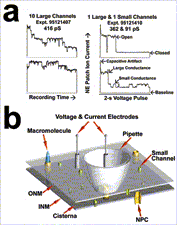
Fig. 7.
Patch-clamp detection of NE large and small
conductance ion channels. (a) Ion
current recordings for two experiments with Dunning G prostate cancer cell
nuclei showing an NE patch containing 10 channels of 416 pS and a patch
containing a channel of 362 pS and a channel of 91 pS. The current signals were generated with 2-s
voltage pulses applied between the pipette and the bath electrodes. Note that the onset of the voltage pulse
generates a capacitive current that is related to the dielectric and not the
ion conducting properties of the NE.
(b) Diagram illustrating the two-electrode approach of patch-clamp. One electrode is applied to the inside of
the recording pipette and the other is applied to the bath. The electronic apparatus is based on the virtual-ground
operational amplifier. The electrode
inside the pipette receives a known clamp voltage (thus patch-clamp). The bath electrode is used as reference. The voltage difference between the two electrodes
contributes to the driving force for the electrical charge carriers. Although the pipette is applied to the ONM,
the large number of open NPCs outside the pipette short-circuit, and thus make
transparent to the recording, the NE outside the NE patch. Only when all NPCs are closed or plugged
(i.e. not allowing ion flow) can we be sure that the recorded ion channel
activity derives from sources other than NPCs.