
Click image to go to larger resolution.
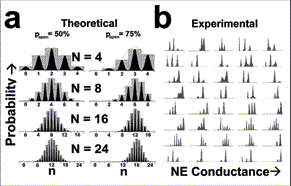
Fig. 6.
Theoretical and experimental amplitude
histograms for patch-clamp recordings from the nuclear envelope. (a) Binomial distribution histograms (gray
bars) for a population of N identical and independent ion conducting channels
having two states: open and closed. N
was set to 4, 8, 16 and 24 to predict the effect of the putative peripheral
channels (thought to be 8 per NPC). The
histograms on the left and right columns were generated for single channel open
probability, popen, of 50% and 70%, respectively. On the horizontal axis, the relative NE
conductance amplitude is given. The
number n represents the relative level of conductance (as ion channel opens and
closes, their populations will display quantum jumps in the value of NE
conductance). Therefore, n corresponds
to the number of channels simultaneously open.
On the vertical axis, the relative probability of finding the particular
value of NE conductance is given. As
the measured current is a continuous variable and is contaminated by noise, for
each particular level, there is a normal distribution of values described by a
Gaussian curve (black bell-shaped curves).
The simulations were carried out with the binomial java applet given by
Stark (2002). (b) Experimental
histograms from 12 experiments. The
histograms were generated with pClamp (Axon Instruments). As for our discussion, neither the height
nor the width is relevant, to facilitate comparison, the peaks of each histogram
was set to the same height. Although
the width of the histograms are the same, they do not necessarily correspond to
the same conductance interval because not all channels have the same
conductance (e.g. one may be 350, the other may be 450 pS). Finally, note that the NE conductance starts
at zero conductance (leftmost point in the axis).