
Click image to go to larger resolution.
Fig. 4.
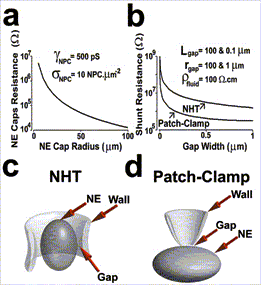
Computed values for the resistance contributed by the NE and for
the shunt resistance using the NHT model. (a) Plot of expected values for the resistance of the NE caps, RNE-caps,
with NPC conductance, gNPC, of 500 pS and
with density of ion conducting NPCs set to 10 NPC.mm-2. (b)
Plot of shunt resistance, Rshunt, due to the leak of
electrolyte between the NE and the wall of the NHT tubing (gap length, Lgap,
of 100 mm; gap radius, rgap, 100 mm) and between
the NE and the tip of the patch-clamp pipette (Lgap = 0.1 mm, rgap
=1 mm). The
resistivity, r, was assumed to be 100 W.cm
(conductivity= 10 mS.cm-1).
The values of gap width, w, used were between 1.0 and 10-4 mm. For NHT, Rshunt goes between 1.6
MW and 15.9 GW. For patch-clamp, Rshunt goes between 318.3 kW and 1.59 GW. Therefore, from these models one should
expect that the NHT method provided better seal than patch-clamp. However, this is not supported by the
experimental observations.