
Click image to go to larger resolution.
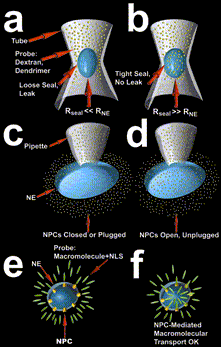
Fig. 2.
Use of fluorescence microscopy to determine the state of ion and
macromolecular conduction of nuclear pores. (a, b) Tests for NHT are performed with probes (e.g. Alexa
Fluor-Dextrans, Molecular Probes) to determine the relevance of the leak or
shunt current and the dimension of the gap.
In a, the fluorescent probe passes through the gap between the nucleus
and the tube wall but does not enter the nucleus. Therefore, the shunt is too great to assume it negligible (i.e. Rshunt
<< RNE). In b, the gap
is of small dimensions and the molecular interactions between the NE and the
tube wall are strong enough to produce a tight seal. Therefore, the shunt is negligible (i.e. Rshunt
>> RNE). (c, d) Test for patch-clamp are performed with
similar probes. When the NPCs are
closed or plugged, panel c, the probes cannot enter the nucleus because the
NPCs are the only direct route for nucleocytoplasmic transport. Therefore, any ion channel activity recorded
derives from the ONM. When the NPCs are
open and unplugged (i.e. there is no macromolecular translocation), panel d,
the probes go inside the nucleus.
Therefore, the ion channel activity derives from NPCs. Under these conditions, the NPCs outside the
pipette provide a bypass route that makes the nucleoplasmic side of the NE
virtually connected to the bath electrode.
Panels e and f demonstrate the use of macromolecular probes (e.g.
B-phycoerythrin, Molecular Probes, conjugated to the NLS of the SV40 large T
antigen, Sigma Chemical). A
macromolecular probe is placed outside the nucleus. Whether or not the molecules enter the nucleus, will indicate
that the NPCs are or ar not capable of macromolecular transport.